The slides, written out
AI-drawn illustration. Simplified to explain the idea, not to scale.
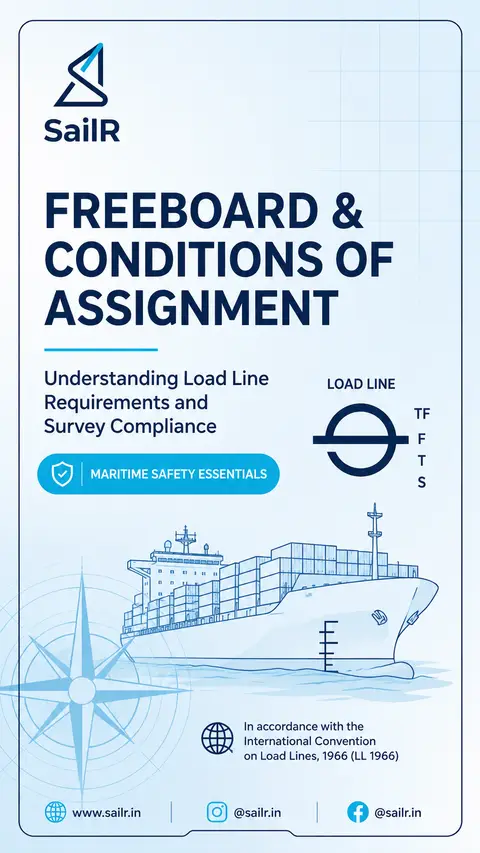
Slide 1 · FREEBOARD & CONDITIONS OF ASSIGNMENT
FREEBOARD & CONDITIONS OF ASSIGNMENT
Understanding Load Line Requirements and Survey Compliance
MARITIME SAFETY ESSENTIALS
LOAD LINE
TF
F
T
S
In accordance with the International Convention on Load Lines, 1966 (LL 1966)
Slide 2 · 02 WHY IT MATTERS
02 WHY IT MATTERS
WHY IS
FREEBOARD
REQUIRED?
Freeboard is a critical safety margin that ensures
adequate reserve buoyancy and protection
against excessive submergence.
1. STABILITY
Maintain compliance
with stability criteria
and preserve
righting capability.
2. RESERVE
BUOYANCY
Ensure sufficient
buoyancy remains
available in adverse
weather conditions.
3. WATER INGRESS
PROTECTION
Keep critical openings
above water and
protected by approved
closing appliances.
Meeting stability requirements ALONE does
not automatically guarantee adequate freeboard.
DECK LINE
LOAD LINE
Slide 3 · 03 CONDITIONS OF ASSIGNMENT
03 CONDITIONS OF ASSIGNMENT
WHAT ARE
CONDITIONS OF
ASSIGNMENT?
The structural and fitting requirements that must
be satisfied before a vessel's freeboard can be
assigned and its Load Line Certificate issued.
1. HATCHWAYS
Covers, coamings,
gaskets and securing
devices in good
condition and weathertight.
2. DOORS
Watertight and
weathertight doors
properly fitted and
operable.
3. VENTILATORS
Sufficient coaming
height and approved
closing arrangements.
4. AIR PIPES
Minimum heights
above deck and
permanently attached
closing means.
5. FREEING PORTS
Adequate number and
area to ensure efficient
drainage of shipped
water from decks.
6. CREW PROTECTION
Guardrails, bulwarks and
safe means of access
to and from crew areas
and machinery spaces.
Without maintaining these arrangements,
the assigned freeboard loses its safety value.
Slide 4 · 04 SURVEY CHECKLIST
04 SURVEY CHECKLIST
TYPICAL ITEMS
CHECKED DURING
A LOAD LINE SURVEY
Surveyors verify that all Conditions of Assignment remain effective throughout the vessel's certification period.
A. STRUCTURAL CHECKS
1. LOAD LINE MARK
Correct position, permanently marked and clearly visible.
2. DECK LINE
Weathertight integrity with no unauthorized openings.
3. HATCH COVERS
Covers, coamings, gaskets, cleats and compression bars in good condition.
4. SUPERSTRUCTURE INTEGRITY
End bulkheads and openings watertight and in good order.
5. SIDE SCUTTLES
Deadlights operable and positioned above the freeboard deck.
B. SAFETY & PROTECTION CHECKS
1. VENTILATORS
Coaming height and approved closing appliances in good condition.
2. AIR PIPES
Permanently attached closing means and minimum height above deck as per rules.
3. WATERTIGHT DOORS
Proper operation, no deformation or corrosion and clearly marked.
4. FREEING PORTS
Clear of obstruction and sufficient area for efficient discharge of water.
5. GUARDRAILS & ACCESS
Adequate height, secure fittings and safe access routes for crew.
The vessel must be maintained so that all openings, fittings, railings and means of access continue to deliver the safety intended by the assigned freeboard.
FREEBOARD + STRUCTURAL INTEGRITY + PROPER SURVEYS = SAFER SHIPS
Drafted by SailR from our daily lessons. AI-drawn illustration. Simplified to explain the idea, not to scale. Last updated 19 Oct 2026.
Spotted a mistake?