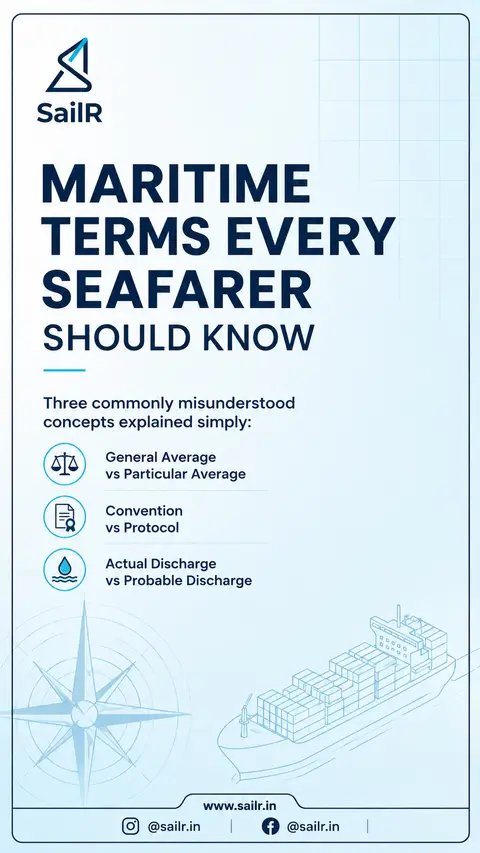
The slides, written out
AI-drawn illustration. Simplified to explain the idea, not to scale.
Slide 1 · MARITIME
MARITIME
TERMS EVERY
SEAFARER
SHOULD KNOW
Three commonly misunderstood
concepts explained simply:
General Average
vs Particular Average
Convention
vs Protocol
Actual Discharge
vs Probable Discharge
Slide 2 · GENERAL AVERAGE
GENERAL AVERAGE
vs PARTICULAR AVERAGE
Two fundamental concepts in marine insurance
based on York–Antwerp Rules.
GENERAL AVERAGE
PARTICULAR AVERAGE
INTENTIONAL SACRIFICE
FOR COMMON SAFETY
ACCIDENTAL
PARTIAL LOSS
Examples:
Cargo jettisoned to
refloat the vessel
Emergency towage
or salvage expenses
Fire-fighting or other
sacrifices
Examples:
Seawater damaged cargo
Bent propeller due
to striking object
Weather-related cargo
damage
LOSS SHARED BY
ALL INTERESTS
Ship + Cargo + Freight
LOSS BORNE BY
OWNER OR INSURER
No sharing of loss
KEY TAKEAWAY
GENERAL AVERAGE = INTENTIONAL & SHARED
PARTICULAR AVERAGE = ACCIDENTAL & INDIVIDUAL
VS
Slide 3 · CONVENTION
CONVENTION
VS PROTOCOL
Key instruments of international maritime law
under IMO frameworks.
CONVENTION
PROTOCOL
FOUNDATION TREATY
FRAMEWORK
UPDATES, AMENDS,
OR EXPANDS A CONVENTION
Establishes the main legal
obligations and principles
for States.
Used to add new requirements
or modify existing provisions
without replacing the Convention.
Examples:
Examples:
SOLAS
MARPOL
STCW
UNCLOS
1997 MARPOL Protocol
(added Annex VI)
1992 CLC Protocol
(increased liability limits)
CREATES CORE
LEGAL OBLIGATIONS
Ratified by States
MAY REQUIRE
SEPARATE
RATIFICATION
KEY TAKEAWAY
CONVENTION = MAIN RULEBOOK
PROTOCOL = UPDATE OR EXPANSION
Slide 4 · ACTUAL DISCHARGE
ACTUAL DISCHARGE
VS PROBABLE DISCHARGE
Reporting obligations under MARPOL Article 8
and Protocol I.
ACTUAL DISCHARGE
PROBABLE DISCHARGE
CONFIRMED RELEASE
OBSERVED
LIKELY RELEASE
NOT YET CONFIRMED
VS
Examples:
Examples:
Bunker oil spill detected
Grounding or collision damage
Cargo oil leakage to sea
Breached tank or pipeline
under inspection
Machinery-space oil discharge
Equipment failure
(e.g. valve, hose, manifold)
Operational discharge
exceeding limits
Near-miss incidents with
risk of release
REPORT IMMEDIATELY
to nearest coastal State
and Flag State
REPORT IMMEDIATELY
to nearest coastal State
and Flag State
MARPOL PRINCIPLE
If there is a reasonable likelihood of pollution,
reporting should not wait for confirmation.
BASED ON:
MARPOL Article 8 – Reports on incidents
Protocol I – Reports on Incidents Involving Harmful Substances
MARPOL Annex I – Regulation 37 (SOPEP requirements)
Drafted by SailR from our daily lessons. AI-drawn illustration. Simplified to explain the idea, not to scale. Last updated 19 Oct 2026.
Spotted a mistake?