The slides, written out
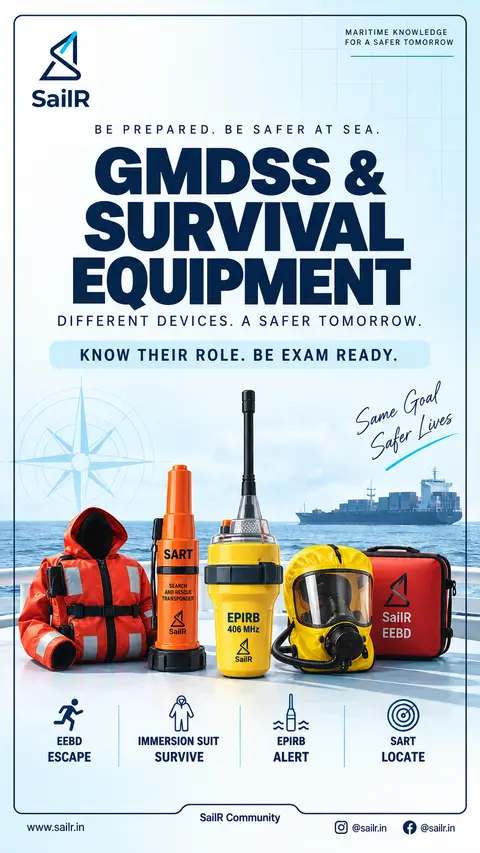
AI-drawn illustration. Simplified to explain the idea, not to scale.
Slide 1 · MARITIME KNOWLEDGE
MARITIME KNOWLEDGE
FOR A SAFER TOMORROW
BE PREPARED. BE SAFER AT SEA.
GMDSS &
SURVIVAL
EQUIPMENT
DIFFERENT DEVICES. A SAFER TOMORROW.
KNOW THEIR ROLE. BE EXAM READY.
Same Goal
Safer Lives
SART
SEARCH AND RESCUE TRANSPONDER
EPIRB 406 MHz
SailR EEBD
EEBD
ESCAPE
IMMERSION SUIT
SURVIVE
EPIRB
ALERT
SART
LOCATE
Slide 2 · MARITIME KNOWLEDGE
MARITIME KNOWLEDGE
FOR A SAFER TOMORROW
GMDSS ESSENTIALS
EPIRB
Emergency Position Indicating
Radio Beacon
THE DISTRESS ALERT
Your primary float free distress alerting device. It transmits a distress alert through the Cospas Sarsat system, even if the bridge is gone.
COSPAS SARSAT GLOBAL COVERAGE
406 MHz Distress alert
121.5 MHz Homing signal
GNSS Position information (modern units)
MEOSAR / RLS Enhanced capability (where supported)
EPIRB 406 MHz
HOW IT WORKS
Transmits on 406 MHz to Cospas Sarsat satellites.
Also transmits a 121.5 MHz homing signal for SAR aircraft and rescue units.
Modern units may incorporate GNSS for position information.
Newer beacon capabilities may include enhanced MEOSAR / Return Link Service functions where supported.
SAR
EXAM POINTS
48 HOURS Minimum operating duration
FLOAT FREE Automatically releases and water activates (Category I)
TESTING Routine inspection as per applicable requirements. Annual testing under SOLAS requirements.
5 YEARS Shore based maintenance at intervals not exceeding 5 years (subject to requirements).
KEY RULE
Once activated, leave it ON until rescued.
Small Device Big Difference
Slide 3 · MARITIME KNOWLEDGE
MARITIME KNOWLEDGE
FOR A SAFER TOMORROW
Be Seen
Be Rescued
GMDSS ESSENTIALS
SART
Search and Rescue Transponder
THE SEARCH LOCATOR
A radar based locating beacon.
While the EPIRB tells the world
you are in distress, the SART lets
a searching ship's or aircraft's
radar see you among the waves
and clutter.
SART
SEARCH AND RESCUE TRANSPONDER
OPERATES ON
9 GHz
(X-BAND)
HOW IT WORKS
• When interrogated by a searching radar,
the SART responds with a distinctive signal
on the radar screen.
• Signal appearance:
12 DOTS
(Far range)
12 ARCS
(Closing range)
CONCENTRIC CIRCLES
(Very close range)
RANGE 6 NM
RINGS 1 NM
X-BAND
SART
Helps rescuers determine
the direction and approximate
range to your position.
EXAM POINTS
FREQUENCY
9 GHz
(X-Band radar)
RANGE
~ 5 NM
(to a ship with 15 m
antenna height)
~ 30 NM
(to an aircraft
under specified
conditions)
BATTERY CAPABILITY
96 hours
standby
8 hours
continuous
interrogation
TESTING
Routine testing should
follow the applicable
Administration,
approved servicing
requirements and
manufacturer's
instructions.
AIS-SART
Broadcasts its distress position
information using AIS to suitably
equipped receiving stations.
Small Device
Big Impact
Slide 4 · MARITIME KNOWLEDGE FOR A SAFER TOMORROW
Prepared People Survive
SURVIVAL ESSENTIALS
SURVIVE THE IMMEDIATE DANGER
DIFFERENT THREATS. DIFFERENT PROTECTION.
IMMERSION SUIT
EEBD
PROTECTION FROM HYPOTHERMIA
EMERGENCY ESCAPE BREATHING DEVICE
Designed to reduce rapid body heat loss in cold water and give you more time for rescue.
ESCAPE ONLY
Designed for emergency escape from smoke or dangerous atmospheres.
Watertight and thermally protective
Integral hood, boots and gloves (as applicable)
Retro reflective material and whistle
Designed for rapid donning
Donning within 2 minutes (as per requirements)
SailR EEBD
Minimum service duration: 10 minutes
Hood or suitable face covering arrangement (depending on approved design)
Follow the manufacturer's activation and donning procedure.
DO NOT USE EEBD FOR
Firefighting
Re entry into dangerous spaces
Tank entry
Prolonged rescue or work
REMEMBER
The immersion suit provides thermal protection.
A lifejacket provides buoyancy where required.
RIGHT EQUIPMENT. MORE TIME. A SAFER YOU.
Same Goal A Safer Tomorrow
Slide 5 · MARITIME KNOWLEDGE
MARITIME KNOWLEDGE
FOR A SAFER TOMORROW
Escape
Survive
Alert
Locate
GMDSS & SURVIVAL EQUIPMENT
4 DEVICES
4 DIFFERENT PURPOSES
KNOW THE ROLE. BE EXAM READY.
EEBD
ESCAPE
IMMERSION SUIT
SURVIVE
EPIRB
ALERT
SART
LOCATE
Emergency Escape Breathing Device
Primary role
Get you out of dangerous atmosphere (smoke or toxic gas).
When it's used
During an emergency on board, before abandoning.
Immersion Suit
Primary role
Keep you alive in cold water by reducing heat loss.
When it's used
When you are going into the water.
Emergency Position Indicating Radio Beacon
Primary role
Send a distress alert to the world with your position.
When it's used
Once you have abandoned ship (or mustered at the lifeboat) and are in distress.
Search and Rescue Transponder
Primary role
Let a searching ship's or aircraft's radar see you among the waves and clutter.
When it's used
Once rescuers are searching for you.
QUICK RECAP
EEBD
GET OUT
IMMERSION SUIT
STAY ALIVE
EPIRB
CALL FOR HELP
SART
HELP THEM FIND YOU
EXAM FOCUS
Know the purpose of each device
Key operating principles
Important figures and limits
Carriage and testing requirements
Different Roles
Same Goal
Save Lives
Safer Mariners
Stronger Seas
Drafted by SailR from our daily lessons. AI-drawn illustration. Simplified to explain the idea, not to scale. Last updated 19 Oct 2026.
Spotted a mistake?