Grain Code stability criteria: heel, area and GM
- Chief Mate
- MEO Class 2
- 2nd Mate
- MEO Class 1
- times asked
- 64
- times asked
- questions
- 15
- questions
- last asked
- 2026
- last asked
A ship carrying grain in bulk must stay safe even after the cargo is assumed to shift. Here are the three International Grain Code checks, how the grain shift is calculated, and the rules for a ship without a document of authorization.
The slides, written out
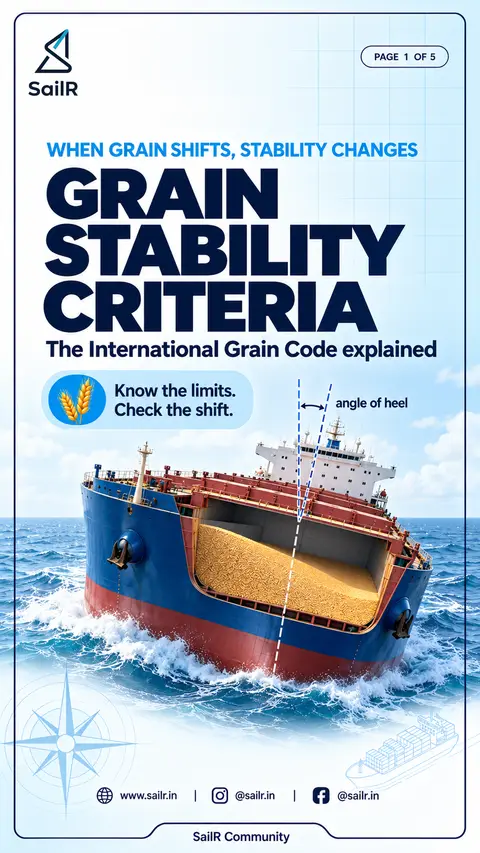
AI-drawn illustration. Simplified to explain the idea, not to scale.
Slide 1 · When grain shifts, stability changes
When grain shifts, stability changes. Grain stability criteria: the International Grain Code explained. Know the limits. Check the shift. The picture shows a heeled bulk carrier with a hold cut away and the angle of heel marked.
Slide 2 · The Code and the document of authorization
The Code and the document of authorization. The International Grain Code was adopted by IMO Resolution MSC.23(59) on 23 May 1991. It applies to ships of any size, including those under 500 gross tonnage, carrying grain in bulk under SOLAS chapter VI, Part C. A cargo ship carrying grain must comply with the Code and hold a document of authorization (SOLAS chapter VI, regulation 9.1). The document is issued by the Administration, an organization it recognizes, or a Contracting Government on its behalf. It accompanies or is part of the grain loading manual, and a copy with the stability data and plans stays on board. If the port of loading Government asks, the master must show the ship meets the criteria at every stage of the voyage. Ref: SOLAS chapter VI, regulation 9.1; Grain Code Part A, paragraphs 1.1, 3.1, 3.2, 3.4 and 7.2.
Slide 3 · Three mandatory stability checks
Three mandatory stability checks. Angle of heel: the heel due to grain shift must not exceed 12°, or, for ships built on or after 1 January 1994, the angle at which the deck edge is immersed, whichever is less. Residual area: the area between the righting lever curve and the grain heeling arm, up to the angle of maximum difference, 40° or the angle of flooding, whichever is least, must be at least 0.075 metre-radians (0.075 m.rad) in all loading conditions. Initial GM: after correcting for free surface effects of liquids in tanks, at least 0.30 m. The criteria apply from loading to discharge, and the master makes sure the ship is upright before going to sea. All three criteria must be met at the same time, for the whole voyage. The chart is illustrative. Ref: Grain Code Part A, paragraphs 7.1, 7.1.1, 7.1.2, 7.1.3, 7.3 and Figure A7.
Slide 4 · How grain shift is calculated
How grain shift is calculated. In a filled, trimmed compartment the grain surface after shifting is assumed at 15° to the horizontal. In a partly filled compartment, not secured, it is assumed at 25° to the horizontal. A surface secured by overstowing, strapping or lashing, or wire mesh is not assumed to shift 25°. The voids change shape and position as grain moves from the high side to the low side, which creates the volumetric heeling moment. Divide it by the stowage factor to get the heeling moment in tonne-metres: Mw = Mv ÷ SF, where Mw is the weight heeling moment (tonne-metres), Mv is the volumetric heeling moment (m⁴) and SF is the stowage factor (m³ per tonne). Stowage factor is the volume per unit weight of the grain, as attested by the loading facility. Use the right assumed surface, then divide by the stowage factor. Never multiply. Ref: Grain Code Part B, paragraphs 2.2, 2.3 and 6.1 (as amended by MSC.552(108)); Part A, paragraph 2.6, sections 16 to 18 and Figure A7 note 1.
Slide 5 · Optional rules for partial cargoes, for ships without a document of authorization
Optional rules for partial cargoes, for ships without a document of authorization. Without a document, the master must show the ship complies before loading. Part A, section 9 is the optional route for part cargoes. Bulk grain must not exceed one third of the ship's deadweight. Filled, trimmed compartments get a centreline division for their full length, from the underside of the deck or hatch covers down at least one eighth of the maximum breadth or 2.4 m, whichever is greater. Hatches to filled, trimmed compartments are closed and the covers secured. In partly filled spaces the grain surface is trimmed level and secured. Throughout the voyage, GM after free surface correction must be 0.30 m or the value from the formula in Part A, paragraph 9.1.5, whichever is greater. The master satisfies the Administration, or the port of loading Government on its behalf, that the loaded ship will comply. Section 9 is optional, and every limit in it must be met at the same time. Ships with keels laid before 25 May 1980 may use section 9 without the one-third limit (Part A, paragraph 8.3). Ref: Grain Code Part A, paragraphs 3.5 and 9.1.1 to 9.1.6; SOLAS chapter VI, regulation 9.2.
What it is
The International Grain Code sets the intact stability a ship must keep while she carries grain in bulk. It was adopted by Resolution MSC.23(59) on 23 May 1991 and took effect on 1 January 1994 (Resolution MSC.23(59), title and operative paragraphs 1 and 2).
SOLAS makes it binding. A cargo ship carrying grain must comply with the Code and hold a document of authorization, and for this purpose the Code is treated as mandatory (SOLAS chapter VI, regulation 9.1).
Size gives no escape. The Code applies to ships regardless of size, including those of less than 500 gross tonnage, engaged in the carriage of grain in bulk. Grain covers wheat, maize (corn), oats, rye, barley, rice, pulses, seeds and their processed forms that behave like grain in its natural state (International Grain Code, Part A, paragraphs 1.1 and 2.1).
Why it matters
The Code does not leave grain shift to chance. It assumes the shift happens, and treats the heeling moment as the result of the voids changing shape and position after grain moves from the high side to the low side (International Grain Code, Part B, paragraph 2.2).
The ship must then meet the stability criteria throughout the voyage with that heeling moment taken into account, in the manner set out in Part B and Figure A7 (International Grain Code, Part A, paragraph 7.1).
Paperwork can stop a ship at the berth. A ship without a document of authorization shall not load grain until the master demonstrates to the Administration, or to the port of loading Government acting on its behalf, that the ship in its loaded condition complies (International Grain Code, Part A, paragraph 3.5; SOLAS chapter VI, regulation 9.2).
Even with the document, the port of loading may ask. Before loading, the master shall demonstrate the ship's ability to meet the criteria at all stages of the voyage if that Government requires it (International Grain Code, Part A, paragraph 7.2).
How it works on board
Start with the grain loading manual. The document of authorization, issued by the Administration, an organization it recognizes or a Contracting Government on its behalf, accompanies the manual or is built into it. A copy, with the grain loading stability data and plans, stays on board for the master to produce at the port of loading (International Grain Code, Part A, paragraphs 3.1, 3.2 and 3.4).
On the statical stability diagram the heeling arm at zero heel is λ0. It equals the assumed volumetric heeling moment due to transverse shift divided by the product of stowage factor and displacement. At 40° the arm is λ40, which is 0.8 times λ0, and the heeling arm may be drawn as the straight line AB between them (International Grain Code, Part A, Figure A7, note 1).
Stowage factor is the volume per unit weight attested by the loading facility, with no allowance for lost space when the space is nominally filled. Displacement covers the ship, fuel, fresh water, stores and cargo (International Grain Code, Part A, paragraph 2.6; Figure A7, note 1).
Where line AB crosses the righting arm curve you read the angle of heel due to grain shift. The righting arm curve comes from cross curves that include 12° and 40° (International Grain Code, Part A, Figure A7 and note 2; paragraph 6.2.7).
The assumed shift depends on how each hold is stowed. In a filled compartment, trimmed, the grain surface after shifting lies at 15° to the horizontal. In a partly filled compartment whose surface is not secured, it lies at 25° (International Grain Code, Part B, paragraphs 2.3 and 6.1).
Securing changes the assumption. If the free surface is secured by overstowing, strapping or lashing, or wire mesh, the 25° shift is not assumed (International Grain Code, Part B, paragraph 6.1).
Partly filled holds carry a penalty for the vertical shift of the grain surface. Their total heeling moment is 1.12 times the calculated transverse heeling moment (International Grain Code, Part B, paragraph 1.5).
All necessary and reasonable trimming is done to level free grain surfaces and to minimize the effect of shifting. After loading, the master ensures the ship is upright before proceeding to sea (International Grain Code, Part A, paragraphs 10.1 and 7.3).
The rules
Heel: not greater than 12° or, for ships constructed on or after 1 January 1994, the deck edge immersion angle, whichever is the lesser (International Grain Code, Part A, paragraph 7.1.1).
Residual area: at least 0.075 metre-radians (0.075 m.rad) between the heeling arm and righting arm curves, up to the angle of maximum difference, 40° or the angle of flooding, whichever is the least, in all conditions of loading (International Grain Code, Part A, paragraph 7.1.2).
Metacentric height: initial GM, after free surface correction for liquids in tanks, at least 0.30 m (International Grain Code, Part A, paragraph 7.1.3).
No document: bulk grain at most one third of deadweight, with centreline divisions in filled, trimmed compartments reaching one eighth of the compartment's maximum breadth or 2.4 m below the deck line, whichever is greater (International Grain Code, Part A, paragraphs 9.1.1 and 9.1.2).
No document, hatches and surfaces: hatches to filled, trimmed compartments are closed and the covers secured, and free grain surfaces in partly filled spaces are trimmed level and secured. The master demonstrates compliance to the Administration, or the port of loading Government on its behalf (International Grain Code, Part A, paragraphs 9.1.3, 9.1.4 and 9.1.6).
No document, continued: GM of 0.3 m or the GMR formula value, whichever is greater, throughout the voyage (International Grain Code, Part A, paragraph 9.1.5).
Existing ships, with keels laid before 25 May 1980, may use those optional rules without the deadweight limit (International Grain Code, Part A, paragraphs 8.1 and 8.3).
The 2024 amendments, in force from 1 January 2026, add a new class of specially suitable compartment and renumber parts of Part B. Section 7 of Part A is not amended (Resolution MSC.552(108), operative paragraph 3 and annex).
Common mistakes
The usual slip is to quote 12° as the whole heel limit. For ships constructed on or after 1 January 1994 the limit is the lesser of 12° and the deck edge immersion angle (International Grain Code, Part A, paragraph 7.1.1).
The residual area is often worked to 40° by habit. The area stops at the angle of maximum difference between the curves, at 40°, or at the angle of flooding, and the least of these governs (International Grain Code, Part A, paragraph 7.1.2).
Arithmetic goes wrong at the stowage factor. It is volume per unit weight, so the volumetric heeling moment is divided by it, together with displacement, to get λ0. Multiplying gives a heeling arm that bears no relation to the ship (International Grain Code, Part A, Figure A7, note 1; paragraph 2.6).
Older notes quote Part B section 5 for the 25° assumption. Since 1 January 2026 that paragraph is Part B, paragraph 6.1, because a new section 4 was inserted (Resolution MSC.552(108), annex item 15).
In exams
Asked 64 times across 15 different questions, most recently in 2026. Asked most in Chief Mate (44), MEO Class 2 (10), 2nd Mate (9), MEO Class 1 (1).
Sources
- International Grain Code, Part A, paragraphs 1.1, 2.1, 2.5, 2.6, 3.1 to 3.5, 6.2.7, 6.3.2, 6.3.5, 6.3.6, 7.1 to 7.3, 8.1, 8.3, 9, 9.1.1 to 9.1.6, 10.1 and Figure A7 with notes; Part B, paragraphs 1.5, 2.2, 2.3 and 6.1, IMO Resolution MSC.23 59
- Amendments to the International Grain Code, operative paragraph 3 and annex items 10 and 15, IMO Resolution MSC.552 108
- SOLAS chapter VI, regulations 8.2, 9.1 and 9.2, IMO Resolution MSC.22 59
Drafted by SailR from the regulations cited. AI-drawn illustration. Simplified to explain the idea, not to scale. Last updated 31 Oct 2026.
Spotted a mistake?