The slides, written out
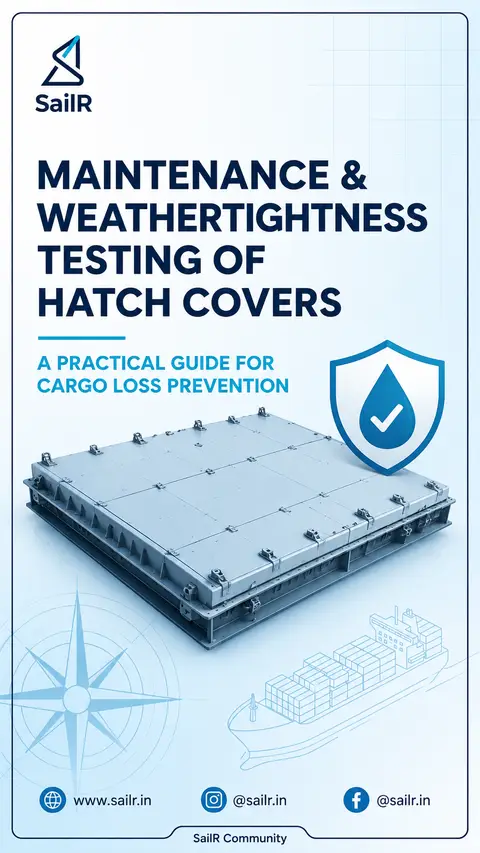
AI-drawn illustration. Simplified to explain the idea, not to scale.
Slide 1 · MAINTENANCE & WEATHERTIGHTNESS TESTING OF HATCH COVERS
MAINTENANCE & WEATHERTIGHTNESS TESTING OF HATCH COVERS
A PRACTICAL GUIDE FOR CARGO LOSS PREVENTION
Slide 2 · ROUTINE MAINTENANCE
ROUTINE MAINTENANCE
= LOSS PREVENTION
Well-maintained hatch covers keep cargo safe
and prevent claims, delays and detentions.
WHAT TO INSPECT
SEALING RUBBERS
Check for perishing, compression
set, cuts and uneven wear.
COMPRESSION BARS &
CROSS-JOINT BARS
Keep clean and free from rust,
scale and old mastic residue.
CLEATS, WEDGES & DOGS
Check for worn pins, scored
surfaces and tightness.
Lubricate moving parts lightly.
DRAINS & NON-RETURN VALVES
Ensure channels are clear and
valves seat properly.
Avoid green water ingress.
STRUCTURAL CONDITION
Look for cracks, corrosion and
deformation, especially at
corners and lifting eyes.
OPENING / CLOSING SYSTEM
Check hydraulics, motors, chains,
limit switches, interlocks and
fasteners. Look for oil leaks.
GUTTERING / INTERPANEL
VOIDS
Keep clean and free from debris
and corrosion.
MAINTENANCE SCHEDULE
EVERY CARGO
OPERATION
Visual inspection of seals,
cleats, drains and cover
components during
opening and closing.
PERIODIC
(MONTHLY)
Thorough inspection
of sealing rubbers with
covers tilted.
Check compression bars,
clear drains and test
non-return valves.
PLANNED MAINTENANCE
(PMS)
Follow manufacturer's
manual.
Replace packing rubbers
as per intervals.
Re-bed compression bars.
Overhaul rams and
mechanisms.
Maintain full records
in PMS.
A WELL-MAINTAINED HATCH COVER IS
THE FIRST DEFENCE AGAINST CARGO CLAIMS.
Slide 3 · WEATHERTIGHTNESS TESTING METHODS
WEATHERTIGHTNESS TESTING METHODS
Various methods are used to check the weathertight integrity of hatch covers. Each method has its purpose and limitations.
METHOD | PURPOSE | KEY LIMITATION
1. CHALK TEST | Checks contact between compression bar and sealing rubber. | Confirms contact only. Does not verify gasket compression or prove weathertightness.
2. LIGHT TEST | Detects daylight or visible gaps in the cover, coaming or deck. | Requires empty hold and daylight. Identifies only gross defects.
3. HOSE TEST | Simulates water ingress using a jet of water on joints and seals. | Follow maker/Class procedure. Needs empty hold and team effort. Leak location is general.
Ensure interpanel voids and guttering are plugged. Some operators use collection bags on drain outlets as a practical troubleshooting aid (not a statutory method).
4. AIR TEST | Detects air leakage by applying low air pressure and observing bubbles in soap solution. | Requires empty hold and daylight. Follow approved safety procedures.
5. PUTTY / MOULDING CLAY TEST | Provides a compression Impression to assess contact and pressure distribution. | Localised assessment only. Does not prove overall weathertightness.
6. ULTRASONIC TEST | Uses ultrasound transmission to locate leakage paths with high accuracy. | Requires calibrated equipment and qualified personnel in accordance with recognized procedures.
IMPORTANT
No test can fully duplicate severe sea and weather conditions. Testing validates maintenance—it does not replace it.
| |
Slide 4 · BEST PRACTICES FOR
BEST PRACTICES FOR
WEATHERTIGHT
HATCH COVERS
Good maintenance, correct testing and proper records
ensure weathertight integrity in every voyage.
1
INSPECT BEFORE EVERY
CARGO OPERATION
Visually check seals, cleats, drains,
hinges and cover components.
2
KEEP CLEAN & MAINTAIN
COMPONENTS
Clean seals, compression bars,
drains and gutters.
3
FOLLOW PMS & MANUFACTURER'S
RECOMMENDATIONS
Renew packing rubbers as per intervals.
Overhaul rams, chains and mechanisms.
4
USE APPROPRIATE
TESTING METHODS
Use suitable methods as per maker/Class
procedures; test regularly.
5
MAINTAIN ACCURATE
RECORDS
Keep inspection, maintenance and
testing records up to date.
6
VERIFY COMPLIANCE DURING
STATUTORY & CLASS SURVEYS
Ensure hatch cover integrity is demonstrated
at all required surveys.
TESTING
VALIDATES
MAINTENANCE—
IT DOES NOT
REPLACE IT.
REFERENCES
International Convention on Load Lines, 1966 (as amended)
Definition of "Weathertight".
IACS Recommendation No.14
Hatch Cover Tightness Testing.
IACS Recommendation No.15
Hatch Cover Maintenance.
IACS International Association of Classification Societies
Drafted by SailR from our daily lessons. AI-drawn illustration. Simplified to explain the idea, not to scale. Last updated 19 Oct 2026.
Spotted a mistake?