Hatch cover weathertightness: tests and leak action
- Chief Mate
- UK Management
- 2nd Mate
- MEO Class 2
- times asked
- 30
- times asked
- questions
- 7
- questions
- last asked
- 2026
- last asked
A hatch cover in position 1 or 2 must keep water out of the ship in any sea conditions. Here is what the Load Lines rules require, how tightness is checked at survey and on board, and what to do when a cover leaks.
The slides, written out
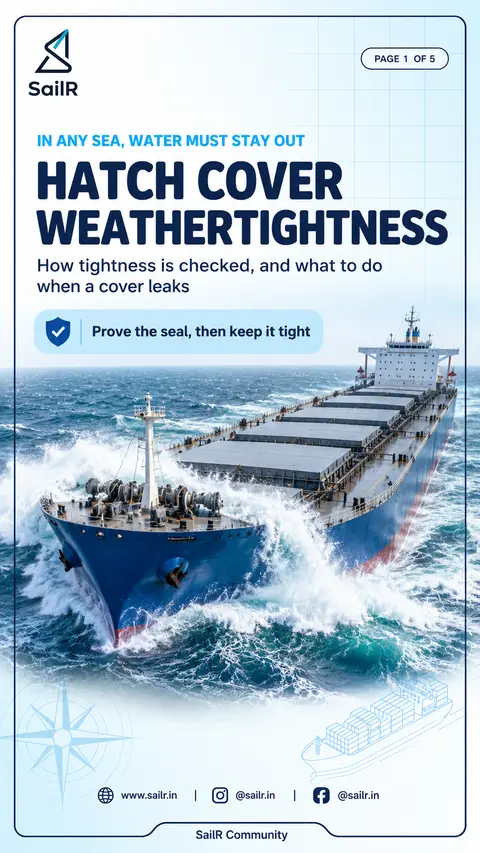
AI-drawn illustration. Simplified to explain the idea, not to scale.
Slide 1 · In any sea, water must stay out
In any sea, water must stay out. Hatch cover weathertightness. How tightness is checked, and what to do when a cover leaks. Prove the seal, then keep it tight. The picture shows a blue-hulled bulk carrier in a moderate head sea with closed steel hatch covers on every hold, and green water and spray breaking over the forward deck near the first hatch.
Slide 2 · Load Lines Convention
Load Lines Convention. What the rules require. Steel covers, gaskets and clamping devices. Weathertight: in any sea conditions, water will not penetrate into the ship. Position 1 and 2: every hatchway in position 1 or 2 has steel covers (or equivalent) that are weathertight, with gaskets and clamping devices, except as in Regulation 14(2). Any sea conditions: the arrangements must keep the covers tight in any sea conditions, to the satisfaction of the Administration. Tightness tests, initial survey: a tightness test is required at the initial survey. It may also be required at annual and renewal surveys, or more often. Annual survey: within 3 months either side of each anniversary date, the surveyor checks that the fittings protecting openings are kept in effective condition. The cross-section shows the edge of a closed steel hatch cover on the hatch coaming, with the gasket pressing on the compression bar and a cleat holding the cover edge down. Only the initial survey test is mandatory. The surveyor may ask for one at any later survey. Ref: Load Lines Convention, Annex I, Regulations 3(13), 13, 14(2) and 16(1); 1988 Load Lines Protocol, Article 14(1)(c).
Slide 3 · Survey and testing
Survey and testing. How tightness is checked. Operate, examine, then prove the seal. Operate fully: covers are surveyed open, closed and in operation to the full extent in each direction. Closing includes fastening every peripheral and cross joint cleat. Examine the seals: gaskets for condition and permanent deformation, gasket lips, compression bars, drainage channels, non-return valves and cleating. Prove the seal: where considered necessary, a hose or chalk test, supplemented by dimensional measurements of the seal compressing components. New hatch covers: after installation, a chalk test first, then a hose test at a water pressure of at least 200 kN/m². Hose test guidance: nozzle diameter at least 12 mm, and the nozzle no more than 1.5 m from the structure. Alternative methods of tightness testing will be considered. The picture shows a crew member aiming a hose nozzle at the cross joint between two closed hatch cover panels, marked "max 1.5 m", "nozzle min 12 mm" and "water pressure min 200 kN/m²". For bulk carriers under the ESP Code, at the renewal survey the sealing of all hatch covers should be checked by hose testing or an equivalent method. Ref: 2011 ESP Code, Annex A, Part A, paragraphs 2.4.3, 3.3.2, 3.3.5 and 3.3.7; MSC/Circ.1071, paragraphs 4.2, 4.7.2, 4.7.3 and 4.9; IACS Recommendation 14, paragraphs 6.1 to 6.3.
Slide 4 · Owners' inspection and maintenance
Owners' inspection and maintenance. The ship's own checks. Mandatory for bulk carriers under SOLAS chapter XII, regulation 7.2. Voyage checks: examine the closed covers and their securing in anticipation of and after heavy weather, and at least once a week, weather permitting. Forward 25%: pay particular attention to covers in the forward 25% of the ship's length, where sea loads are normally greatest. Each voyage cycle: when covers are opened, inspect gaskets, gasket lips, compression bars, drainage channels and non-return valves for condition and permanent deformation. This need not be more often than once a month. Drains: keep all hatch cover drains and their non-return valves in working order. Drains inboard of the seal line have non-return valves against boarding seas. Before sailing: complete the securing of all covers before the sea passage begins. The picture shows a bulk carrier in side profile with seven closed hatch covers and the forward 25% of the ship's length shaded. Keep a Maintenance Plan and a record of maintenance and replacements. It forms part of the safety management system. Ref: SOLAS chapter XII, regulation 7.2; Resolution MSC.169(79), annex, paragraphs 2.3.6, 2.5, 3.3 and 3.4.2; MSC/Circ.1071, paragraph 3.8.
Slide 5 · When a cover is not weathertight
When a cover is not weathertight. Action on a leaking cover. Corrective action under the ISM Code and the hatch cover standards. Step 1, report: report the non-conformity with its possible cause. If the defect affects the safety of the ship, the master or owner reports it at the earliest opportunity to the Administration or the recognized organization. Step 2, find the cause: wear and tear (deformation of the coaming or cover from impact, worn friction pads, worn cleating) or lack of maintenance (corrosion, no lubrication, worn or wrong-specification gaskets and rubber pads). Step 3, renew as a panel set: renew seals, rubber washers and cleats at least as a panel set, using spares of the correct specification, and keep the securing loads equalized. Step 4, major repairs: only after consulting the hatch cover manufacturer and with the approval of the Administration. If the securing system does not work properly, repairs are done under the Administration's supervision. Step 5, record: record the corrective action and the components replaced. The picture shows a hatch cover panel seen from below with its perimeter gasket being renewed along the full length, labelled "renew as a panel set". Common mistake: renewing only a short length of rubber or a few cleats. Partial replacement can overload single cleats and lead to sequential failure. Ref: ISM Code, paragraph 10.2; SOLAS chapter I, regulation 11(c); Resolution MSC.169(79), annex, paragraphs 2.1, 2.3.5, 2.4 and 2.5; MSC/Circ.1071, paragraphs 3.4, 3.5, 4.5 and 4.6.
What it is
Weathertight has a fixed meaning in the Load Lines Convention: in any sea conditions, water will not penetrate into the ship. In the Annex I text as amended in 2003, that definition is Regulation 3(13) (Load Lines Convention, Annex I, Regulation 3(13), as amended by Resolution MSC.143(77)).
Hatchways are grouped by where they sit. Position 1 covers exposed freeboard and raised quarter decks, and exposed superstructure decks forward of a point a quarter of the ship's length from the forward perpendicular. Position 2 covers exposed superstructure decks abaft that point and at least one standard height of superstructure above the freeboard deck (Load Lines Convention, Annex I, Regulation 13).
Every hatchway in position 1 or 2 has covers of steel or other equivalent material. Except as allowed in Regulation 14(2), those covers are weathertight and fitted with gaskets and clamping devices (Load Lines Convention, Annex I, Regulation 16(1)).
Why it matters
The standard is written for the worst weather the ship will meet. The means for securing and maintaining weathertightness must satisfy the Administration, and the arrangements must ensure that tightness can be maintained in any sea conditions (Load Lines Convention, Annex I, Regulation 16(1)).
Bulk carriers carry an extra duty. SOLAS requires them to comply with the Standards for owners' inspection and maintenance of bulk carrier hatch covers, Resolution MSC.169(79), so the ship's own checks are mandatory for this ship type (SOLAS chapter XII, regulation 7.2).
The load on the covers is not even along the hull. The standards single out the forward 25% of the ship's length as the area where sea loads are normally greatest (Resolution MSC.169(79), annex, paragraph 3.3).
IMO also draws attention to the dangers of proceeding to sea without fully secured hatch covers. Securing of all covers should be completed before a sea passage begins (MSC/Circ.1071, paragraph 3.8).
How it works on board
A hatchway coaming is at least 600 mm high in position 1 and 450 mm in position 2. For covers under Regulation 16(2) to (5), it may be reduced or omitted if the Administration is satisfied that safety is not impaired (Load Lines Convention, Annex I, Regulation 14-1(1) and (2)).
At sea the checks are external. The closed covers and their securing arrangements are examined in anticipation of heavy weather and after it, and at least once a week when the weather permits (Resolution MSC.169(79), annex, paragraph 3.3).
When the covers are opened on each voyage cycle, inspect the gaskets, gasket lips, compression bars, drainage channels and non-return valves of each set for condition and permanent deformation. This need not be done more often than once per month (Resolution MSC.169(79), annex, paragraph 3.4.2).
All hatch cover drains and their non-return valves, where fitted, are kept in working order. Drains inboard of the seal lines have non-return valves so that water from boarding seas cannot enter the hold (Resolution MSC.169(79), annex, paragraph 2.3.6).
Seals are replaced in line with the manufacturer's recommendations, using spares of the correct specification, because each seal is designed for a particular degree of compression and hardness (Resolution MSC.169(79), annex, paragraph 2.3.5).
The ship keeps a Maintenance Plan with a record of maintenance and component replacement. These plans form part of the safety management system under the ISM Code (Resolution MSC.169(79), annex, paragraph 2.5).
When a cover leaks, the Company ensures that the non-conformity is reported with its possible cause, if known, that corrective action is taken and that records are maintained (ISM Code, paragraphs 10.2.2, 10.2.3 and 10.2.4).
A defect that affects the safety of the ship goes further. The master or owner reports it at the earliest opportunity to the Administration, the nominated surveyor or the recognized organization responsible for the certificate, who decide whether a survey is needed (SOLAS chapter I, regulation 11(c)).
Major repairs should be undertaken only after consultation with the hatch cover manufacturer and with the approval of the Administration. Where the securing system does not function properly, repairs are carried out under the supervision of the Administration (MSC/Circ.1071, paragraphs 3.5 and 4.5).
The rules
Tightness tests: required at the initial survey, and may be required at renewal and annual surveys or at more frequent intervals (Load Lines Convention, Annex I, Regulation 16(1)).
Annual survey: within 3 months before or after each anniversary date, to ensure the fittings and appliances for the protection of openings are maintained in an effective condition (1988 Load Lines Protocol, Article 14(1)(c)(ii)).
Survey items: at initial and annual Load Line surveys the surveyor examines the means of securing the weathertightness of cargo hatchways (Resolution A.1186(33), Annex 2, items (LI) 1.1.2.5 and (LA) 1.2.2.5).
Enhanced survey, annual: hatch cover sets are surveyed open, closed and in operation to the full extent in each direction, at least the sets in the forward 25% of the ship's length and one more set, with closing that fastens all peripheral and cross joint cleats (2011 ESP Code, Annex A, Part A, paragraph 3.3.2).
Proving the seal: where considered necessary, by hose or chalk testing supplemented by dimensional measurements of seal compressing components (2011 ESP Code, Annex A, Part A, paragraph 3.3.7).
Enhanced survey, renewal: the sealing of all hatch covers should be checked by hose testing or an equivalent method (2011 ESP Code, Annex A, Part A, paragraph 2.4.3).
New covers: a chalk test, then a hose test with a water pressure not less than 200 kN/m². Alternative methods of tightness testing will be considered (IACS Recommendation 14, paragraphs 6.1 to 6.3, cited in MSC/Circ.1071, paragraph 2.3).
Common mistakes
The most repeated error is that a hose test is required at every annual survey. Regulation 16(1) makes the tightness test mandatory at the initial survey only, and says it may be required later (Load Lines Convention, Annex I, Regulation 16(1)).
Holding the nozzle within 1 m of the joint has no source behind it. The guidance figures are a nozzle diameter of at least 12 mm and a distance to the structure of no more than 1.5 m (IACS Recommendation 14, paragraph 6.2).
Crews often renew only the damaged length of rubber. The guidance recommends renewing seals, rubber washers and cleats at least as a panel set to help equalise securing loads. Partial replacement can overload isolated cleats and lead to sequential failure (MSC/Circ.1071, paragraphs 3.4 and 4.6).
Blaming the gasket alone misses half the causes. Weathertightness may also be lost through deformation of the coaming or cover by impact, worn friction pads, corrosion or lack of lubrication (Resolution MSC.169(79), annex, paragraph 2.1).
Hatch cover weathertightness is set by the Load Lines Convention, Annex I, Regulations 13 to 16, not by SOLAS chapter II-1. MSC.1/Circ.1234, sometimes quoted for hose testing, deals with drainage of fire-fighting water from vehicle, ro-ro and special category spaces (Load Lines Convention, Annex I, Regulations 13 to 16; MSC.1/Circ.1234, title).
In exams
Asked 30 times across 7 different questions, most recently in 2026. Asked most in Chief Mate (22), UK Management (4), 2nd Mate (3), MEO Class 2 (1).
Sources
- Load Lines Convention, Annex I, Regulations 3 13 , 13, 14 1 , 14-1 1 and 2 , and 16 1 , as amended by IMO Resolution MSC.143 77
- Protocol of 1988 relating to the International Convention on Load Lines, 1966, Article 14 1 c ii and 14 2 copy hosted by the Maritime Administration of Mongolia
- SOLAS chapter XII, regulation 7.2, IMO Resolution MSC.170 79
- Standards for owners' inspection and maintenance of bulk carrier hatch covers, IMO Resolution MSC.169 79 , annex, paragraphs 2.1, 2.3.5, 2.3.6, 2.4, 2.5, 3.3 and 3.4.2
- MSC/Circ.1071, Guidelines for bulk carrier hatch cover surveys and owner's inspections and maintenance, paragraphs 2.3, 3.4, 3.5, 3.8, 4.2, 4.5, 4.6, 4.7.2, 4.7.3 and 4.9 copy hosted by the German flag Administration
- 2011 ESP Code, IMO Resolution A.1049 27 , Annex A, Part A, paragraphs 2.4.3, 3.3.2, 3.3.4, 3.3.5.2, 3.3.5.3 and 3.3.7
- Survey Guidelines under the Harmonized System of Survey and Certification, 2023, IMO Resolution A.1186 33 , Annex 2, items LI 1.1.2.5 and LA 1.2.2.5
- IACS Recommendation 14, Hatch cover securing and tightness, Rev.2 2005, paragraphs 6.1 to 6.3, cited by MSC/Circ.1071, paragraph 2.3 copy hosted by Mareflex; no IACS-hosted copy could be opened
- ISM Code, IMO Resolution A.741 18 , paragraphs 10.2.2 to 10.2.4
- SOLAS chapter I, regulation 11 c , consolidated 2024 text copy site
- MSC.1/Circ.1234, title copy site
Drafted by SailR from the regulations cited. AI-drawn illustration. Simplified to explain the idea, not to scale. Last updated 1 Nov 2026.
Spotted a mistake?