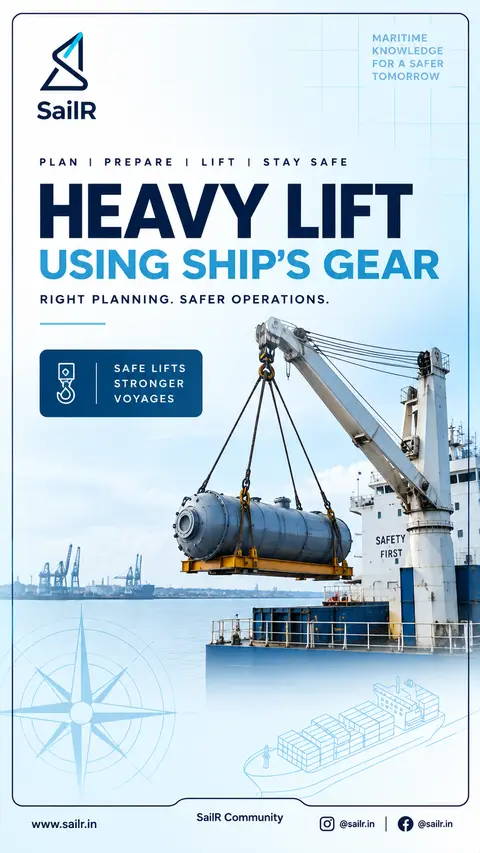
The slides, written out
AI-drawn illustration. Simplified to explain the idea, not to scale.
Slide 1 · MARITIME KNOWLEDGE FOR A SAFER TOMORROW
PLAN | PREPARE | LIFT | STAY SAFE
HEAVY LIFT
USING SHIP'S GEAR
RIGHT PLANNING. SAFER OPERATIONS.
SAFE LIFTS STRONGER VOYAGES
SAFETY FIRST
Slide 2 · 1/4
HEAVY LIFT SERIES
HEAVY LIFT
PLANNING PHASE
PLAN WELL. LIFT SAFELY.
01
KNOW THE LOAD
Confirm the actual gross weight, including lifting tackle.
Verify centre of gravity, dimensions and lifting points.
Resolve any conflicting weight information before lifting.
SWL CG LIFTING POINTS
02
VERIFY THE LIFTING ARRANGEMENT
Follow the approved lifting and rigging plan.
Confirm the ship's gear, ropes, shackles, slings and attachments are suitable for the planned configuration.
Do not substitute or modify lifting gear without competent technical review.
APPROVED LIFTING PLAN
03
CHECK SWL AND STABILITY
Confirm the appliance remains within its certified SWL and applicable radius/load limits.
Check vessel stability, heel, trim and downflooding risk throughout the lifting sequence.
Use the approved ballast plan where ballasting is required.
KEEP THE VESSEL UPRIGHT
EXAMINER'S KEY POINT
A heavy lift must be properly planned, supervised and carried out safely.
Slide 3 · 2/4
HEAVY LIFT SERIES
HEAVY LIFT
PREPARATION & RIGGING
RIG IT RIGHT. LIFT IT SAFE.
01
INSPECT THE GEAR
Check lifting appliances and loose gear for wear, corrosion, deformation and damage.
Confirm required examination / certification is valid.
Report defects before the operation.
02
CHECK THE RIGGING
Ensure all loads are properly slung and securely attached.
Check leads, blocks, falls, guys and attachments.
Protect ropes and slings from damaging edges.
Follow the approved configuration and manufacturer's instructions.
03
CONTROL THE WORK AREA
Establish the danger / exclusion zone.
Keep unnecessary personnel clear.
Ensure competent personnel are assigned to the operation.
Maintain effective communication between the operator and lifting team.
KEY PRINCIPLE
The lifting accessory must be suitable for the load, gripping points, loose gear, atmospheric conditions and slinging configuration.
CERTIFIED & SERVICEABLE
LIFTING TEAM
DANGER
KEEP CLEAR OF SUSPENDED LOAD
Slide 4 · 3/4
HEAVY LIFT SERIES
HEAVY LIFT
DURING THE OPERATION
CONTROL THE LIFT. KEEP IT SAFE.
01
TAKE THE WEIGHT SLOWLY
Avoid snatch loading and sudden acceleration.
Control hoisting, lowering and slewing speeds.
Keep the load under positive control.
02
WATCH THE SHIP
Maintain acceptable heel and trim throughout the lift.
Monitor stability and downflooding risk.
Follow the planned ballast sequence where required.
03
WATCH THE LOAD AND GEAR
Maintain safe clearances.
Never allow personnel beneath a suspended load.
Avoid side loading, dragging and excessive overturning moments.
Stop the operation if unsafe conditions develop.
SAFETY ALWAYS
NEVER STAND UNDER A LOAD
04
LANDING THE LOAD
Use the approved landing and load-transfer procedure.
Do not use improvised methods.
Control the transfer of load from ship's gear to the landing surface.
EXAMINER'S KEY POINT
Never allow the lifting operation to create an uncontrolled load, excessive heel or overturning moment.
Slide 5 · 4/4
HEAVY LIFT
SERIES
WIRE ROPE
WHEN DO YOU CONDEMN?
INSPECT. IDENTIFY. REPLACE WHEN IN DOUBT.
01
BROKEN WIRES
Excessive or significant broken wires are a discard concern.
Do NOT use a universal "10% of wires in one rope lay" rule.
Follow the applicable standard, manufacturer's criteria and company inspection procedure.
02
DIAMETER LOSS
Significant reduction in rope diameter.
Excessive wear or abrasion.
Localised reduction caused by damage or loading.
03
CORROSION
Severe external corrosion.
Pitting.
Suspected internal corrosion.
04
DISTORTION / DAMAGE
Kinking, crushing, birdcaging, flattening.
Strand damage.
Damaged or slipping termination (socket, eye, ferrule, splice).
05
SHOCK / OVERLOAD / HEAT
Evidence of thermal or heat damage.
If the rope has been subjected to shock loading, overloading or treatment likely to cause damage, take it out of service and have it examined by a competent person before further use.
BROKEN WIRES
WEAR / DIAMETER LOSS
CORROSION
KINKING / BIRDCAGING
HEAT DAMAGE
GOLDEN RULE
When applicable discard criteria are reached, replace the rope.
Follow the relevant standard (e.g. ISO 4309), manufacturer's guidance and company inspection / discard procedure.
Drafted by SailR from our daily lessons. AI-drawn illustration. Simplified to explain the idea, not to scale. Last updated 19 Oct 2026.
Spotted a mistake?