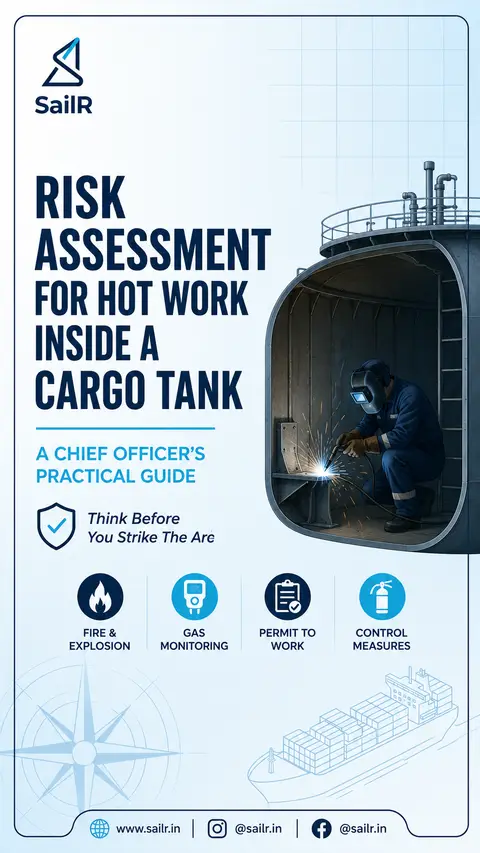
The slides, written out
AI-drawn illustration. Simplified to explain the idea, not to scale.
Slide 1 · RISK ASSESSMENT FOR HOT WORK INSIDE A CARGO TANK
RISK ASSESSMENT FOR HOT WORK INSIDE A CARGO TANK
A CHIEF OFFICER'S PRACTICAL GUIDE
Think Before You Strike The Arc
FIRE & EXPLOSION
GAS MONITORING
PERMIT TO WORK
CONTROL MEASURES
Slide 2 · 5 STEPS
5 STEPS
OF AN EFFECTIVE
RISK ASSESSMENT
A logical approach. A safer operation.
01
IDENTIFY THE HAZARDS
Find out what can cause harm.
Examples: flammable vapour, toxic gases,
oxygen deficiency, fire, explosion, electric shock.
02
DECIDE WHO MIGHT BE HARMED & HOW
Consider everyone who can be affected
and how – inhalation, contact, blast,
heat, smoke, etc.
03
EVALUATE THE RISKS & DECIDE CONTROLS
Risk = Likelihood × Consequence.
Apply the hierarchy of control – Eliminate,
Substitute, Engineer, Administrative, PPE.
04
RECORD THE FINDINGS
Document the assessment and control measures.
It's your evidence for PTW, Master,
and inspections.
05
REVIEW & UPDATE AS NECESSARY
Conditions change. So does risk.
Reassess when conditions, scope, or
personnel change.
PREVENTION IS ALWAYS BETTER THAN REACTION.
Slide 3 · HOT WORK INSIDE
HOT WORK INSIDE
A CARGO TANK
KEY HAZARDS, RISKS & CONTROL MEASURES
HAZARD & RISK
CONTROL MEASURES
FLAMMABLE VAPOUR
Fire / Explosion – personnel, vessel
Tank gas freed to <1% LFL.
Continuous ventilation (explosion-proof).
Atmosphere tested before entry and monitored continuously or at defined intervals.
Adjacent spaces checked and controlled.
OXYGEN DEFICIENCY
Asphyxiation – all personnel inside tank
Atmosphere must contain oxygen within safe limits as per SMS.
Continuous ventilation.
Gas monitor worn. Buddy system in place.
TOXIC GASES
Inhalation injury – welder, fire watch
Tank cleaned and gas freed.
Toxic gas test (zero).
RPE selected as per hazard & company procedures.
ELECTRICAL SHOCK
Electrocution – welder
Welding equipment inspected and isolated.
Cables in good condition. Dry gloves & rubber boots.
Welding return leads per manufacturer instructions & company procedures.
FIRES FROM SPARKS / SLAG
Structural fire, coating ignition, pipe damage
Fire watch inside and outside tank.
Firefighting equipment ready (hose, foam, CO2).
Combustibles removed or protected.
Welding curtains and adequate clearance.
HEAT STRESS
Heat exhaustion – welder, fire watch
Work / rest cycles as per heat stress assessment & company procedures.
Provide drinking water & adequate ventilation.
Monitor personnel condition.
INADEQUATE COMMUNICATION
Delayed rescue, misunderstanding of stop-work authority
Designated safety officer supervising.
Two-way communication tested.
All persons aware of stop-work authority and evacuation routes.
EMERGENCY RESCUE FAILURE
Delayed recovery of injured personnel
Rescue plan briefed. Rescue equipment rigged.
SCBA available for rescue team.
Standby personnel dedicated.
Emergency procedures and contact verified.
RISK RATING GUIDE
Risk = Likelihood (L) × Consequence (C)
Consequence (C)
1-4 Low
5-9 Medium
10-14 High
15-25 Very High
All risks must be controlled to a level that is As Low As Reasonably Practicable (ALARP).
| |
Slide 4 · CHIEF OFFICER
CHIEF OFFICER
CHECKLIST
BEFORE HOT WORK BEGINS
TANK CLEANED AND GAS FREED
Cleaning record available and certified.
ATMOSPHERE TESTED
Oxygen within safe limits.
Flammable & toxic gases within safe limits.
HOT WORK PERMIT ISSUED
Permit-to-Work completed and
authorised by Master.
SAFETY MEETING COMPLETED
All personnel briefed on hazards,
controls and emergency procedures.
VENTILATION OPERATING
Continuous ventilation maintained
throughout the work.
FIREFIGHTING EQUIPMENT READY
Hose, foam, CO₂ extinguishers
and fire blanket ready for use.
FIRE WATCH POSTED
Inside and outside tank.
Trained and equipped.
COMMUNICATION ESTABLISHED
Two-way communication checked.
Emergency signals understood.
RESCUE PLAN REVIEWED
Rescue equipment rigged.
Rescue team on standby.
MASTER AUTHORIZATION OBTAINED
Work approved and permit endorsed.
FOLLOW SAILR
FOR MARITIME SAFETY & COMPLIANCE INSIGHTS
SAFE HOT WORK
IS NOT ACHIEVED
BY LUCK.
IT IS ACHIEVED
THROUGH
PLANNING,
CONTROL, AND
CONTINUOUS
MONITORING.
PTW
Drafted by SailR from our daily lessons. AI-drawn illustration. Simplified to explain the idea, not to scale. Last updated 19 Oct 2026.
Spotted a mistake?