The slides, written out
AI-drawn illustration. Simplified to explain the idea, not to scale.
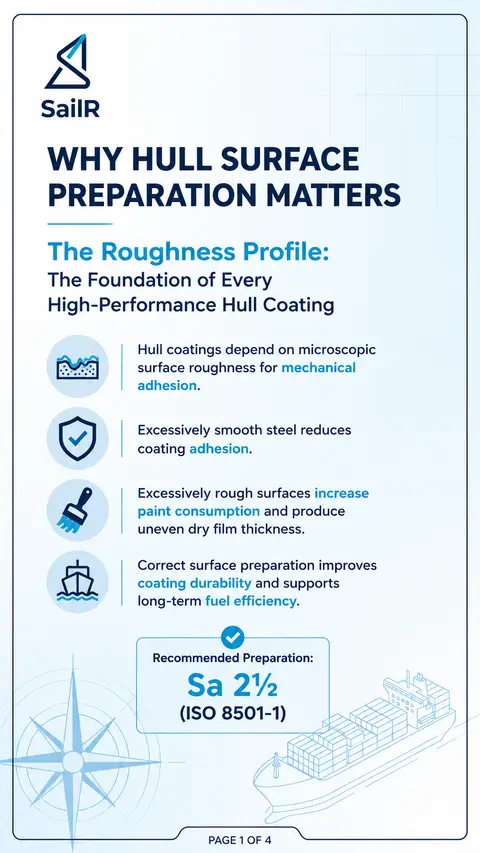
Slide 1 · WHY HULL SURFACE
WHY HULL SURFACE
PREPARATION MATTERS
The Roughness Profile:
The Foundation of Every
High-Performance Hull Coating
Hull coatings depend on microscopic surface roughness for mechanical adhesion.
Excessively smooth steel reduces coating adhesion.
Excessively rough surfaces increase paint consumption and produce uneven dry film thickness.
Correct surface preparation improves coating durability and supports long-term fuel efficiency.
Recommended Preparation:
Sa 2½
(ISO 8501-1)
Slide 2 · SURFACE PREPARATION
SURFACE PREPARATION
Achieving the Correct Blast Profile
Blast cleaning removes
mill scale, rust and
previous coatings.
ISO 8501-1
defines Sa 2½ as
Very Thorough Blast Cleaning.
Surface profile should follow the
coating manufacturer's specification
and abrasive used.
Typical profiles for marine epoxy
systems are approximately 50–85 µm.
(Measured in accordance with ISO 8503)
Uniform blasting
produces a consistent
coating surface,
hull-wide.
DID YOU KNOW?
Surface profile is measured
according to ISO 8503.
Slide 3 · MODERN SOPHISTICATED HULL COATINGS
MODERN SOPHISTICATED HULL COATINGS
TBT-Free | High Performance | Environmentally Compliant
1. SELF-POLISHING COPOLYMER (SPC)
The coating slowly polishes as the vessel moves, continually releasing biocide and exposing a fresh surface.
Controlled polishing
Continuous biocide release
Smooth hull surface & long-term protection
2. SILYL-ACRYLATE POLYMERS
Advanced SPC technology using silyl-acrylate binder for predictable and stable performance.
Predictable polishing rate
Effective in warm and cold waters
Excellent long-term fouling control
3. SILICONE-BASED LOW-ADHESION COATINGS
Create a very slippery surface that prevents strong attachment of marine organisms.
No biocides
Low surface energy
Fouling removed during normal vessel operation at appropriate speeds
4. EPOXY-BASED HARD COATINGS (WITH GLASS FLAKES)
Thick, tough and abrasion-resistant systems for harsh operating conditions.
High abrasion resistance
Ice-class, dredgers & offshore vessels
Mechanical damage protection
5. ZINC SILICATE / INORGANIC ZINC PRIMERS
Provide excellent corrosion protection as part of a complete coating system.
Excellent barrier & corrosion resistance
Requires Sa 2½ surface preparation
Overcoated with epoxy tie coat & antifouling
REGULATORY NOTE
Under the IMO AFS Convention, application of organotin (TBT) compounds was prohibited from 2003, and from 2008 ships may not bear such coatings unless sealed with an approved barrier coating.
Slide 4 · WHY IT MATTERS
WHY IT MATTERS
The Right Preparation. The Right Coating.
Measurable Results.
IMPROVED COATING LIFE
Proper preparation and advanced coatings extend service intervals and reduce downtime.
LOWER MAINTENANCE FREQUENCY
Long-lasting systems reduce dry-docking frequency and maintenance costs.
REDUCED CORROSION RISK
High-quality primers and coatings provide excellent barrier protection for the steel hull.
BETTER HYDRODYNAMIC PERFORMANCE
Smoother hull surfaces reduce resistance, supporting lower fuel consumption.
SUPPORTS EEXI & CII EFFICIENCY OBJECTIVES
A well-maintained hull supports year-on-year efficiency and regulatory compliance.
ENVIRONMENTALLY COMPLIANT SOLUTIONS
Modern TBT-free coatings align with global environmental standards and regulations.
THE BOTTOM LINE
Correct surface preparation combined with the right sophisticated coating system delivers long-term protection, efficiency and environmental responsibility.
Modern coating performance depends on selecting the correct coating system, preparing the steel surface properly, and following manufacturer specifications throughout application.
| |
Drafted by SailR from our daily lessons. AI-drawn illustration. Simplified to explain the idea, not to scale. Last updated 19 Oct 2026.
Spotted a mistake?