The slides, written out
AI-drawn illustration. Simplified to explain the idea, not to scale.
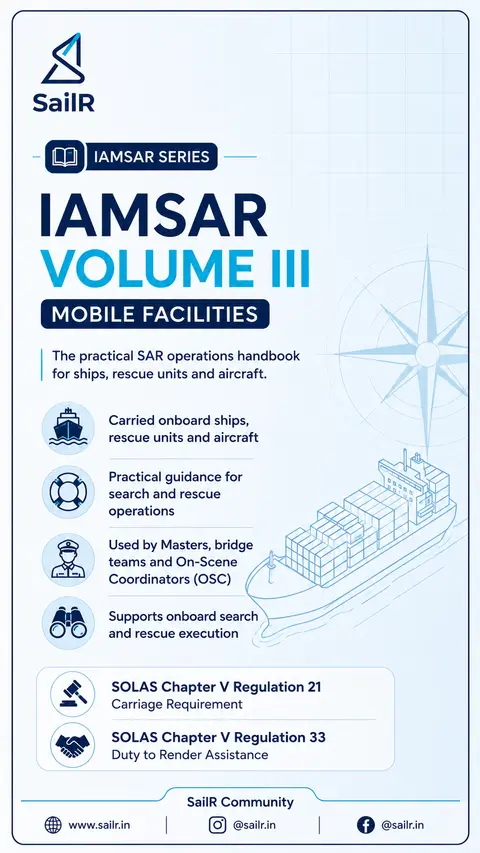
Slide 1 · IAMSAR SERIES
IAMSAR SERIES
IAMSAR
VOLUME III
MOBILE FACILITIES
The practical SAR operations handbook
for ships, rescue units and aircraft.
Carried onboard ships,
rescue units and aircraft
Practical guidance for
search and rescue
operations
Used by Masters, bridge
teams and On-Scene
Coordinators (OSC)
Supports onboard search
and rescue execution
SOLAS Chapter V Regulation 21
Carriage Requirement
SOLAS Chapter V Regulation 33
Duty to Render Assistance
Slide 2 · IAMSAR VOLUME III
IAMSAR VOLUME III
WHAT'S INSIDE
VOLUME III?
Practical guidance for conducting
maritime search and rescue operations.
MASTER'S
RESPONSIBILITIES
The Master's obligations
to assist persons in
distress at sea.
SAR SIGNALS
Distress alerts,
urgency and safety
signals and their use.
SEARCH PATTERNS &
THEIR EXECUTION
Sector, expanding
square, track line and
other search patterns.
ON-SCENE
COORDINATOR (OSC)
Duties, organisation of
multiple facilities and
coordination of aircraft.
COMMUNICATIONS
PROCEDURES
SAR frequencies,
on-scene VHF working
channels and practices.
POSITION REPORTING
& DRIFT ESTIMATION
Establishing and updating
the search datum and
estimating drift.
Volume III is the operational handbook you carry onboard
to search, coordinate and save lives at sea.
Slide 3 · IAMSAR VOLUME III
IAMSAR VOLUME III
EXPANDED SQUARE
SEARCH PATTERN
Used when operating a single search unit in a small,
well-defined search area with an accurate datum.
USED WHEN
Single search unit
available
Small search area
Datum is known
with confidence
HOW IT WORKS
Start at the datum or as
close as safely possible.
Run a leg of one track
spacing (S).
Turn 90° in the same
direction and run the next
leg.
After every pair of legs,
increase the leg length by
one additional track spacing (S).
Continue expanding until
the assigned area is covered.
PATTERN SEQUENCE (TRACK SPACING = S)
S → S → 2S → 2S → 3S → 3S → 4S → 4S ...
3S
2S
3S
2S
DATUM
S
S
IMPORTANT
Turn the same way at the end of every leg
(all right turns or all left turns) to keep the
square expanding consistently.
KEY POINTS
Start at
Datum
Maintain Track
Spacing (S)
Same Direction
Turns
Expand Until
Area Covered
The first leg is usually oriented into the wind to minimize
navigational error due to leeway.
Slide 4 · IAMSAR VOLUME III
IAMSAR VOLUME III
QUICK REVISION
SEARCH PATTERNS
Choose the right pattern for the right situation.
PATTERN | BEST USED FOR | KEY FEATURES | NOTES
SECTOR SEARCH
When the datum is well established and concentrated coverage around the datum is required.
• Arcs are run back and forth across the sector.
• Repeated coverage of the datum.
Good for small search areas.
EXPANDED SQUARE
Single search unit, small search area and accurate datum.
• Starts at datum and expands outward.
• Track spacing (S) increased after every pair of legs.
Simple, systematic and effective.
TRACK LINE SEARCH
When the probable area of the object is along a narrow path or route.
• Fast coverage along the line of drift or probable track.
• Least thorough pattern.
Quick initial search.
PARALLEL TRACK SEARCH
Large search area or uncertain datum with multiple search units.
• Systematic coverage of large areas.
• Efficient for multiple SRUs.
Most common pattern for large searches.
REMEMBER
Start at Datum
Maintain Track Spacing (S)
Update Drift and Environmental Factors
Maintain Clear Communications
OSC Coordinates Multiple Units Effectively
The On-Scene Coordinator (OSC) is responsible for organising search operations, coordinating all facilities, and maximising the chance of survival.
REFERENCE
IMO/ICAO IAMSAR Manual Volume III – Mobile Facilities
The global standard for conducting maritime search and rescue.
Volume III is the operational manual you carry onboard to search, coordinate and save lives at sea.
Select the correct pattern based on the situation, datum accuracy, search area and available resources.
| |
Drafted by SailR from our daily lessons. AI-drawn illustration. Simplified to explain the idea, not to scale. Last updated 19 Oct 2026.
Spotted a mistake?