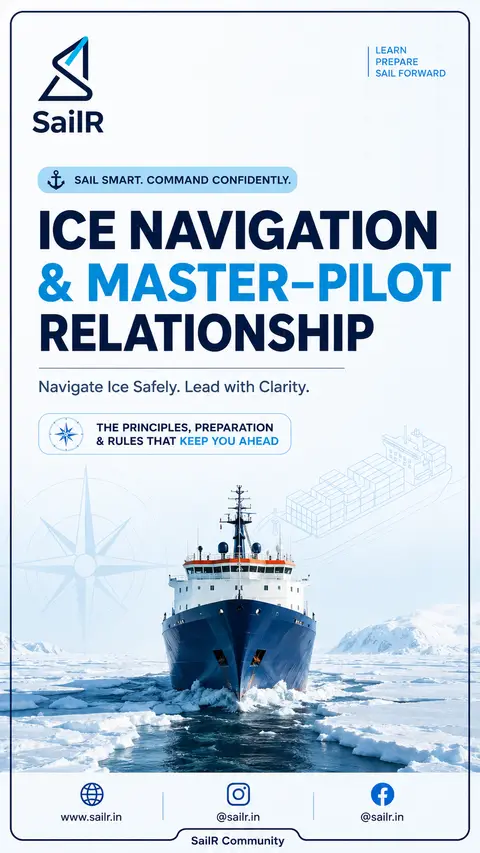
The slides, written out
AI-drawn illustration. Simplified to explain the idea, not to scale.
Slide 1 · LEARN
LEARN
PREPARE
SAIL FORWARD
ICE NAVIGATION
& MASTER-PILOT
RELATIONSHIP
Navigate Ice Safely. Lead with Clarity.
THE PRINCIPLES, PREPARATION
& RULES THAT KEEP YOU AHEAD
Slide 2 · LEARN
LEARN
PREPARE
SAIL FORWARD
SAFE ICE NAVIGATION
Principles Before Manoeuvring
1. KNOW THE ICE
Assess the key characteristics:
• Concentration – percentage of sea surface covered by ice
• Stage of development / thickness – new, first year, multi year ice
• Form – fast ice, drifting ice and floe sizes
• Dynamics – ridging, pressure, drift, leads and cracks
• Icebergs – location and characteristics where relevant
2. KNOW YOUR SHIP
Your ship's ice capability depends on its assigned ice class / Polar Class, where applicable.
POLAR CLASS PC1 – PC7
≠
POLAR SHIP CATEGORIES A, B, C
The Polar Code uses the Category A / B / C framework for certification and operational assessment.
3. MONITOR CONTINUOUSLY
Ice conditions must be continuously assessed during navigation.
The Polar Code requires appropriate polar training and qualifications for masters, chief mates and officers in charge of a navigational watch.
The Polar Code does not establish a universal mandatory onboard position titled "Ice Navigator"; IMO polar navigation Guidelines recommend an Ice Navigator for ships operating in polar ice-covered waters.
4. USE THE FULL INFORMATION PICTURE
Use analysis and forecast ice charts together with weather forecasts. Longer range (7–30 days and seasonal) predictions support voyage planning.
5. UNDERSTAND THE NAVIGATION CHALLENGES
Ice affects position fixing, communications, sensors, horizon visibility, compass performance, logs and chart accuracy. Stay aware. Stay prepared.
SailR logo
Slide 3 · LEARN
LEARN
PREPARE
SAIL FORWARD
ICE NAVIGATION SERIES
BEFORE ENTERING ICE
Voyage Planning & Equipment
1. REGULATORY PLANNING
Where required, obtain the necessary regional or national permission / authorization for ice navigation and coordinate with applicable icebreaking services.
2. RISK ASSESSMENT
Key factors to assess:
• Ice conditions and forecast
• Ship's ice capability
• Weather
• Icebreaker escort / prepared tracks
• Crew experience
• Remote operating environment
• Ports of refuge and support limitations
3. USE THE INFORMATION PICTURE
Combine for better decisions:
Ice Charts
+
Weather Forecasts
+
Ice Forecasts
• Tactical information: ~24 to 144 hours
• Longer range: ~7 to 10 days to 30 days & seasonal
• Ice is strongly influenced by weather prediction.
4. CREW & TRAINING
• Ensure as many deck and engine officers are ice-trained as possible.
• Polar Code requires appropriate polar training for masters, chief mates and officers in charge of a navigational watch.
5. BRIDGE EQUIPMENT CHECKS
For applicable Polar Code ships, ensure the following are in place:
Two independent non magnetic means to determine and display heading.
Connected to main and emergency sources of power.
GNSS compass or equivalent
for ships proceeding above 80° latitude.
Two independent echo sounding devices,
or one echo sounder with two separate independent transducers, where the applicable Polar Code requirement applies.
Appropriate means for visual detection of ice in darkness.
NOTE
The Polar Code does not require two radar systems or two speed/distance measuring devices as a general requirement.
MANOEUVRING MINDSET
Take due account of: ship class, environmental conditions, icebreaker escort or prepared tracks, short/local routes, crew experience and the lack of shore and support infrastructure.
Slide 4 · LEARN
LEARN
PREPARE
SAIL FORWARD
SLAIR
SHARED RESPONSIBILITY. CLEAR COMMUNICATION.
MASTER–PILOT
RELATIONSHIP
Different Roles. Shared Safety Responsibility.
THE KEY IMO PRINCIPLE
The pilot's presence on board does not relieve the master or OOW
of their duties and obligations for the safety of the ship.
The master, bridge officers and pilot share responsibility for good communication
and understanding of each other's role. The master and bridge team must
support the pilot and monitor the pilot's actions at all times.
Source: IMO Resolution A.960(23), Annex 2, Paragraphs 2.1 to 2.3
CONTINUOUS INFORMATION EXCHANGE
Begins before pilotage commences and continues throughout the pilotage.
PILOT → MASTER
Local navigation procedures,
rules and conditions
Tides, currents and depths
Traffic situation
Navigational hazards
and reporting systems
Weather and visibility
Pilot's intended passage
and pilotage plan
MASTER → PILOT
Ship's characteristics –
dimensions, draught,
manoeuvring, engine power
Engine / propulsion capability
and any limitations
Defects, deficiencies or
operational limitations
Bridge team details and
communication arrangements
Cargo related constraints
and special requirements
Ship's passage plan and
contingency arrangements
SUPPORTING TOOL
Pilot Card, checklist
or form may assist
the exchange of
information.
It supplements
communication,
it does not replace
verbal exchange.
Source: IMO A.960(23), Annex 2, Paragraph 5.3.3
THE PILOT PROVIDES SPECIALIST
LOCAL KNOWLEDGE AND PILOTAGE
EXPERTISE.
The pilot's presence on board does not relieve the
master or OOW of their duties and
obligations for the safety of the ship.
Source: IMO A.960(23), Annex 2, Paragraph 2.1
REMEMBER
COMMUNICATE EARLY. EXCHANGE FULLY.
AGREE THE PLAN. MONITOR CONTINUOUSLY.
Slide 5 · LEARN
LEARN
PREPARE
SAIL FORWARD
ICE NAVIGATION SERIES
PILOT BOARDING POINT
Safe Boarding + Time to Exchange Information
The competent pilotage authority should establish and promulgate safe pilot embarkation and disembarkation points.
Source: IMO Resolution A.960(23), Annex 2, Section 3
TWO KEY REQUIREMENTS
01
SAFE BOARDING
The boarding point should be sufficiently far from the commencement of pilotage to allow safe boarding conditions.
02
SUFFICIENT SEA ROOM
The boarding point should provide sufficient time and sea room to complete the master–pilot information exchange before pilotage proceeds.
EXAMINER'S KEY POINT
Pilot boarding does not transfer command of the ship to the pilot.
The master remains responsible for the safety of the vessel within the framework of applicable law and duties, while the pilot provides specialist pilotage expertise.
BOARD SAFELY
Ensure safe pilot boarding conditions.
EXCHANGE INFORMATION
Share all relevant information.
AGREE THE PLAN
Confirm the passage plan and contingencies.
MONITOR CONTINUOUSLY
Monitor pilot's actions and vessel's progress at all times.
NOTE
The master, bridge officers and pilot share responsibility for good communication and understanding of each other's role.
Source: IMO Resolution A.960(23), Annex 2, Sections 2 & 5
Drafted by SailR from our daily lessons. AI-drawn illustration. Simplified to explain the idea, not to scale. Last updated 19 Oct 2026.
Spotted a mistake?