The slides, written out
AI-drawn illustration. Simplified to explain the idea, not to scale.
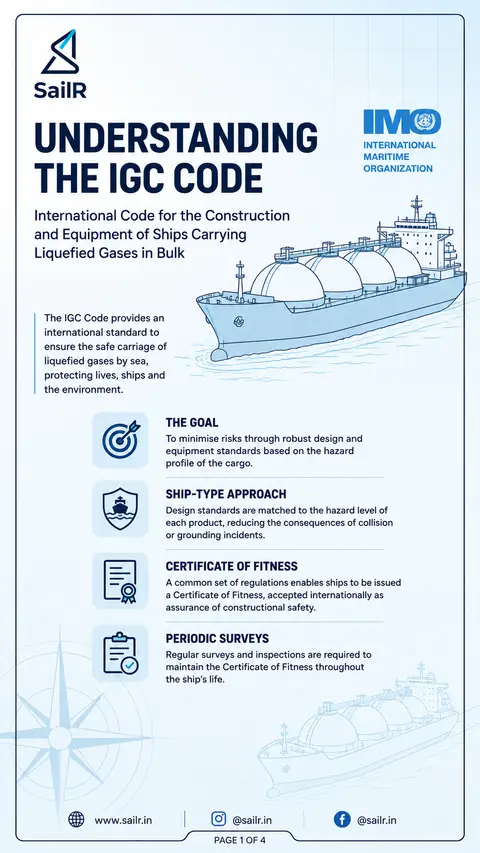
Slide 1 · UNDERSTANDING
UNDERSTANDING
THE IGC CODE
International Code for the Construction
and Equipment of Ships Carrying
Liquefied Gases in Bulk
The IGC Code provides an
international standard to
ensure the safe carriage of
liquefied gases by sea,
protecting lives, ships and
the environment.
THE GOAL
To minimise risks through robust design and
equipment standards based on the hazard
profile of the cargo.
SHIP-TYPE APPROACH
Design standards are matched to the hazard level of
each product, reducing the consequences of collision
or grounding incidents.
CERTIFICATE OF FITNESS
A common set of regulations enables ships to be issued
a Certificate of Fitness, accepted internationally as
assurance of constructional safety.
PERIODIC SURVEYS
Regular surveys and inspections are required to
maintain the Certificate of Fitness throughout
the ship's life.
INTERNATIONAL MARITIME ORGANIZATION
Slide 2 · MAJOR HAZARDS
MAJOR HAZARDS
ON GAS CARRIERS
Liquefied gas cargoes present multiple hazards.
Understanding them is the first step to safe operations.
1. FLAMMABILITY
Many cargoes form flammable mixtures with air.
LPG vapours are heavier than air and collect in low spaces.
Methane vapour is lighter than air and rises.
2. TOXICITY
Some gases (e.g. ammonia, chlorine, sulphur dioxide) are highly toxic.
Certain products are both flammable and toxic.
3. ASPHYXIATION
Non-toxic gases can displace oxygen in enclosed spaces.
Continuous gas monitoring and safe entry procedures are essential.
4. CORROSIVITY
Some gases are corrosive to metals, coatings, seals and equipment.
Proper materials selection and maintenance are critical.
5. REACTIVITY
Certain products can react with water, air or other substances.
Cargo compatibility must always be verified.
6. CRYOGENIC / LOW TEMPERATURE
Cargoes are carried at very low temperatures (e.g. Propane -42°C, LNG -163°C).
Contact with the hull can cause brittle fracture of ordinary steel.
Tanks are insulated and built with special low-temperature materials.
7. VAPOUR PRESSURE & BOIL-OFF
Heat ingress or equipment failure increases boil-off.
Excess pressure may lead to pressure relief valve operation.
Requires reliable vapour handling systems.
KEY TAKEAWAY
Every cargo presents a different hazard profile, which determines ship design, containment system and operational procedures.
Slide 3 · SHIP TYPES &
SHIP TYPES &
CARGO TANK SYSTEMS
The IGC Code classifies ships by hazard level
and tanks by design and construction.
IGC SHIP TYPES (BASED ON HAZARD LEVEL)
SHIP TYPE
HAZARD LEVEL
TYPICAL PRODUCTS
DAMAGE SURVIVABILITY REQUIREMENT
TYPE 1G
1G
GREATEST OVERALL HAZARD
Chlorine, Sulphur Dioxide
Must survive the most severe damage standard; cargo tanks at maximum prescribed distance inboard.
TYPE 2G
2G
SIGNIFICANT HAZARD
Ammonia, Butane, Propane, Methane (LNG)
Survive significant damage; tanks positioned inboard to a lesser extent than Type 1G.
TYPE 2PG
2PG
SIGNIFICANT HAZARD (≤150 m LOA, TYPE C TANKS ONLY)
Propane, Butane (semi-refrigerated / pressurised)
Same damage standard as 2G; applicable to ships ≤150 m with independent Type C tanks. MARVS ≥7 bar, design temp -55°C or above.
TYPE 3G
3G
MODERATE HAZARD
Carbon Dioxide, Nitrogen
Survive the least severe damage standard; tanks closest to the shell.
IMPORTANT
Ship Type is determined by the hazard level of the cargo. It defines survivability requirements and tank location.
CARGO TANK TYPES (BASED ON DESIGN & CONSTRUCTION)
TYPE A
Prismatic (Gravity Tanks)
Design pressure < 0.7 bar
Fully-refrigerated LPG carriers
External insulation
Supported by the hull structure
TYPE B
Independent (Moss/SPB)
Spherical (Moss) or Prismatic (SPB)
Designed using enhanced engineering analysis and crack-propagation assessment
Higher stress allowed than Type A
Common on LNG carriers and VLECs
TYPE C
Pressure Vessels
Cylindrical or spherical pressure vessels
Design pressure ≥ 7 bar (typically)
Fully-pressurised and semi-pressurised ships
No secondary barrier required
MEMBRANE
Thin Metal Liner
Thin Invar or stainless steel membrane
Not self-supporting
Supported by insulation and the inner hull structure
Used on the vast majority of modern LNG carriers
SHIP TYPE ≠ TANK TYPE
Ship type is based on the hazard level of the cargo and required survivability. Tank type is based on the cargo's thermodynamic properties, pressure and design requirements.
Slide 4 · HOW LIQUEFIED GASES
HOW LIQUEFIED GASES
ARE CARRIED AT SEA
Different methods of liquefaction and carriage conditions
ensure cargo remains in liquid state safely and efficiently.
METHODS OF LIQUEFACTION / CARRIAGE CONDITIONS
1
FULLY PRESSURISED (FP)
2
SEMI-PRESSURISED / SEMI-REFRIGERATED (SR)
3
FULLY REFRIGERATED (FR)
4
MULTI-GRADE (MIXED CARGO)
Cargo carried at ambient temperature.
Tank pressure equals vapour pressure of the cargo (typically 7–18 bar depending on cargo and design).
Type C tanks only.
Simple, low capital cost but higher energy cost per unit.
Typical Use
Small to medium LPG carriers
Cargo carried at a temperature below ambient, with moderate pressure.
Type C tanks with reliquefaction plant.
Flexible operation – carriage conditions can be adjusted to suit cargo and terminal requirements.
Typical Use
LPG carriers with flexible trading operations
Cargo carried at or near its atmospheric boiling point (very low pressure).
LPG: Type A prismatic tanks with reliquefaction plant.
LNG: Membrane or Type B tanks.
Boil-off is returned to tank (LPG) or used as fuel / reliquefied (LNG) depending on ship design.
Typical Use
Large LPG & LNG carriers
Multiple independent Type C tanks.
Different cargoes carried simultaneously at different temperatures and pressures.
Requires separate reliquefaction circuits and careful cargo compatibility management.
Typical Use
Multi-product LPG carriers
BOIL-OFF GAS HANDLING PROCESS (LPG CARRIERS)
1. BOIL-OFF GAS
Heat ingress causes liquid to evaporate naturally.
2. COMPRESSION
Boil-off vapour is compressed to increase pressure and temperature.
3. COOLING
The compressed gas is cooled in the heat exchanger using refrigerant.
4. CONDENSATION
Vapour condenses back to liquid in the condenser.
5. RETURN TO TANK
Liquefied cargo is returned to the cargo tank.
LNG carriers may use boil-off gas as fuel, employ reliquefaction plants, or both, depending on vessel design and operational profile.
KEY TAKEAWAY
The choice of carriage method affects tank design, cargo handling systems, safety arrangements, ship size, energy efficiency and operating flexibility.
Drafted by SailR from our daily lessons. AI-drawn illustration. Simplified to explain the idea, not to scale. Last updated 19 Oct 2026.
Spotted a mistake?