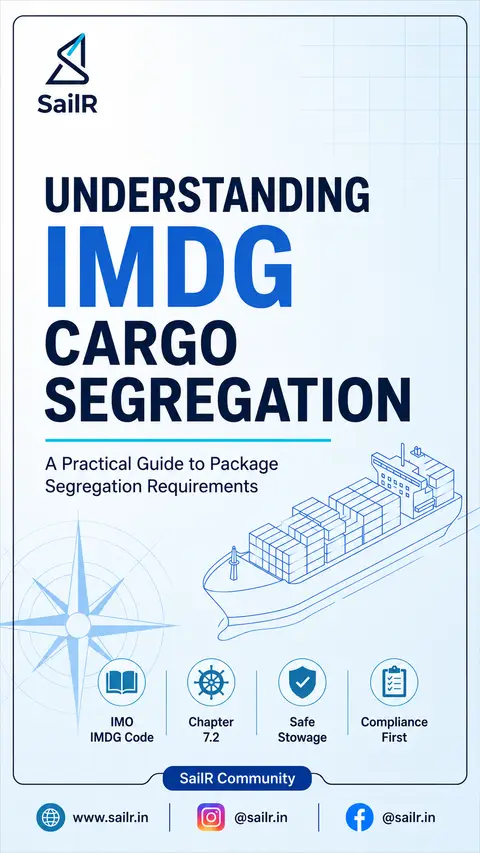
The slides, written out
AI-drawn illustration. Simplified to explain the idea, not to scale.
Slide 1 · UNDERSTANDING
UNDERSTANDING
IMDG
CARGO
SEGREGATION
A Practical Guide to Package
Segregation Requirements
IMO
IMDG Code
Chapter
7.2
Safe
Stowage
Compliance
First
Slide 2 · IMDG CARGO SEGREGATION
IMDG CARGO SEGREGATION
UNDERSTANDING THE LEVELS
PAGES 2 OF 4
1 AWAY FROM (CODE 1)
DEFINITION
Effectively segregated so that incompatible materials cannot interact dangerously in the event of an accident. They may be in the same compartment or hold or on deck, but must have a minimum horizontal separation of 3 metres, projected vertically.
WHAT IT MEANS FOR YOU
You can load both incompatible goods in the same hold, as long as there's a minimum horizontal separation of 3 metres, projected vertically. The intervening space may be occupied by cargo compatible with both dangerous goods, provided the required separation is maintained.
SAME HOLD PERMITTED
Package A (Class 3)
3m Min. Gap
Package B (Class 8)
INTERVENING SPACE MAY BE OCCUPIED BY CARGO COMPATIBLE WITH BOTH DANGEROUS GOODS
2 SEPARATED FROM (CODE 2)
DEFINITION
In different holds when stowed under deck. An intervening deck that is resistant to fire and liquid may be accepted as equivalent to vertical separation (i.e. in different compartments one above the other).
WHAT IT MEANS FOR YOU
You can't put them in the same hold. They must be in different holds.
If they are in compartments stacked vertically, the deck between them must be both fire-resistant and liquid-tight.
On deck: Maintain a minimum horizontal separation of 6 metres.
DIFFERENT HOLDS REQUIRED
Hold 1 Package A (Class 3)
Hold 2 Package B (Class 8)
WATERTIGHT BULKHEAD
ON DECK REQUIREMENT
6m Min. Gap
Slide 3 · IMDG CARGO SEGREGATION
IMDG CARGO SEGREGATION
UNDERSTANDING THE LEVELS
PAGES 3 OF 4
3
SEPARATED BY A COMPLETE COMPARTMENT OR HOLD FROM (CODE 3)
DEFINITION
Either a vertical or a horizontal separation using a complete compartment. If the intervening decks are not resistant to fire and liquid, then only a longitudinal (fore-and-aft) separation—an intervening complete compartment— is acceptable.
WHAT IT MEANS FOR YOU
• You need an entire hold or compartment between them.
• If you can't rely on the decks (e.g. a 'tween deck with non-fire-resistant hatches), you must separate them horizontally— a full hold in between.
• This is more restrictive than "separated from".
• On deck: Maintain 12 metres horizontal separation.
ONE COMPLETE COMPARTMENT BETWEEN
Hold 1 Package A (Class 3)
Hold 2 (Empty or Compatible Cargo)
Hold 3 Package B (Class 8)
ON DECK REQUIREMENT
12m Min. Gap
APPLIES ALSO WHEN ONE PACKAGE IS ON DECK AND THE OTHER IN AN UPPER COMPARTMENT: MAINTAIN 12 METRES HORIZONTAL SEPARATION.
4
SEPARATED LONGITUDINALLY BY AN INTERVENING COMPLETE COMPARTMENT OR HOLD FROM (CODE 4)
DEFINITION
A longitudinal separation only— vertical separation alone does not satisfy this requirement.
WHAT IT MEANS FOR YOU
• You must have a full compartment horizontally in between.
• Even stacking one on top with a deck between doesn't work.
• On deck: Maintain 24 metres longitudinal separation.
• For one package under deck and one on deck: Maintain 24 metres longitudinal separation including one complete intervening compartment.
LONGITUDINAL SEPARATION ONLY
Hold 1 Package A (Class 3)
Hold 2 Complete Compartment (Empty or (Compatible Cargo)
Hold 3 Package B (Class 8)
FORE AFT
ON DECK REQUIREMENT
24m Min. Longitudinal Gap
APPLIES ALSO WHEN ONE PACKAGE IS UNDER DECK AND THE OTHER ON DECK: MAINTAIN 24 METRES LONGITUDINAL SEPARATION INCLUDING ONE COMPLETE INTERVENING COMPARTMENT.
Slide 4 · IMDG CARGO SEGREGATION
IMDG CARGO SEGREGATION
QUICK REFERENCE SUMMARY
PAGES 4 OF 4
IMDG SEGREGATION SUMMARY
SEGREGATION TERM
UNDER DECK
ON DECK
KEY POINT
AWAY FROM
(CODE 1)
Same hold permitted with minimum 3 metres horizontal separation (projected vertically).
Minimum 3 metres horizontal separation.
Intervening space may be occupied by cargo compatible with both dangerous goods.
SEPARATED FROM
(CODE 2)
Must be in different holds or compartments. A fire- and liquid-resistant deck may be accepted as equivalent to vertical separation.
Minimum 6 metres horizontal separation.
Different holds under deck. On deck, maintain 6 metres separation.
SEPARATED BY A COMPLETE COMPARTMENT OR HOLD FROM (CODE 3)
Either vertical or horizontal separation using one complete compartment. If decks are not fire/liquid resistant, longitudinal separation only.
Minimum 12 metres horizontal separation.
Requires one complete compartment between the cargoes. On deck, maintain 12 metres separation.
SEPARATED LONGITUDINALLY BY AN INTERVENING COMPLETE COMPARTMENT OR HOLD FROM (CODE 4)
A full compartment must be between the cargoes. Vertical separation alone does not satisfy this requirement.
Minimum 24 metres longitudinal separation.
On deck: 24 metres longitudinally. One under deck and one on deck: 24 metres longitudinal separation including one complete intervening compartment.
KEY REMINDER
Always verify segregation using:
IMDG Dangerous Goods List
Segregation Table
Special Segregation Codes (SG)
Stowage Codes
IMPORTANT
Proper segregation prevents dangerous reactions, protects crew, ship and cargo, and ensures compliance with the IMDG Code.
Safe Stowage, Safe Voyage.
Drafted by SailR from our daily lessons. AI-drawn illustration. Simplified to explain the idea, not to scale. Last updated 19 Oct 2026.
Spotted a mistake?