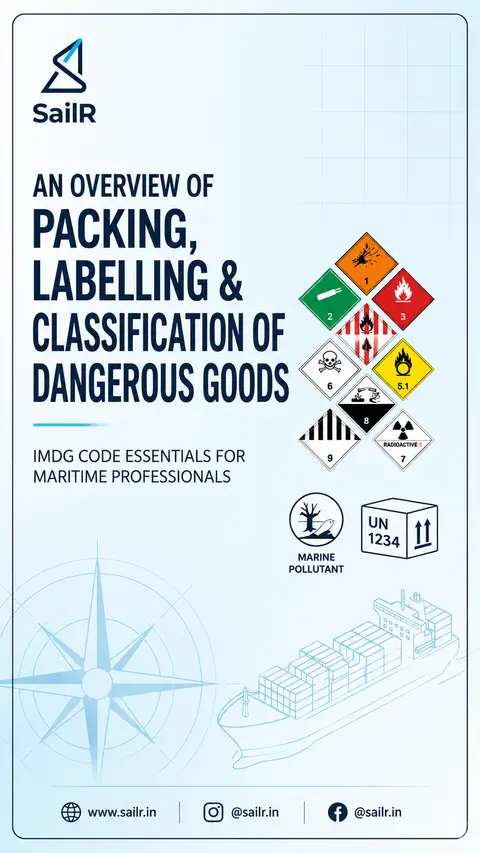
The slides, written out
AI-drawn illustration. Simplified to explain the idea, not to scale.
Slide 1 · AN OVERVIEW OF
AN OVERVIEW OF
PACKING,
LABELLING &
CLASSIFICATION OF
DANGEROUS GOODS
IMDG CODE ESSENTIALS FOR
MARITIME PROFESSIONALS
MARINE
POLLUTANT
UN
1234
Slide 2 · PACKING OF
PACKING OF
DANGEROUS GOODS
Where applicable, dangerous goods are assigned
to Packing Groups according to the degree of
danger they present.
PACKING GROUP I
HIGH DANGER
PACKING GROUP II
MEDIUM DANGER
PACKING GROUP III
LOW DANGER
NOT ALL DANGEROUS GOODS
ARE ASSIGNED PACKING GROUPS.
Certain classes and substances follow
specific classification and packaging
provisions rather than Packing
Group assignment.
Packaging selected
according to
IMDG Packing
Instructions.
UN-approved
packaging
is required.
Must pass
the required
performance tests:
Drop Test
Leakproofness Test
Stack Test
Unstable substances
must be stabilized,
inhibited, or
temperature-
controlled as
specified in the
Dangerous Goods List.
Slide 3 · LABELLING REQUIREMENTS
LABELLING REQUIREMENTS
Every package offered for carriage must be correctly labelled as per IMDG Code.
1
DANGEROUS GOODS LABEL
Primary hazard class.
2
SUBSIDIARY RISK LABELS
Where required by the IMDG Code.
3
PROPER SHIPPING NAME (PSN)
As per Dangerous Goods List.
4
UN NUMBER
As per Dangerous Goods List.
5
MARINE POLLUTANT MARK
Where applicable as per MARPOL Annex III.
6
ORIENTATION ARROWS
On packages containing liquids where required by the applicable IMDG packing provisions.
INSPECTOR NOTE
If labels are damaged, missing, or incorrect, they must be rectified before the cargo is accepted and the reason for the discrepancy investigated.
Slide 4 · THE 9 CLASSES
THE 9 CLASSES
OF DANGEROUS GOODS
The numerical order of classes does not indicate
the degree of danger.
1 EXPLOSIVES
1.1 Mass explosion hazard
1.2 Projection hazard
1.3 Fire + minor blast / projection hazard
1.4 No significant hazard
1.5 Very insensitive, mass explosion hazard
1.6 Extremely insensitive, no mass explosion
2 GASES
2.1 Flammable gases
2.2 Non-flammable, non-toxic gases
2.3 Toxic gases
3 FLAMMABLE LIQUIDS
Flammable liquids, including liquid-desensitized explosives.
4 FLAMMABLE SOLIDS; SUBSTANCES LIABLE TO SPONTANEOUS COMBUSTION; SUBSTANCES WHICH, IN CONTACT WITH WATER, EMIT FLAMMABLE GASES
4.1 Flammable solids, self-reactive substances, desensitized explosives
4.2 Substances liable to spontaneous combustion
4.3 Substances which, in contact with water, emit flammable gases
5 OXIDIZING SUBSTANCES AND ORGANIC PEROXIDES
5.1 Oxidizing substances
5.2 Organic peroxides
6 TOXIC AND INFECTIOUS SUBSTANCES
6.1 Toxic substances
6.2 Infectious substances
7 RADIOACTIVE MATERIAL
Radioactive material.
8 CORROSIVE SUBSTANCES
Corrosive substances.
9 MISCELLANEOUS DANGEROUS SUBSTANCES AND ARTICLES
Miscellaneous dangerous substances and articles.
IMPORTANT
Many substances across Classes 1–9 are also identified as marine pollutants under MARPOL Annex III and must carry the Marine Pollutant mark where applicable. In the IMDG Dangerous Goods List, these substances are identified by the symbol "P" in the Marine Pollutant (MP) column.
MARINE POLLUTANT
Drafted by SailR from our daily lessons. AI-drawn illustration. Simplified to explain the idea, not to scale. Last updated 19 Oct 2026.
Spotted a mistake?