The slides, written out
AI-drawn illustration. Simplified to explain the idea, not to scale.
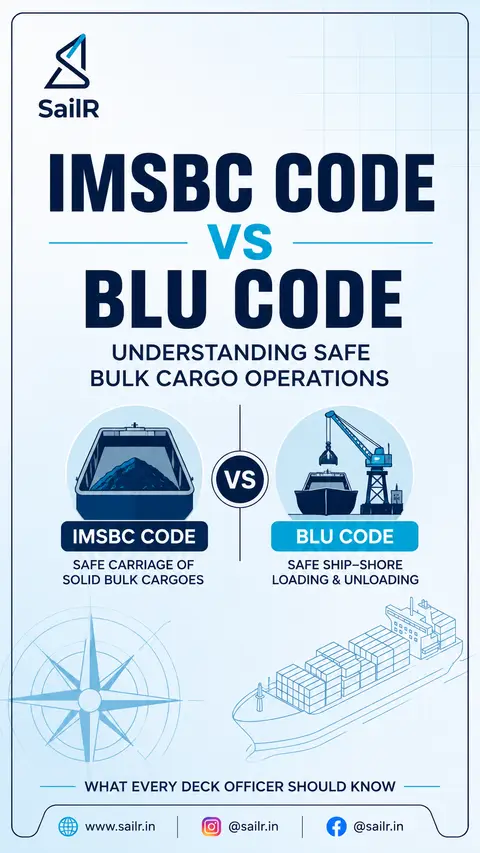
Slide 1 · IMSBC CODE
IMSBC CODE
VS
BLU CODE
UNDERSTANDING SAFE
BULK CARGO OPERATIONS
IMSBC CODE
SAFE CARRIAGE OF
SOLID BULK CARGOES
BLU CODE
SAFE SHIP–SHORE
LOADING & UNLOADING
VS
WHAT EVERY DECK OFFICER SHOULD KNOW
Slide 2 · IMSBC CODE
IMSBC CODE
SAFE CARRIAGE OF SOLID BULK CARGOES
The IMSBC Code provides mandatory requirements for the safe carriage of solid bulk cargoes under SOLAS Chapter VI, Regulation 1–2.
1. CARGO CLASSIFICATION
Cargoes are divided into three groups based on their hazards.
GROUP A
LIQUEFACTION RISK
Cargoes that may liquefy (e.g., iron ore fines, nickel ore). Require TML and moisture certificate.
GROUP B
CHEMICAL HAZARDS
Cargoes with chemical hazards (e.g., some coals, DRI). Require special stowage and handling.
GROUP C
OTHER CARGOES
Cargoes not liable to liquefaction or chemical hazards, but still require proper carriage.
2. CRITICAL INFORMATION
To be provided by the shipper before loading.
BCSN
Correct Bulk Cargo Shipping Name
MOISTURE CONTENT
Actual moisture content of cargo
TML CERTIFICATE (Where Applicable)
Transportable Moisture Limit for Group A cargoes
STOWAGE FACTOR & ANGLE OF REPOSE
For loading, stability and trimming
3. AT SEA REQUIREMENTS
Ongoing care of the cargo throughout the voyage.
VENTILATION
As required, restricted or prohibited based on cargo schedule.
ATMOSPHERE MONITORING
Check for oxygen deficiency or toxic / flammable gases.
REGULAR INSPECTIONS
Look for signs of liquefaction, heating, or abnormal condition.
STRUCTURAL & STABILITY CONTROL
Follow approved loading manual and monitor hull stresses.
Focus: CARGO HAZARDS & SAFE CARRIAGE
Slide 3 · BLU CODE
BLU CODE
SAFE SHIP–SHORE OPERATIONS
The BLU Code is referenced by SOLAS Chapter VI
Regulation 7 and provides internationally accepted
procedures for the safe loading and unloading of bulk carriers.
1. BEFORE LOADING / UNLOADING
BERTH & APPROACH
Terminal to provide information on berth depth, draft limits, tidal & current conditions.
PLANNING
Agree the loading / unloading rate, sequence of holds, ballast plan and maximum final rate.
MOORING & SAFETY
Ensure ship is properly moored and all safety precautions are in place.
SHIP/SHORE CHECKLIST
Master and terminal representative complete and sign the Ship/Shore Safety Checklist before operations begin.
2. DURING OPERATIONS
CONTINUOUS COMMUNICATION
Maintain constant communication between ship and terminal.
EMERGENCY STOP
Terminal must be ready to stop immediately upon receiving the "STOP" order.
MONITOR & CONTROL
Monitor loading instrument, tank levels, stability, and structural integrity.
BALLAST COORDINATION
Ballast operations to proceed in step with cargo operations to maintain safety.
3. KEY DOCUMENTS & INFORMATION
SHIP/SHORE SAFETY CHECKLIST
Confirms safe readiness of ship and terminal for operations.
LOADING / UNLOADING PLAN
Includes rate, sequence of holds, ballast plan and final trimming.
CARGO DECLARATION
Declared by shipper as per IMSBC Code – includes BCSN, moisture info, TML (if applicable).
COMMUNICATION PROCEDURES
Agreed signals, channels and emergency contact details.
Focus: SHIP–TERMINAL COORDINATION & SAFETY
Slide 4 · PRACTICAL EXAMPLE
PRACTICAL EXAMPLE
IRON ORE FINES LOADING
How IMSBC Code & BLU Code work together in real operations
STEP 01
BEFORE ARRIVAL
Iron ore fines are a Group A cargo → Liquefaction risk
Review cargo information and moisture content certificate
Verify Transportable Moisture Limit (TML) compliance
Check stowage factor and plan loading sequence for stability and stress
IMSBC REQUIREMENTS
STEP 02
PORT OPERATIONS
Complete Ship/Shore Safety Checklist (BLU Code)
Agree loading rate, hold sequence and ballast plan
Agree "stop loading" and emergency signals and procedures
Confirm communication channels with terminal
BLU CODE PROCEDURES
STEP 03
DURING LOADING
Monitor loading instrument (bending moments & shear forces)
Ensure loading rate does not exceed agreed limit
Maintain continuous communication with terminal
Stop immediately if limits are approached or any unsafe condition occurs
MONITOR. COMMUNICATE. CONTROL.
STEP 04
AT SEA
Follow IMSBC cargo schedule for ventilation, inspections & care
Monitor cargo condition for signs of liquefaction, heating or abnormality
Carry out regular hold inspections and log all observations
Maintain stability and comply with SOLAS requirements
SAFE CARGO SAFE VOYAGE
IMSBC = CARGO SAFETY
BLU = LOADING SAFETY
Different roles, Same goal: Safe operations.
KNOW THE CODES. FOLLOW THE PROCEDURES. GO HOME SAFE.
Drafted by SailR from our daily lessons. AI-drawn illustration. Simplified to explain the idea, not to scale. Last updated 19 Oct 2026.
Spotted a mistake?