The slides, written out
AI-drawn illustration. Simplified to explain the idea, not to scale.
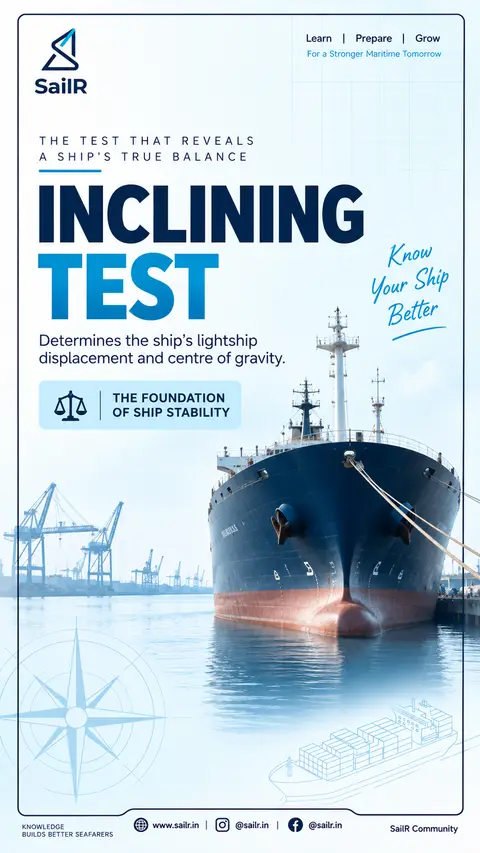
Slide 1 · Learn | Prepare | Grow
Learn | Prepare | Grow
For a Stronger Maritime Tomorrow
THE TEST THAT REVEALS
A SHIP'S TRUE BALANCE
INCLINING
TEST
Know
Your Ship
Better
Determines the ship's lightship
displacement and centre of gravity.
THE FOUNDATION
OF SHIP STABILITY
KNOWLEDGE
BUILDS BETTER SEAFARERS
| |
Slide 2 · Learn | Prepare | Grow
Learn | Prepare | Grow
For a Stronger Maritime Tomorrow
SHIP STABILITY ESSENTIALS
INCLINING TEST
The Foundation of Ship Stability
Determines the ship's lightship displacement and centre of gravity, which form the basis of all stability calculations.
WHAT DOES IT DETERMINE?
01
LIGHTSHIP DISPLACEMENT
The displacement of the ship in its approved lightship condition.
02
LIGHTSHIP CENTRE OF GRAVITY
Determines the ship's KG and LCG, which form the basis of subsequent stability calculations.
WHEN IS IT REQUIRED?
Upon completion of a new build, before delivery.
After alterations or modifications that materially affect stability.
Passenger ships: lightweight survey at intervals not exceeding 5 years.
Re-inclining is required when the applicable deviation limits are exceeded.
WHO IS COVERED?
Every passenger ship regardless of size.
Every cargo ship of 24 m length and upwards.
KEY IDEA
Lightship data is the foundation on which the ship's stability information is built.
KNOWLEDGE BUILDS BETTER SEAFARERS
| |
Slide 3 · Learn | Prepare | Grow
Learn | Prepare | Grow
For a Stronger Maritime Tomorrow
SHIP STABILITY ESSENTIALS
INCLINING TEST
Prepare Right
Get Reliable Results
Preparation Before the Test
01
SHIP CONDITION
• Ship should be as complete as possible and as close as practicable to the intended lightship condition.
• Temporary materials, tools, staging, debris and unnecessary personnel should be reduced to the absolute minimum.
All equipment stowed and secured in normal seagoing position
02
TANKS & LIQUIDS
• Minimize free surface effects.
• Tanks should preferably be completely empty or completely full.
• If a tank must remain slack, its free surface effect must be accurately determined and included in the calculations.
Preferably Full
Preferably Empty
03
MOORING & LOCATION
• Conduct the test in a quiet, sheltered area with sufficient water depth.
• Ship must be moored so that it can heel freely.
• Shore connections such as hoses and power cables should be kept to a minimum and slack.
Quiet location | Slack moorings
04
INITIAL CONDITION
• Ship should be as upright as possible before starting the test.
• Up to 0.5° initial list is acceptable with the weights in their initial positions.
• Water specific gravity should be accurately recorded.
• All draughts should be recorded.
Use certified hydrometer for water density
IMPORTANT
Accurate preparation ensures reliable results and a correct lightship calculation.
KNOWLEDGE BUILDS BETTER SEAFARERS
| |
Slide 4 · Learn | Prepare | Grow
Learn | Prepare | Grow
For a Stronger Maritime Tomorrow
SHIP STABILITY ESSENTIALS
INCLINING TEST
Measure Calculate Build Confidence
How the Test Works
01 POSITION THE WEIGHTS
• Accurately weighed inclining weights are placed on deck.
• Their vertical centre of gravity should be known, and positioned as far outboard as practical without changing the ship's trim.
Weights placed symmetrically, near midships
02 SHIFT THE WEIGHTS
Move weight through distance d
• Weights are shifted transversely through a measured distance (d).
• This produces a known heeling moment.
Heeling Moment = m × d
m = weight moved (tonnes)
d = horizontal distance moved (metres)
03 MEASURE THE HEEL
• The resulting heel is measured using a pendulum (plumb line) or an approved alternative.
• For a pendulum:
tan θ = a / l
a = pendulum deflection (metres)
l = pendulum length (metres)
Pendulum deflection is proportional to the angle of heel
04 CALCULATE GM
• For an individual weight movement:
GM = (m × d) / (Δ × tan θ)
Using the pendulum:
GM = (m × d × l) / (Δ × a)
05 DETERMINE KG
• Once GM is found, and KM is read from the metacentric diagram:
KG = KM − GM
IMPORTANT
• Several weight movements are performed (normally 8) and the results are plotted to verify linearity.
• Do not rely on a single movement.
TYPICAL HEEL ANGLE
• Total test weight should normally produce a minimum heel of 1° and a maximum heel of 4° to each side.
• For large ships, a smaller angle may be accepted by the Administration.
KNOWLEDGE BUILDS BETTER SEAFARERS
| |
Slide 5 · Learn | Prepare | Grow
Learn | Prepare | Grow
For a Stronger Maritime Tomorrow
SHIP STABILITY ESSENTIALS
INCLINING TEST
Right Data Safer Voyages
Key Precautions, Numbers & Takeaways
KEY PRECAUTIONS
01 UNRESTRICTED HEELING
Moorings, hoses and shore connections must not restrain the ship. Ship must be free to heel.
02 CALM ENVIRONMENT
Conduct the test in a quiet, sheltered area. Wind and external forces can affect readings.
03 FREE SURFACE
Minimize slack tanks. Tanks should preferably be completely full or empty. If a tank must remain slack, its free surface effect must be accurately determined and included.
04 MINIMUM PERSONNEL
All non-essential personnel should leave the ship. Gangway to be landed.
05 DECK & BILGES
Decks should be free of water. Bilges must be clean and dry.
06 ACCURATE RECORDS
All tank contents, weights and compartments must be known. Keys to all locked spaces should be available.
IMPORTANT NUMBERS
1° Minimum normal inclination produced by test weights
4° Maximum heel to each side
0.5° Maximum initial list with weights in initial positions
5 years Passenger ship lightweight survey interval
SISTER SHIP DISPENSATION
Ship Length (L) | Max. Lightship Displacement Deviation
50 m or less | 2%
160 m or more | 1%
Between 50 m and 160 m | Linear interpolation
Lightship LCG deviation should not exceed 0.5% of L.
WHO IS MANDATORY?
Every passenger ship regardless of size.
Every cargo ship of 24 m length and upwards.
FINAL TAKEAWAY
The inclining test establishes the ship's lightship characteristics – the starting point for reliable stability calculations.
Stable Ships Brighter Horizons
KNOWLEDGE BUILDS BETTER SEAFARERS
| |
Drafted by SailR from our daily lessons. AI-drawn illustration. Simplified to explain the idea, not to scale. Last updated 19 Oct 2026.
Spotted a mistake?