ISM Code Clauses 9 and 12: Incident Reporting, Internal Audits and Ice Navigation
- MEO Class 2
- ETO
- Master
- MEO Class 1
- times asked
- 44
- times asked
- questions
- 7
- questions
- last asked
- 2026
- last asked
Learn how the ISM Code turns incident reporting and internal audits into practical improvements in shipboard safety. Review the key voyage-planning considerations for ships navigating in ice-covered polar waters.
The slides, written out
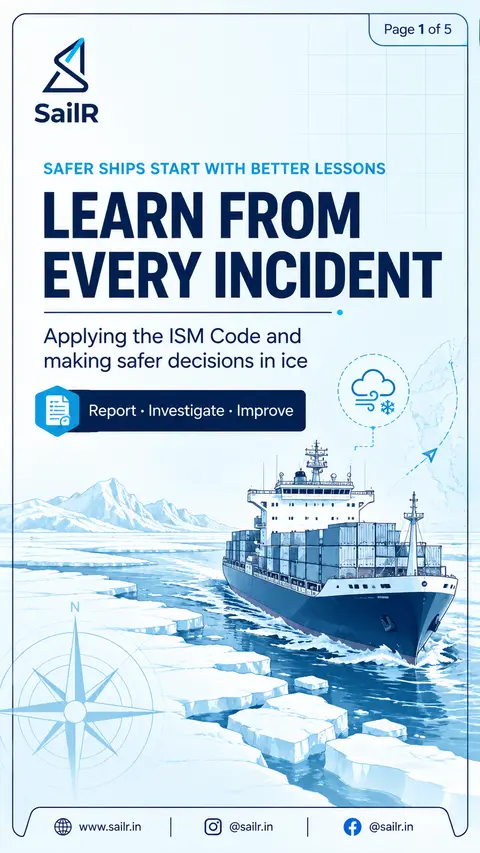
AI-drawn illustration. Simplified to explain the idea, not to scale.
Slide 1 · Learn from every incident
Learn from every incident. The ISM Code provides a framework for improving safety management through reporting, investigation and corrective action. Safe navigation in ice also requires current information, assessment of route hazards and readiness to adjust the passage plan.
Slide 2 · ISM Code Clause 9 requires the Safety Management System to provide procedures for repor…
ISM Code Clause 9 requires the Safety Management System to provide procedures for reporting, investigating and analysing non-conformities, accidents and hazardous situations. Corrective action should address identified problems and support improvements in safety and pollution prevention. A report is useful when it leads to effective preventive action.
Slide 3 · ISM Code Clause 12 requires the company to arrange internal safety audits and periodica…
ISM Code Clause 12 requires the company to arrange internal safety audits and periodically evaluate the effectiveness of the Safety Management System. Audit findings should be communicated to responsible personnel, and corrective action should be taken in a timely manner. An audit creates value when findings lead to effective correction.
Slide 4 · ISM Code Clause 1.2 sets objectives for safe ship operation, pollution prevention, safe…
ISM Code Clause 1.2 sets objectives for safe ship operation, pollution prevention, safeguards against identified risks and continual improvement of safety-management skills. Familiarization, training, risk assessment and operational feedback help translate those objectives into everyday shipboard practice.
Slide 5 · Ice navigation requires current information about ice conditions and the hazards along…
Ice navigation requires current information about ice conditions and the hazards along the intended route. The Polar Code requires voyage planning to consider potential hazards and current information about ice and icebergs near the route. Assess the ship’s capabilities, monitor changing conditions and be ready to adjust the plan.
What it is
The ISM Code requires a Safety Management System (SMS) that supports safe ship operation and pollution prevention. For the Master, this means treating reports, investigations and audits as part of the ship’s working safety system. Their value lies in identifying problems and improving the way work is carried out. (ISM Code 1.2.1, 9.1)
Clause 9 addresses reports and analysis of non-conformities, accidents and hazardous situations. The SMS should provide procedures for reporting these events to the company, investigating them and analysing their causes. The company should also establish procedures for implementing corrective action. (ISM Code 9.1–9.2)
Clause 12 addresses verification of the SMS through internal safety audits and periodic evaluation. These activities help the company determine whether safety and pollution-prevention activities comply with the SMS and whether the system remains effective. (ISM Code 12.1–12.2)
Ice navigation involves a different but related decision-making challenge. The Polar Code addresses the hazards associated with operating in polar waters, including voyage planning and the information needed to assess the intended route. The ship’s operational capabilities and limitations must inform decisions about the voyage. (Polar Code Part I-A, Chapter 11; IMO Polar Code overview)
Why it matters
An incident report can reveal a weakness that is not apparent during routine operations. If the investigation stops at identifying the immediate action that preceded an event, the underlying causes may remain unaddressed. Clause 9 therefore calls for investigation and analysis with the objective of improving safety and pollution prevention. (ISM Code 9.1)
Corrective action needs follow-up. A defect may be repaired, a procedure revised or additional training arranged, but completion alone does not establish that the underlying problem has been addressed. The company’s procedures should support corrective action, while subsequent evaluation helps establish whether the SMS is effective. (ISM Code 9.2, 12.2)
Internal audits provide another opportunity to identify weaknesses in the safety-management system. Repeated findings can prompt a closer examination of the procedures and controls involved. The purpose is to improve compliance and effectiveness, rather than to treat the audit report as an end in itself. (ISM Code 12.1–12.6)
Ice conditions also affect voyage decisions. A route assessment based on outdated information may fail to reflect the conditions near the intended route. The Polar Code requires voyage planning to account for potential hazards and current information about ice and icebergs in the vicinity of the intended route. (Polar Code Part I-A, 11.2–11.3)
How it works on board
When an accident, non-conformity or hazardous situation occurs, the Master should ensure that it is handled under the ship’s SMS. Immediate hazards should be controlled, the event reported through the established process and the relevant facts gathered for investigation. The investigation should examine contributing factors and underlying causes instead of stopping at the last action in the sequence. (ISM Code 9.1–9.2)
The responsible personnel should identify appropriate corrective action through the company’s procedures. The action should have a clear owner and a means of checking completion. Where the findings indicate a weakness in familiarization or competence, the company and shipboard management can consider whether further instruction or a change to the relevant procedure is appropriate. (ISM Code 6.3, 9.2)
For an internal audit, the Master should support access to the ship, records and personnel required for the audit. Findings should be communicated through the applicable SMS process. Corrective action should then be taken in a timely manner, with follow-up directed at the issue identified. The company’s periodic evaluation should consider whether the SMS remains effective. (ISM Code 12.1–12.6)
For navigation in ice, the Master should obtain current information relevant to the intended passage and assess the hazards before proceeding. The assessment should take account of the ship’s operational capabilities and limitations. The Polar Water Operational Manual provides information intended to support decisions by the owner, operator, Master and crew. (Polar Code Part I-A, 11.2–11.3; IMO Polar Code overview)
Conditions should be reassessed as the passage develops. If the available information indicates that the intended route presents unacceptable hazards, the Master should reconsider the plan in accordance with the ship’s procedures and applicable requirements. Decisions must be based on the actual conditions and the ship’s capabilities, not on an assumption that a previously observed opening remains suitable. (Polar Code Part I-A, Chapter 11)
The rules
ISM Code 1.2.1: The SMS should include objectives for safe practices in ship operation and a safe working environment.
ISM Code 1.2.2: The company should assess identified risks to its ships, personnel and the environment and establish appropriate safeguards.
ISM Code 1.2.3: The company should continually improve the safety-management skills of shore-based and shipboard personnel, including preparation for emergencies related to safety and environmental protection.
ISM Code 9.1: The SMS should provide procedures for reporting, investigating and analysing non-conformities, accidents and hazardous situations.
ISM Code 9.2: The company should establish procedures for implementing corrective action.
ISM Code 12.1–12.2: The company should conduct internal safety audits and periodically evaluate the effectiveness of the SMS.
ISM Code 12.3–12.6: The Code addresses audit procedures, independence where practicable, communication of results and timely corrective action.
Polar Code Part I-A, 11.2–11.3: Voyage planning should consider potential hazards and current information about ice and icebergs near the intended route.
(ISM Code 1.2, 9.1–9.2, 12.1–12.6; Polar Code Part I-A, 11.2–11.3)
Common mistakes
A frequent weakness in incident investigation is to focus on the person closest to the event without examining the conditions that contributed to it. The investigation should establish the facts and analyse the event with the objective of improving safety and pollution prevention. (ISM Code 9.1)
Another weakness is to close an audit finding once a corrective action has been recorded, without considering whether the SMS is effective. Internal audits and periodic evaluation serve different but complementary purposes in verifying and improving the system. (ISM Code 12.1–12.2)
During ice navigation, relying on an earlier observation without considering current information can undermine the route assessment. The Polar Code specifically requires consideration of current information about ice and icebergs near the intended route. The Master should assess the hazards and the ship’s capabilities before deciding how to proceed. (Polar Code Part I-A, 11.2–11.3)
In exams
Asked 44 times across 7 different questions, most recently in 2026. Asked most in MEO Class 2 (21), ETO (10), Master (9), MEO Class 1 (4).
Sources
- IMO Resolution A.741 18 , International Safety Management ISM Code , Clauses 1.2, 9.1–9.2 and 12.1–12.6.
- IMO Polar Code, adopted text , Part I-A, Chapter 11, particularly paragraphs 11.2–11.3.
- IMO, International Code for Ships Operating in Polar Waters , overview of the Code, ship operational capabilities and limitations, and the Polar Water Operational Manual.
Drafted by SailR from the regulations cited. AI-drawn illustration. Simplified to explain the idea, not to scale. Last updated 29 Oct 2026.
Spotted a mistake?