The slides, written out
AI-drawn illustration. Simplified to explain the idea, not to scale.
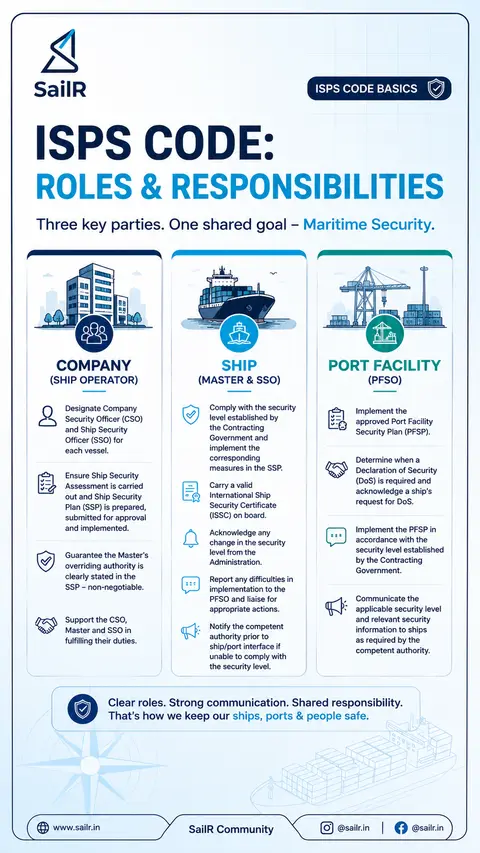
Slide 1 · ISPS CODE BASICS
ISPS CODE BASICS
ISPS CODE:
ROLES & RESPONSIBILITIES
Three key parties. One shared goal – Maritime Security.
COMPANY
(SHIP OPERATOR)
Designate Company Security Officer (CSO) and Ship Security Officer (SSO) for each vessel.
Ensure Ship Security Assessment is carried out and Ship Security Plan (SSP) is prepared, submitted for approval and implemented.
Guarantee the Master's overriding authority is clearly stated in the SSP – non-negotiable.
Support the CSO, Master and SSO in fulfilling their duties.
SHIP
(MASTER & SSO)
Comply with the security level established by the Contracting Government and implement the corresponding measures in the SSP.
Carry a valid International Ship Security Certificate (ISSC) on board.
Acknowledge any change in the security level from the Administration.
Report any difficulties in implementation to the PFSO and liaise for appropriate actions.
Notify the competent authority prior to ship/port interface if unable to comply with the security level.
PORT FACILITY
(PFSO)
Implement the approved Port Facility Security Plan (PFSP).
Determine when a Declaration of Security (DoS) is required and acknowledge a ship's request for DoS.
Implement the PFSP in accordance with the security level established by the Contracting Government.
Communicate the applicable security level and relevant security information to ships as required by the competent authority.
Clear roles. Strong communication. Shared responsibility.
That's how we keep our ships, ports & people safe.
Slide 2 · ISPS CODE BASICS
ISPS CODE BASICS
UNDERSTANDING
ISPS SECURITY LEVELS
Three levels. Increasing measures.
One objective – Maritime Security.
01
Normal operations
The level at which ships and port facilities normally operate.
SECURITY LEVEL 1
NORMAL
Routine activities
Standard security measures
No specific threat
02
Heightened risk
Applies for as long as there is a heightened risk of a security incident.
SECURITY LEVEL 2
HEIGHTENED
Increased vigilance
Enhanced protective measures
Specific threat or intelligence
03
Imminent threat
Applies for the period when there is a probable or imminent risk of a security incident.
SECURITY LEVEL 3
EXCEPTIONAL
Maximum protective measures
Restricted operations
Active threat or incident unfolding
Security measures increase progressively from Level 1 to Level 3.
Slide 3 · ISPS CODE BASICS
ISPS CODE BASICS
CREW DUTIES
BY SECURITY LEVEL
What the crew must do at each level.
Stay alert. Follow procedures. Protect the ship.
01
SECURITY LEVEL 1
NORMAL
Control access to the ship (gangway watch, ID checks).
Control embarkation of persons and their effects.
Monitor restricted areas – only authorised persons.
Monitor deck areas and areas surrounding the ship.
Supervise handling of cargo and ship's stores.
Ensure security communication is readily available.
02
SECURITY LEVEL 2
HEIGHTENED
Increase frequency of patrols and watchkeeping.
Tighter access control – 100% ID checks, limited entry points.
Enhanced search of baggage, stores and cargo.
Restricted areas expanded or reinforced.
Coordinate with PFSO – joint security sweeps.
Declaration of Security (DoS) completed if not already in place.
03
SECURITY LEVEL 3
EXCEPTIONAL
Full lockdown of the ship – no entry/exit.
Muster all crew at designated safe stations.
Activate ship security alert system (SSAS) if required.
Follow instructions from responding authority.
Prepare for possible evacuation or boarding.
The Ship Security Officer (SSO) coordinates implementation of the SSP at each level and reports any difficulties. The Master has overriding authority for safety and security decisions (ISPS Code 6.1).
Slide 4 · ISPS CODE BASICS
ISPS CODE BASICS
SECURITY COMMUNICATION
& COMPLIANCE FLOW
From Government directive to safe ship operations.
1
Contracting Government
establishes the Security Level.
2
Port Facility
receives the Security Level and
implements the required measures
in the PFSP.
3
Ship is Notified
of the applicable Security Level
and relevant security information
prior to arrival or while in port.
4
Ship Implements SSP
The crew implement the Ship
Security Plan measures corresponding
to the set Security Level.
5
Declaration of Security (DoS)
Completed when required – a formal
agreement between ship and port on
security measures and responsibilities.
6
Ship/Port Interface
Safe operations under the agreed
security arrangements.
7
Report Any Difficulties
Report immediately any difficulties in
implementation to the PFSO and
liaise for appropriate actions.
8
Maintain Records & Certification
Maintain records, security communications
and ensure valid ISSC is carried on board.
KEY DOCUMENTS
SHIP SECURITY PLAN (SSP)
Company approved plan detailing shipboard security measures.
INTERNATIONAL SHIP SECURITY CERTIFICATE (ISSC)
Evidence that the ship complies with the requirements of the ISPS Code.
DECLARATION OF SECURITY (DoS)
Agreement between ship and port on security measures and responsibilities.
PORT FACILITY SECURITY PLAN (PFSP)
Approved plan for the security of the port facility.
Effective communication. Timely actions.
Shared responsibility. Stronger security.
Safer ships, ports & people.
Drafted by SailR from our daily lessons. AI-drawn illustration. Simplified to explain the idea, not to scale. Last updated 19 Oct 2026.
Spotted a mistake?