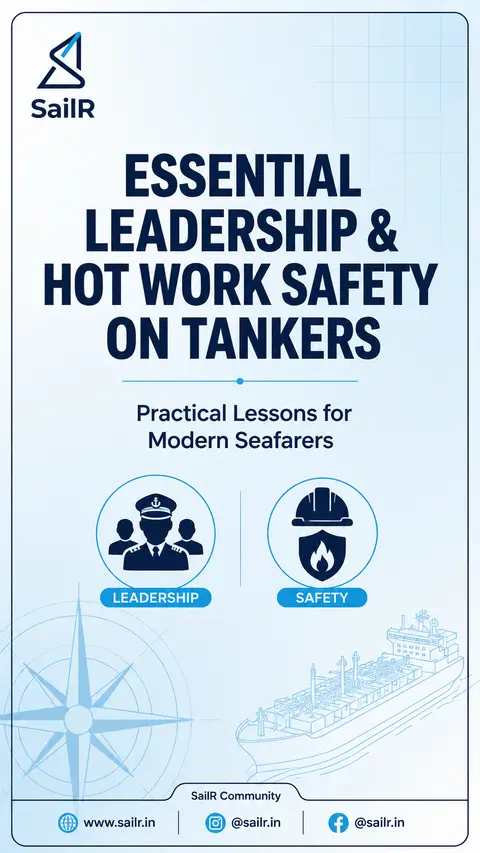
The slides, written out
AI-drawn illustration. Simplified to explain the idea, not to scale.
Slide 1 · ESSENTIAL
ESSENTIAL
LEADERSHIP &
HOT WORK SAFETY
ON TANKERS
Practical Lessons for
Modern Seafarers
LEADERSHIP
SAFETY
Slide 2 · ESSENTIAL ATTRIBUTES
ESSENTIAL ATTRIBUTES
OF AN EFFECTIVE
TEAM LEADER
1. CONFIDENCE & AUTHORITY
Inspire confidence through knowledge,
experience and consistent, competent decisions.
2. CALM UNDER PRESSURE
Stay level-headed in crisis, assess quickly,
make decisions and stick to them.
3. EMPATHY & UNDERSTANDING
Understand your people and their challenges.
Use that understanding to decide what they need.
4. MOTIVATION & COMMITMENT
Lead by example. Show commitment, respect
diversity and build a team that works for each other.
5. OPENNESS & CLARITY
Communicate clearly, listen actively and make
sure everyone understands the plan.
6. QUICK ASSESSMENT & DECISIVENESS
Size up the situation fast, weigh the options
and take decisive action.
Leadership isn't a rank —
it's earned through behaviour.
Slide 3 · HOT WORK ON A TANKER
HOT WORK ON A TANKER:
MAIN HAZARDS
The poop deck is directly above or adjacent to cargo tanks.
Control the risks. Protect the ship, crew and environment.
IGNITION
SOURCE
1. FLAMMABLE
VAPOURS
From cargo tanks,
vent risers, P/V
valves, pipeline
runs, drip trays,
bilges or residual
cargo.
2. IGNITION
SOURCES
Welding arc, grinding
sparks, hot metal,
slag — all can ignite
vapours within the
flammable range.
3. FIRE SPREAD
Heat transfer through
deck plates, burning
paint, grease or
accumulated oil
on deck.
FLAMMABLE
VAPOURS
4. BURNS /
EYE INJURY
From hot metal,
weld spatter, UV
arc flash, or direct
contact with hot
surfaces.
5. TOXIC FUMES
From burning coatings,
zinc, insulation or
hydrocarbon
decomposition.
CARGO TANK
ATMOSPHERE
6. ADJACENT SPACE
HAZARDS
Risk of vapours or gas
accumulation in tanks,
voids or pipe tunnels
beneath the deck.
Hot work remains one of the highest-risk activities
onboard tankers. No job is too urgent to do it safely.
Slide 4 · THE 5-STEP
THE 5-STEP
RISK ASSESSMENT PROCESS
Use a structured approach to ensure every hot work job
is planned, controlled and completed safely.
1
IDENTIFY HAZARDS
• Identify all potential hazards.
• Consider flammable vapours, ignition sources, environment, equipment and substances.
2
IDENTIFY WHO MAY BE HARMED
• Crew directly involved and others nearby.
• Consider the ship, cargo, visitors and the environment.
3
EVALUATE RISKS & CONTROLS
• Assess likelihood and severity.
• Apply control measures using the hierarchy of controls.
4
RECORD FINDINGS
• Complete the risk assessment form.
• Record hazards, controls, residual risk and approvals.
5
REVIEW & IMPROVE
• Monitor the work and controls.
• Debrief after completion and capture lessons learned.
KEY CONTROL MEASURES
PERMIT TO WORK
Mandatory hot work permit issued by authorised officer.
GAS TESTING
Test atmosphere in all adjacent and connected spaces. Ensure safe for hot work.
FIRE WATCH
Trained fire watch with extinguisher and communication.
TOOLBOX TALK & COMMUNICATION
Ensure everyone understands the job, hazards and emergency plan.
EMERGENCY PREPAREDNESS
Firefighting equipment ready. Emergency team on standby.
Safe operations begin long before the first spark.
Residual risk shall be reassessed using the vessel's approved risk matrix and accepted only if it falls within company-defined tolerable limits.
Drafted by SailR from our daily lessons. AI-drawn illustration. Simplified to explain the idea, not to scale. Last updated 19 Oct 2026.
Spotted a mistake?