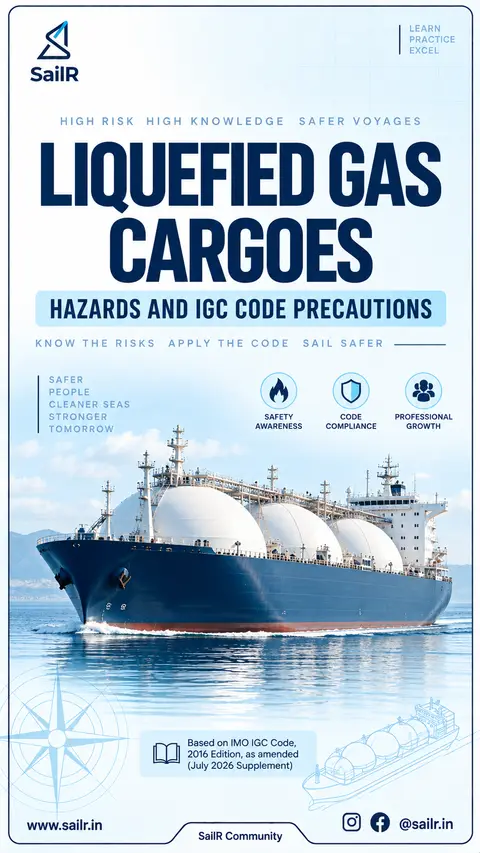
The slides, written out
AI-drawn illustration. Simplified to explain the idea, not to scale.
Slide 1 · LEARN
LEARN
PRACTICE
EXCEL
HIGH RISK HIGH KNOWLEDGE SAFER VOYAGES
LIQUEFIED GAS
CARGOES
HAZARDS AND IGC CODE PRECAUTIONS
KNOW THE RISKS APPLY THE CODE SAIL SAFER
SAFER
PEOPLE
CLEANER SEAS
STRONGER
TOMORROW
SAFETY
AWARENESS
CODE
COMPLIANCE
PROFESSIONAL
GROWTH
Based on IMO IGC Code,
2016 Edition, as amended
(July 2026 Supplement)
Slide 2 · LEARN
LEARN
PRACTICE
EXCEL
LIQUEFIED GAS CARGOES
KEY HAZARDS ON BOARD
KNOW THE RISKS SAIL SAFER
LNG
01
FLAMMABILITY & EXPLOSION
Liquefied gases can rapidly vaporise when released.
Where vapour forms a flammable atmosphere, an ignition
source can result in fire or explosion.
02
ASPHYXIATION
Cargo vapour or inert gas can displace oxygen and create
an oxygen deficient atmosphere.
03
TOXIC EFFECTS
Some cargo vapours can produce acute toxic effects,
including nervous system effects. The specific hazard
depends on the cargo.
04
COLD BURNS & FROSTBITE
Some cargoes are carried at cryogenic or very low temperatures.
Contact with cold liquid, vapour or inadequately protected
equipment can cause cold injury.
05
CORROSIVITY
Certain cargoes can be corrosive to personnel or materials.
Cargo specific compatibility requirements must be followed.
06
REACTIVITY
Certain cargoes can react with other substances or undergo
self reaction such as polymerisation.
07
BRITTLE FRACTURE
Low cargo temperatures can reduce the toughness of
unsuitable materials and may cause brittle fracture.
08
PRESSURE RELEASE
Failure of a pressurised cargo system can cause rapid release
of liquid or vapour, creating a serious release, fire or explosion
hazard.
Reference: IMO IGC Code, 2016 Edition,
as amended (July 2026 Supplement)
Slide 3 · LEARN
LEARN
PRACTICE
EXCEL
LIQUEFIED GAS CARGOES
THE FIRST LINE OF DEFENCE
DESIGN • CARGO • MATERIAL
COMPLY TODAY SAIL SAFER TOMORROW
LNG
01
CORRECT SHIP TYPE
The required ship type depends on the individual product and is specified in IGC Code Chapter 19.
Type 1G
Maximum preventive measures
Type 2G
Significant preventive measures
Type 2PG
Specific Type C containment requirements
Type 3G
Moderate preventive measures
02
TYPE 2PG – KEY LIMITS
A Type 2PG ship is a ship of 150 m length or less carrying cargo in independent Type C tanks, with the following:
Ship length
≤ 150 m
Tank type
Independent Type C
MARVS
≥ 0.7 MPa gauge
Design temperature
≥ −55°C
03
MATERIAL COMPATIBILITY
Cargo-system materials must be suitable for the cargo and applicable temperature conditions as per IGC Code Chapter 17.
Example: Certain cargoes have restrictions on copper and copper-bearing alloys.
04
VERIFY BEFORE LOADING
Confirm the following before loading:
Cargo is listed for carriage
Valid International Certificate of Fitness
Within cargo limits
Approved containment system
Reference: IMO IGC Code, 2016 Edition, as amended (July 2026 Supplement)
Slide 4 · LEARN
LEARN
PRACTICE
EXCEL
LIQUEFIED GAS CARGOES
CONTROL THE CARGO
BEFORE • DURING • AFTER OPERATIONS
SAFE OPERATIONS STRONGER TOMORROW
LNG
01
GAS DETECTION
Gas detection equipment must be properly maintained and tested in accordance with applicable requirements and manufacturer instructions.
O2 20.9 %
LEL 0 %
H2S 0 ppm
CO 0 ppm
DETECT MONITOR STAY SAFE
Flammable vapour
Toxic vapour
Oxygen deficiency
02
OXYGEN MONITORING
An oxygen measuring instrument is required for checking inert atmospheres where applicable.
Oxygen 20.9%
!
Never enter an enclosed or suspect atmosphere without proper testing and entry procedures.
03
PERSONAL PROTECTIVE EQUIPMENT (PPE)
Use PPE appropriate to the specific cargo and operation. Follow the cargo information, SDS and shipboard procedures.
RIGHT PPE
RIGHT JOB
RIGHT SAFETY
Respiratory protection
Cold protection
Chemical protection
Eye and face protection
04
TEMPERATURE CONTROL
Maintain cargo and containment-system temperatures within approved operating limits. Temperature instruments and alarms must be properly maintained.
-162.0 °C
CARGO TEMPERATURE
05
OPERATING MANUAL
Cargo operations must be conducted in accordance with the approved ship-specific cargo operating procedures and manuals.
CARGO OPERATING MANUAL
FOLLOW PROCEDURES SAFER OPERATIONS
Reference: IMO IGC Code, 2016 Edition, as amended (July 2026 Supplement)
Slide 5 · LEARN
LEARN
PRACTICE
EXCEL
LIQUEFIED GAS CARGOES
THE FINAL SAFETY CHECK
CONTROL THE REACTION
VERIFY THE CERTIFICATE
SAME CODE SAFER VOYAGES
01
SELF REACTIVE CARGOES
Cargoes liable to self reaction (e.g. polymerisation) must be sufficiently inhibited to prevent self reaction during the voyage, as required by the IGC Code.
Certain cargoes also have specific inerting requirements.
CONTROLLED TODAY SAFER TOMORROW
02
INHIBITOR INFORMATION
Verify the following from the inhibitor certificate:
Inhibitor name
Quantity / concentration
Date added
Expected effectiveness
Temperature limitations
Required action if effectiveness expires
INHIBITOR CERTIFICATE
Inhibitor details
Quantity / concentration
Date added
Effectiveness
Temperature limits
Validity confirmed
03
CERTIFICATE OF FITNESS
Before loading, the Master should ascertain that:
The product is listed on the International Certificate of Fitness
The quantity and characteristics are within the certificate limits
The cargo and operating conditions comply with the IGC Code and loading and stability information
INTERNATIONAL CERTIFICATE OF FITNESS FOR THE CARRIAGE OF LIQUEFIED GASES IN BULK
04
FINAL CHECK
RIGHT CARGO
Check product, properties and limits
RIGHT SHIP
Correct type and approved systems
RIGHT CONDITIONS
Follow procedures and monitor
RIGHT PROCEDURES
Use manuals Do not rely on memory
Reference: IMO IGC Code, 2016 Edition, as amended (July 2026 Supplement)
KNOW MORE
SAIL SAFER
GO FURTHER
Drafted by SailR from our daily lessons. AI-drawn illustration. Simplified to explain the idea, not to scale. Last updated 19 Oct 2026.
Spotted a mistake?