Lloyd’s Open Form (LOF) 2000 and 2011 Explained: No Cure, No Pay, SCOPIC and Arbitration
- times asked
- 36
- times asked
- questions
- 21
- questions
- last asked
- 2026
- last asked
Lloyd’s Open Form is a standard salvage agreement used when a ship or other property needs salvage assistance at sea. Understand the no-cure-no-pay principle, SCOPIC, the LOF 2000 and 2011 forms, and the role of arbitration.
The slides, written out
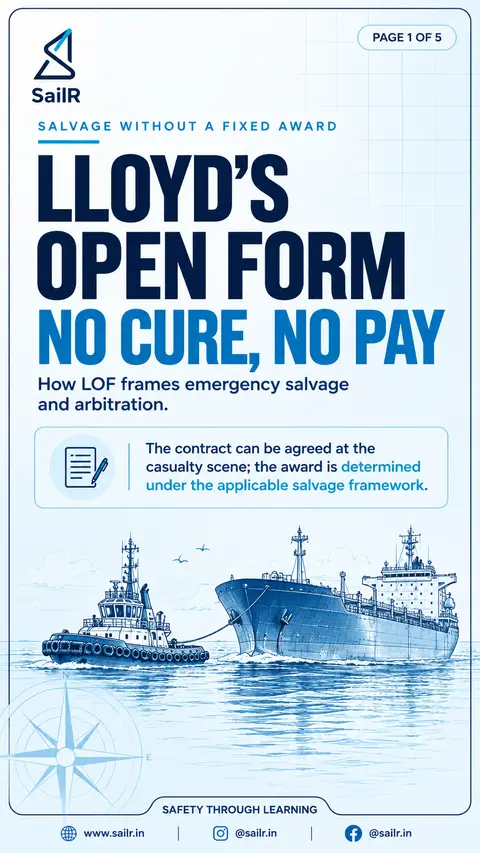
AI-drawn illustration. Simplified to explain the idea, not to scale.
Slide 1 · Lloyd’s Open Form provides a contractual framework for emergency salvage
Lloyd’s Open Form provides a contractual framework for emergency salvage. It allows the parties to establish the terms of salvage assistance without agreeing the final award in advance. The amount of remuneration is determined under the applicable salvage framework.
Slide 2 · Lloyd’s Open Form, also known as LOF, is Lloyd’s Standard Form of Salvage Agreement
Lloyd’s Open Form, also known as LOF, is Lloyd’s Standard Form of Salvage Agreement. It provides a framework for salvage services and the determination of remuneration. The traditional no-cure-no-pay principle links the salvor’s reward to success, subject to applicable legal and contractual provisions.
Slide 3 · SCOPIC is an optional contractual clause that can be incorporated into LOF
SCOPIC is an optional contractual clause that can be incorporated into LOF. It provides a mechanism for special compensation in accordance with its terms. It is associated with the need to encourage salvage operations that prevent or minimise environmental damage when an ordinary salvage award may be insufficient.
Slide 4 · LOF 2000 provided a streamlined contractual structure with procedural provisions in inc…
LOF 2000 provided a streamlined contractual structure with procedural provisions in incorporated documents. Box 7 and Clause C address the incorporation of SCOPIC. The main agreement and the incorporated clauses must be read together to understand the applicable terms.
Slide 5 · LOF 2011 provides for arbitration in London under Clause I and incorporates the applica…
LOF 2011 provides for arbitration in London under Clause I and incorporates the applicable Lloyd’s Standard Salvage and Arbitration Clauses and Procedural Rules. Clause K addresses the authority of the master or other signatory acting as agent for the property owners. The agreement also addresses salvage security through its incorporated provisions.
What it is
Lloyd’s Open Form (LOF) is Lloyd’s Standard Form of Salvage Agreement. It provides a contractual framework for salvage services when property at sea requires assistance. The form establishes the basis on which the salvor undertakes the operation and how remuneration is determined. Lloyd’s Salvage Arbitration Branch administers the form and provides a framework for resolving disputes about salvage awards. (LOF 2011, Clauses A and I; Lloyd’s Open Form official guidance)
The expression “no cure, no pay” describes the traditional principle that a salvor earns a reward when the salvage operation succeeds. This principle is expressly stated in LOF 2011, Clause D, subject to the applicable provisions concerning special compensation and SCOPIC. The contract therefore needs to be read as a whole rather than relying on its headline alone. (LOF 2011, Clause D)
Why it matters
A salvage casualty can require immediate action. LOF provides a standard contractual framework so that the parties can arrange salvage assistance without first agreeing the final amount of the award. The remuneration can subsequently be determined through the applicable arbitration process. This structure helps separate the immediate task of conducting salvage operations from the later assessment of payment. (LOF 2011, Clause I)
The traditional no-cure-no-pay principle has a limitation where environmental protection is concerned. A salvor may work to prevent pollution or minimise environmental damage but fail to save the vessel or cargo. The International Convention on Salvage 1989 addresses this problem by providing for special compensation in qualifying circumstances. The purpose is to recognise relevant salvage efforts where an ordinary salvage reward does not adequately address the circumstances. (International Convention on Salvage 1989, Article 14)
How it works on board
The LOF agreement identifies the salvage contractors, the property to be salved, the agreed place of safety and the relevant signing details. Under Clause A, the contractors undertake to use their best endeavours to salve the property and take it to the agreed place of safety. Clause B also requires the contractors to use their best endeavours to prevent or minimise environmental damage while performing the salvage services. (LOF 2011, Boxes 1–9 and Clauses A–B)
The master or another authorised signatory must understand the authority under which the agreement is signed. Clause K states that the master or other person signing on behalf of the property identified in Box 2 enters into the agreement as agent for the respective owners. The provision also specifies the capacity in which those owners are bound. The signing arrangements should therefore be understood before the agreement is executed. (LOF 2011, Clause K)
The contract also provides for arbitration in London. Under Clause I, remuneration and any special compensation are determined in accordance with the applicable Lloyd’s Standard Salvage and Arbitration Clauses and Procedural Rules. Those provisions form an integral part of the agreement. The incorporated documents must be read with the main LOF form when establishing the applicable procedure. (LOF 2011, Clause I)
The rules
LOF 2011, Clause A:** The contractors undertake to use their best endeavours to salve the property and take it to the agreed place of safety. (LOF 2011, Clause A)
LOF 2011, Clause B:** The contractors must use their best endeavours to prevent or minimise environmental damage during the salvage services. (LOF 2011, Clause B)
LOF 2011, Clause C:** The clause addresses SCOPIC incorporation by reference to Box 7. Its contractual status must be determined from the agreement and the applicable SCOPIC provisions. (LOF 2011, Box 7 and Clause C)
LOF 2011, Clause D:** Salvage services are rendered on a no-cure-no-pay basis, subject to the relevant provisions concerning special compensation and SCOPIC. (LOF 2011, Clause D)
LOF 2011, Clause I:** Remuneration and special compensation are determined by arbitration in London under the incorporated clauses and procedural rules. (LOF 2011, Clause I)
LOF 2011, Clause K:** The clause defines the agency capacity of the master or other person signing on behalf of the property owners. (LOF 2011, Clause K)
LSSA Clauses 2011, Clause 4:** The clause addresses salvage security, including security for claims for special compensation in the circumstances specified by the clause. (LSSA Clauses 2011, Clause 4)
International Convention on Salvage 1989, Article 14:** Special compensation is available in qualifying circumstances when the conditions of the article are satisfied. The article sets out the basis for assessing that compensation and the effect of a salvor’s negligence. (International Convention on Salvage 1989, Article 14)
Common mistakes
One common mistake is treating no cure, no pay as an absolute rule that prevents any compensation whenever property is not saved. LOF 2011, Clause D expressly makes the principle subject to provisions concerning special compensation and SCOPIC. The applicable legal and contractual terms must therefore be considered before drawing a conclusion about payment. (LOF 2011, Clause D; International Convention on Salvage 1989, Article 14)
Another mistake is assuming that SCOPIC automatically forms part of every LOF agreement. LOF 2011, Box 7 and Clause C address whether the clause is incorporated. Incorporation and invocation are separate matters under the contractual wording, so the relevant clause and the applicable SCOPIC provisions must be checked. (LOF 2011, Box 7 and Clause C)
It is also a mistake to treat the main agreement as the only document governing the operation. Clause I incorporates the applicable LSSA Clauses and Procedural Rules for arbitration and related matters. The security provisions are also addressed through the incorporated clauses. Reading the main form without those documents can leave the contractual procedure incomplete. (LOF 2011, Clause I; LSSA Clauses 2011, Clause 4)
Finally, historical versions should not be confused with the current form. Lloyd’s publishes LOF and related arbitration documents, including the LOF 2000 and LOF 2011 archive documents and newer forms. When working with a particular agreement, use the version applicable to that agreement and check its incorporated clauses rather than assuming that an older version states the current procedure. (Lloyd’s Salvage Arbitration Branch, Forms and Documents)
### 3\. Publication notes
Technical accuracy: The article distinguishes the no-cure-no-pay principle from special compensation and SCOPIC.
Historical versions: LOF 2000 and LOF 2011 are treated as historical editions. Lloyd’s currently lists LOF 2024 and newer arbitration documents.
Image-text caution: Page 3 should not imply that SCOPIC automatically pays on top of every salvage award. Its operation depends on the applicable contractual terms.
Final status: The five-page series and its web copy are complete. The separate Indian piracy-measures topic from the original submission has not been included in this article, because it belongs in a different SailR series.
In exams
Asked 36 times across 21 different questions, most recently in 2026. Asked most in Chief Mate (31), MEO Class 1 (5).
Sources
- Lloyd’s, Lloyd’s Open Form LOF
- Lloyd’s, Forms and Documents, including LOF 2000, LOF 2011, LSSA Clauses and SCOPIC documents
- LOF 2011, Clause I, Arbitration and the LSSA Clauses
- LOF 2011, Clause K, Scope of Authority
- LSSA Clauses 2011, including Clause 4 on salvage security
- IMO, International Convention on Salvage 1989, including Article 14 on special compensation
Drafted by SailR from the regulations cited. AI-drawn illustration. Simplified to explain the idea, not to scale. Last updated 27 Oct 2026.
Spotted a mistake?