The slides, written out
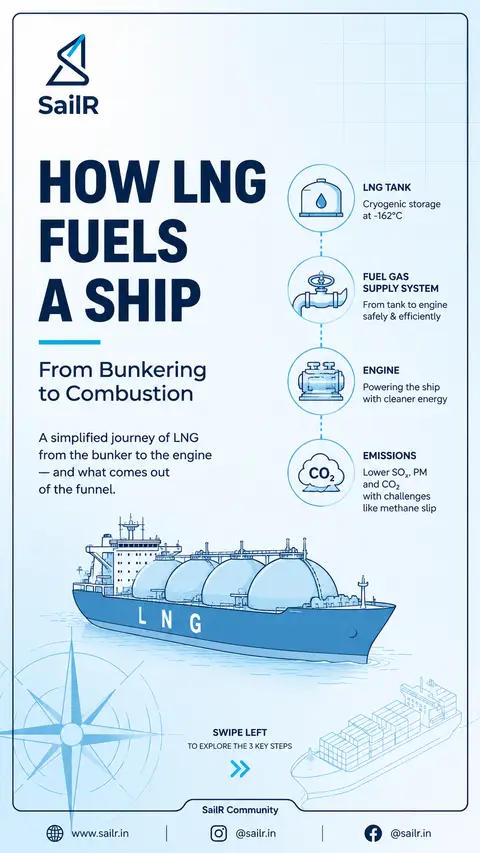
AI-drawn illustration. Simplified to explain the idea, not to scale.
Slide 1 · HOW LNG
HOW LNG
FUELS
A SHIP
From Bunkering
to Combustion
A simplified journey of LNG
from the bunker to the engine
— and what comes out
of the funnel.
LNG
TO EXPLORE THE 3 KEY STEPS
LNG TANK
Cryogenic storage
at -162°C
FUEL GAS
SUPPLY SYSTEM
From tank to engine
safely & efficiently
ENGINE
Powering the ship
with cleaner energy
EMISSIONS
Lower SOx, PM
and CO2
with challenges
like methane slip
Slide 2 · STEP 1
STEP 1
BUNKERING & STORAGE
Receiving LNG safely and keeping it on board
LNG
BUNKERING REQUIREMENTS
Agreed transfer procedure
Emergency shutdown arrangements
Bunkering safety checklist
Communication link established
LNG CHARACTERISTICS
Stored at approximately −162°C
Requires cryogenic materials (e.g., 9% Ni steel, stainless steel 304L)
Ordinary steel may become brittle and fracture
−162°C
CRYOGENIC TEMPERATURE
STORAGE RULE
LNG fuel tanks are generally limited to a maximum filling limit of 98% at reference temperature.
98%
VAPOUR SPACE IS ESSENTIAL
Allows for thermal expansion and boil-off gas (BOG).
OTHER KEY CONSIDERATIONS
Know the density and composition of incoming LNG
Avoid large density differences to prevent rollover
Rollover can cause sudden, massive boil-off and overpressure
ROLLOVER HAZARD
Proper bunkering and storage practices ensure safety, efficiency and environmental compliance.
Slide 3 · STEP 2
STEP 2
FROM TANK
TO ENGINE
The LNG Fuel Gas Supply System
LNG is converted to gas, conditioned
and delivered to the engine safely.
LNG
1 LNG TANK
LNG stored at ~-162°C
and low pressure
(~4–5 bar for Type C)
2 PUMP / PRESSURE
BUILD-UP UNIT
Submerged pump or
pressure build-up
unit pushes LNG
from the tank
3 VAPORISER
Uses engine jacket
water or glycol-water
to warm LNG and
convert it to gas
4 GAS HEATER
Further heating to
bring gas to near
ambient temperature
5 PRESSURE CONTROL VALVE
Reduces gas pressure to
engine inlet requirements
(5–7 bar for LP engines,
300+ bar for HP engines)
6 GAS VALVE TRAIN
Double block-and-bleed valves,
gas detection, interlocks and
safe venting to mast
7 ENGINE
Clean and reliable
fuel for efficient
power generation
GAS VALVE TRAIN
SAFETY FEATURES
DOUBLE BLOCK
& BLEED
Two isolation valves with
a vent in between ensure
safe isolation.
GAS DETECTION
Continuous monitoring
for leaks in gas spaces
and ventilation.
AUTOMATIC
SHUTDOWN
ESD system closes
valves automatically
in an emergency.
SAFE VENTING
ARRANGEMENT
Trapped gas is vented
to a safe location
(vapour mast).
KEY INSIGHT
The gas valve train is
the last line of defence
before fuel enters
the engine.
Proper conditioning, pressure control and safe gas handling
ensure reliable engine performance and operational safety.
Slide 4 · STEP 3
STEP 3
BURNING LNG SAFELY
Combustion, Emissions & Safety
LNG delivers cleaner energy, but responsible use and emission control are essential.
EMISSION BENEFITS
NEAR-ZERO SOx
LNG contains virtually no sulphur.
VERY LOW PARTICULATE MATTER
No asphaltenes or heavy hydrocarbons in LNG.
LOWER CO2 EMISSIONS
LNG produces ~20–25% less CO2 than conventional fuel oil per unit of energy.
THE CHALLENGE: METHANE SLIP
Unburnt methane (CH4) escaping through combustion or venting can reduce overall climate benefits.
Methane has ~27–30 times the global warming potential of CO2 (100-year basis).
ENGINE TECHNOLOGY MATTERS
OTTO-CYCLE (LOW-PRESSURE)
Pre-mixed lean-burn combustion
Lower NOx
Higher methane slip compared to diesel-cycle engines
DIESEL-CYCLE (HIGH-PRESSURE)
Gas injected late in compression stroke
Lower methane slip
Often requires SCR for Tier III NOx compliance
Modern high-pressure dual-fuel engines (eg. MAN ME-GI, WinGD X-DF) achieve very low methane slip with high efficiency.
KEY HAZARDS & CONTROLS
HAZARD | CONTROL MEASURES
Cryogenic Spill: PPE (cryo gloves, face shield) • Spill containment • Insulated & protected piping/tanks
Flammable Gas Cloud: Gas detection in spaces & ventilation returns • ESD system • Automatic shutdown of gas supply
Tank Overpressure: Pressure relief valves • Thermal protection • Do not overfill (98% rule) • Monitor boil-off rate
Rollover (Tank): Manage LNG density & composition • Monitor temperature/density gradients • Avoid mixing vastly different fuel compositions
Leak in Machinery Space: Gas-tight ventilation • Gas detection in ducting & spaces • Regular maintenance & testing
SAFE LNG OPERATIONS DEPEND ON PROPER BUNKERING, GAS HANDLING, PRESSURE MANAGEMENT AND CONTINUOUS MONITORING.
| |
Drafted by SailR from our daily lessons. AI-drawn illustration. Simplified to explain the idea, not to scale. Last updated 19 Oct 2026.
Spotted a mistake?