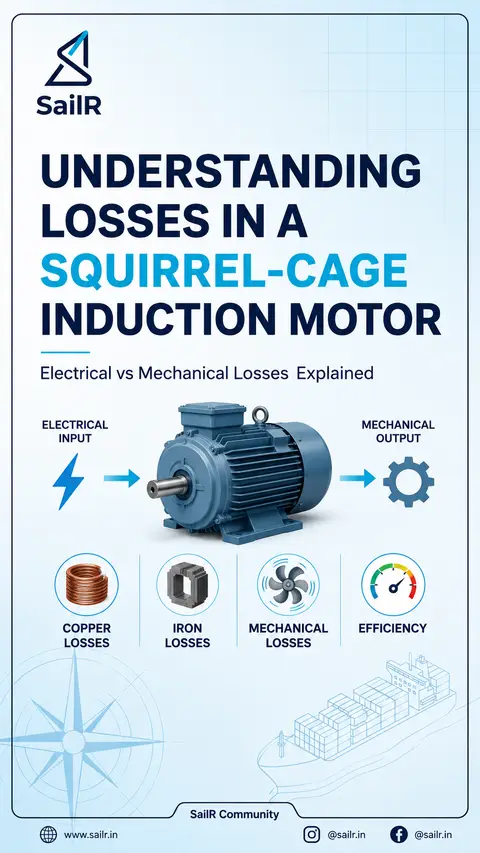
The slides, written out
AI-drawn illustration. Simplified to explain the idea, not to scale.
Slide 1 · UNDERSTANDING
UNDERSTANDING
LOSSES IN A
SQUIRREL-CAGE
INDUCTION MOTOR
Electrical vs Mechanical Losses Explained
ELECTRICAL
INPUT
MECHANICAL
OUTPUT
COPPER
LOSSES
IRON
LOSSES
MECHANICAL
LOSSES
EFFICIENCY
Slide 2 · ELECTRICAL LOSSES (PE)
ELECTRICAL LOSSES (PE)
Electrical losses occur in the stator and rotor due to current flow and core magnetization.
1 COPPER LOSSES (I²R LOSSES)
• Occur in stator windings and rotor cage (bars & end rings).
• Caused by current flow.
• Increase with load.
• Major electrical losses on load.
Formula:
PCu = I²R
Where,
I = Current (A)
R = Resistance (Ω)
STATOR WINDINGS
Stator copper loss
= Is²Rs
ROTOR CAGE
Rotor copper loss
= Ir²Rr
2 IRON (CORE) LOSSES
• Occur in stator and rotor laminations.
• Due to hysteresis and eddy currents.
• Nearly constant on fixed-frequency supply.
• Present whenever the motor is energized.
MAGNETIC FLUX (Φ)
CORE LOSS COMPONENTS
HYSTERESIS LOSS (Ph)
Ph ∝ f B1.6
B
H
EDDY CURRENT LOSS (PE)
Pe ∝ B²f²
On constant voltage & frequency supply, core losses remain nearly constant regardless of load.
Slide 3 · MECHANICAL LOSSES (PM)
MECHANICAL LOSSES (PM)
Mechanical losses arise due to motion, friction, and air resistance.
1 WINDAGE LOSS
Caused by the fan action of the rotor and any external fan.
Due to air resistance.
Approximately proportional to the cube of speed.
Relation:
Pw ∝ N3
Where,
N = Rotational speed (rps)
Higher speed greatly increases windage loss.
2 BEARING FRICTION LOSS
Occurs in bearings due to metal-to-metal contact.
Roughly proportional to speed.
Relation:
Pf ∝ N
Where,
N = Rotational speed (rps)
Only bearing friction applies (no brushes in squirrel-cage rotor).
3 STRAY LOAD LOSSES
Additional losses not captured in other categories.
Due to flux distortion, harmonics, and circulating currents.
Increase with load but are relatively small.
These losses increase with load but are small compared to copper losses.
Slide 4 · LOSS CLASSIFICATION
LOSS CLASSIFICATION
SUMMARY & KEY TAKEAWAYS
Induction motor losses can be grouped based on their dependency on load current and speed.
LOSS TYPE | DEPENDS ON LOAD CURRENT? | DEPENDS ON SPEED? | TYPICAL BEHAVIOUR
COPPER LOSSES (Stator & Rotor) | Yes | Indirectly (through slip) | Increases significantly with load
IRON (CORE) LOSSES (Hysteresis & Eddy Current) | No (approximately constant) | No (approximately constant on fixed V/f) | Present whenever motor is energized; nearly constant on fixed-frequency supply
BEARING FRICTION LOSS (Bearing Friction) | No | Yes (≈ proportional to speed) | Increases approximately linearly with speed
WINDAGE LOSS (Air Resistance) | No | Yes (≈ proportional to speed³) | Increases approximately with the cube of speed
STRAY LOAD LOSSES (Flux Distortion, Harmonics, etc.) | Yes (weakly) | Slightly | Small additional losses; increase with load
KEY TAKEAWAYS
Copper losses increase as current (load) increases.
Core losses remain nearly constant on fixed-frequency supplies.
Mechanical losses depend primarily on rotor speed.
Total losses determine the efficiency and operating cost of the motor.
Higher efficiency means lower operating cost and reduced energy consumption.
Drafted by SailR from our daily lessons. AI-drawn illustration. Simplified to explain the idea, not to scale. Last updated 19 Oct 2026.
Spotted a mistake?