The slides, written out
AI-drawn illustration. Simplified to explain the idea, not to scale.
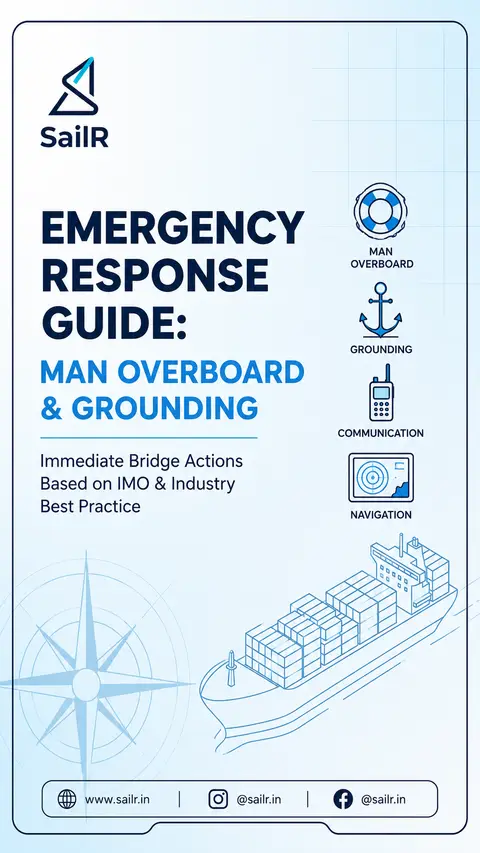
Slide 1 · EMERGENCY
EMERGENCY
RESPONSE
GUIDE:
MAN OVERBOARD
& GROUNDING
Immediate Bridge Actions
Based on IMO & Industry
Best Practice
MAN
OVERBOARD
GROUNDING
COMMUNICATION
NAVIGATION
Slide 2 · MAN OVERBOARD
MAN OVERBOARD
IMMEDIATE ACTIONS
Seconds to minutes that can
save a life.
1 Raise the alarm – "Man Overboard!"
2 Release the MOB lifebuoy with self-igniting
light and smoke close to the casualty.
3 Throw additional buoyant objects
(life rings, danbuoys) to mark the spot.
4 Inform the Master immediately.
5 Maintain continuous visual contact
and post extra lookouts.
6 Press the MOB button on ECDIS/GPS
to mark the position.
7 Commence the appropriate MOB recovery
manoeuvre (Anderson, Williamson or Scharnow
Turn) as per company procedures.
8 Use propulsion as required for safe manoeuvring
while avoiding danger to the casualty.
9 Prepare the rescue boat crew with portable VHF
and a stretcher (if applicable).
10 Transmit the appropriate distress/urgency
communication (MAYDAY or PAN-PAN)
and notify nearby vessels if assistance is required.
11 Update AIS MOB marker (if fitted).
12 Record the incident and complete company
reporting as per SMS requirements.
KEY REFERENCES
IMO
SOLAS
IAMSAR
ICS BRIDGE
PROCEDURES
GUIDE
Slide 3 · GROUNDING
GROUNDING
IMMEDIATE ACTIONS
Act Calm. Assess Quickly. Protect the Ship.
1 Stop propulsion and assess the situation.
Do not attempt astern until the Master's
assessment confirms it is safe.
2 Raise the general alarm.
3 Inform the Master and Chief Engineer immediately.
4 Close watertight doors where appropriate
and as directed.
5 Determine the vessel's position.
Fix, plot and record the time.
6 Sound tanks, bilges and holds to check
for water ingress.
7 Assess hull damage and the extent of grounding.
8 Check for pollution (oil leakage).
Activate SOPEP if required.
9 Take overside soundings where safe
to determine the vessel's position on the seabed.
10 Maintain VHF watch on Ch.16 and transmit the
appropriate message (SECURITÉ, PAN-PAN or
MAYDAY as applicable).
11 Display the correct lights and shapes for
a vessel aground as per COLREG Rule 30.
DAY
NIGHT
12 Record all observations and actions in
the deck logbook and other required records.
NEXT ASSESSMENT PHASE
TIDE & CURRENT EVALUATION
DAMAGE & STABILITY ASSESSMENT
BALLAST / DEBALLAST DECISIONS
REFLOATING PLAN (TUGS / ANCHORS / LIGHTERING)
INFORM OWNERS / DPA & PREPARE GROUNDING REPORT
Slide 4 · EMERGENCY RESPONSE
EMERGENCY RESPONSE
QUICK REFERENCE
Two Critical Situations. One Clear Response.
MAN OVERBOARD (MOB)
VS
GROUNDING
Raise MOB alarm
Raise General Alarm
Mark MOB position
Fix grounding position
Maintain visual contact
Assess hull damage
Deploy lifebuoys
Sound tanks & bilges
Execute recovery manoeuvre
Evaluate refloating options
Prepare rescue boat (if applicable)
Activate SOPEP if required
Appropriate distress / urgency communication (MAYDAY / PAN-PAN as applicable)
Appropriate distress / urgency communication (SECURITÉ / PAN-PAN / MAYDAY as applicable)
Record incident
Record incident
GOLDEN RULE:
PROTECT LIFE • PROTECT THE SHIP • PROTECT THE ENVIRONMENT
Drafted by SailR from our daily lessons. AI-drawn illustration. Simplified to explain the idea, not to scale. Last updated 19 Oct 2026.
Spotted a mistake?