Marine Boiler Feedwater Demand Increasing at Constant Steam Load: Causes and Troubleshooting
- times asked
- 5
- times asked
- questions
- 2
- questions
- last asked
- 2026
- last asked
When boiler make-up water demand rises but steam load remains steady, investigate the water balance before changing the operating settings. Check physical leaks, blowdown, condensate recovery and water chemistry to narrow the cause safely.
The slides, written out
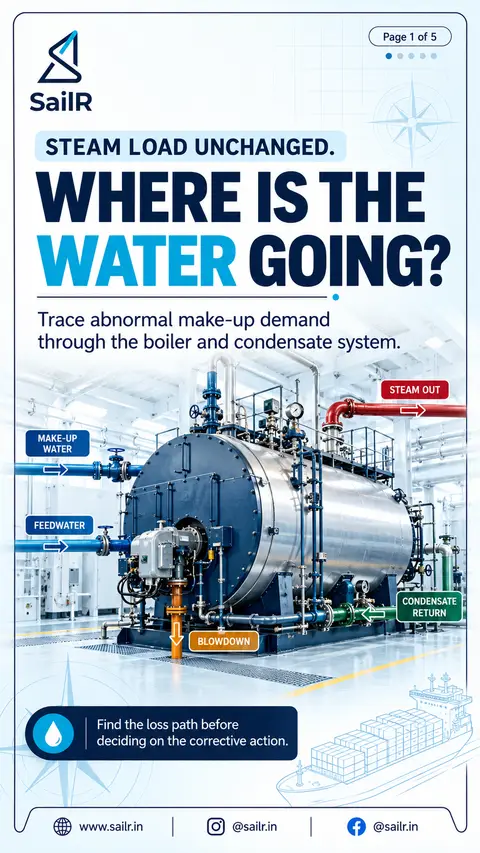
AI-drawn illustration. Simplified to explain the idea, not to scale.
Slide 1 · Rising boiler feedwater demand can indicate a change in water losses or condensate reco…
Rising boiler feedwater demand can indicate a change in water losses or condensate recovery, even when steam load remains unchanged. Trace the water balance through the boiler and condensate system to identify the loss path before deciding on corrective action.
Slide 2 · A rising make-up water requirement with a steady steam load indicates a water-balance d…
A rising make-up water requirement with a steady steam load indicates a water-balance discrepancy that needs investigation. Monitor make-up consumption over time and compare it with actual steam output and operating conditions. Confirm that the increase is genuine before tracing the cause.
Slide 3 · Physical leaks in the boiler or associated equipment can increase make-up water demand
Physical leaks in the boiler or associated equipment can increase make-up water demand. Investigate possible boiler tube leakage, external pipework leaks and passing blowdown valves. Use approved inspection procedures and confirm the source of water loss before planning repairs.
Slide 4 · Unnecessary blowdown increases water and energy losses, while poor condensate recovery…
Unnecessary blowdown increases water and energy losses, while poor condensate recovery increases the requirement for make-up water. Check blowdown valve position and control operation. Investigate steam-line leaks and passing steam traps, and check condensate collection, pumps and return flow.
Slide 5 · Water chemistry results can help identify contamination and explain why additional blow…
Water chemistry results can help identify contamination and explain why additional blowdown may be necessary. Trend chloride and conductivity alongside make-up water and blowdown records. Investigate possible seawater ingress when the results support that concern, and apply the vessel's approved boiler-water treatment limits.
What it is
A rising make-up water requirement is a sign that the boiler system's water balance has changed. If steam load remains steady, the increase deserves investigation rather than an immediate adjustment to feedwater control. Water may be leaving through blowdown, steam or condensate losses, or condensate may no longer be returning at its previous rate. The first task is to establish what has changed in the measured water flows. (U.S. EPA, WaterSense at Work, Section 6.5, Equation 6-7.)
The make-up requirement is closely linked to condensate loss and blowdown. Condensate that is discharged instead of being returned must be replaced, and water discharged during blowdown also requires replacement. This relationship provides the starting point for a structured investigation. It does not, by itself, identify a leaking component or prove that the boiler pressure parts are damaged. (U.S. EPA, WaterSense at Work, Section 6.5, Equation 6-7.)
Why it matters
Returning condensate reduces the amount of make-up water required. Condensate is already hot, so returning it also reduces the energy needed to heat replacement water. Recovering condensate can therefore reduce water use, treatment requirements and energy costs. A deterioration in condensate recovery can increase the make-up demand even when steam production has not increased. (U.S. Department of Energy, Steam Tip Sheet #8, Return Condensate to the Boiler.)
Blowdown serves a different purpose. As water evaporates, dissolved solids remain in the boiler water and become more concentrated. Blowdown removes some of that concentrated water so that solids remain within acceptable operating limits. Excessive blowdown wastes water, energy and treatment chemicals, but reducing it without regard to water chemistry can contribute to deposits or carryover. The aim is correct control, not simply the lowest possible blowdown rate. (U.S. Department of Energy, Steam Tip Sheet #9, Minimize Boiler Blowdown.)
How it works on board
Start by reviewing make-up water records alongside steam output, blowdown records and condensate-return performance. If suitable meters are fitted, use them to compare the water entering the system with the water being returned or discharged. A trend is more informative than a single reading because it helps establish when the change began and whether it persists. (U.S. EPA, WaterSense at Work, Section 6.5, Installing Meters and Control Systems.)
Next, inspect the systems that can account for water loss. Consider physical leaks in accessible pipework and associated equipment, and investigate suspected boiler tube leakage using approved procedures. Check the actual blowdown valve position and control operation rather than relying solely on a log entry. Do not treat a particular sound, plume or temperature change as proof of a tube leak without further evidence. (U.S. Department of Energy, Steam Tip Sheet #9, Minimize Boiler Blowdown.)
Then examine condensate recovery. Check the return system, collection arrangements, pumps and steam traps according to the equipment instructions. Leaks or losses in steam distribution and condensate return can reduce the quantity of water recovered. If condensate return has fallen, the additional make-up requirement may be explained without assuming that the boiler itself has developed a leak. (U.S. Department of Energy, Steam Tip Sheet #8, Return Condensate to the Boiler.)
The rules
Follow the boiler maker's operating instructions and the vessel's approved water-treatment programme.
Keep blowdown within the requirements of the boiler design and water-treatment regime.
Use make-up water and condensate-return measurements where available to monitor water use.
Maintain steam lines and steam traps, and investigate abnormal losses.
Use water chemistry results when evaluating blowdown and make-up water changes.
Do not adopt a universal chemical limit or a fixed diagnostic test duration without the applicable equipment instructions and approved procedures.
These practices follow the water-efficiency and operating guidance in U.S. EPA WaterSense at Work, Section 6.5, and U.S. Department of Energy Steam Tip Sheet #9, Minimize Boiler Blowdown.
Common mistakes
A common mistake is to assume that increased make-up demand proves a boiler tube leak. The same symptom can result from excessive blowdown or a reduction in condensate recovery. The investigation should separate these possibilities using recorded flows, equipment checks and operating history. (U.S. EPA, WaterSense at Work, Section 6.5, Equation 6-7.)
Another mistake is to reduce blowdown simply to lower make-up demand. Blowdown is used to control dissolved and suspended solids, and the appropriate rate depends on boiler and water-treatment conditions. Changes must remain within the approved limits. (U.S. Department of Energy, Steam Tip Sheet #9, Minimize Boiler Blowdown.)
A further mistake is to interpret a chemistry result in isolation. Water chemistry should be assessed alongside operating trends and the vessel's treatment programme. If contamination is suspected, investigate its source rather than relying on additional blowdown alone. Do not assign a specific fault unless the available evidence supports it. (U.S. EPA, WaterSense at Work, Section 6.5, Boiler and Steam Systems.)
In exams
Asked 5 times across 2 different questions, most recently in 2026. Asked most in MEO Class 4 (5).
Sources
- U.S. EPA, WaterSense at Work: Best Management Practices for Commercial and Institutional Facilities, Section 6.5, “Boiler and Steam Systems,” including Equations 6-6 and 6-7. Official PDF
- U.S. Department of Energy, Energy Tips: STEAM, Steam Tip Sheet #8, “Return Condensate to the Boiler.” Official PDF
- U.S. Department of Energy, Energy Tips: STEAM, Steam Tip Sheet #9, “Minimize Boiler Blowdown.” Official PDF
- U.S. EPA, WaterSense at Work, Section 6.5, “Installing Meters and Control Systems.” Section reference
- U.S. Department of Energy, Best Management Practice #8: Steam Boiler Systems. Official guidance
- Drew Marine, Standard Boiler Water Treatment Program, water-testing guidance for chloride and conductivity. Technical data sheet
Drafted by SailR from the regulations cited. AI-drawn illustration. Simplified to explain the idea, not to scale. Last updated 29 Oct 2026.
Spotted a mistake?