The slides, written out
AI-drawn illustration. Simplified to explain the idea, not to scale.
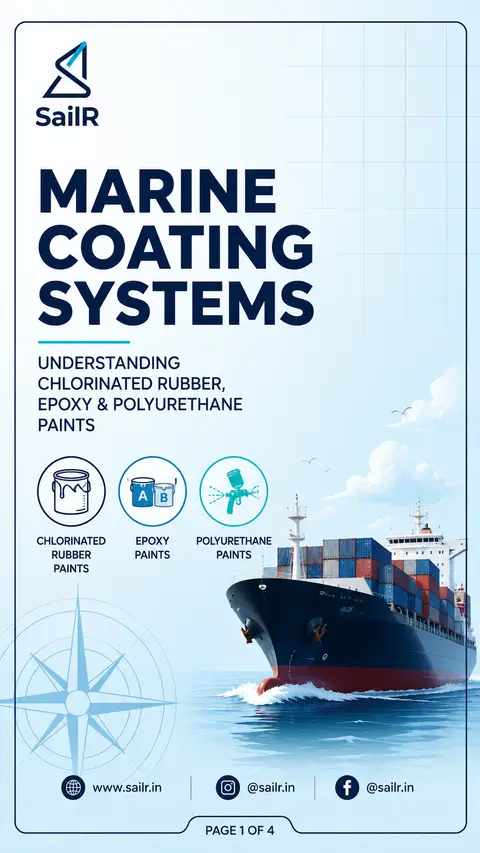
Slide 1 · MARINE
MARINE
COATING
SYSTEMS
UNDERSTANDING
CHLORINATED RUBBER,
EPOXY & POLYURETHANE
PAINTS
CHLORINATED
RUBBER
PAINTS
EPOXY
PAINTS
POLYURETHANE
PAINTS
Slide 2 · CHLORINATED
CHLORINATED
RUBBER
PAINTS
Single-pack (conventional) paints based on
chlorinated rubber as the binder, dissolved
in strong organic solvents. They dry by
physical evaporation of the solvent.
CHLORINATED
RUBBER
PAINT
COMPOSITION
• Single-pack coating
• Chlorinated rubber binder
• Solvent-based system
• Dries by solvent evaporation
ADVANTAGES
✓ Good water resistance
✓ Good chemical resistance
✓ Easy application
LIMITATIONS
✕ High VOC content
✕ Environmental concerns
✕ Largely replaced by
modern systems
TYPICAL APPLICATIONS
• Boot topping
• Topsides
• Older vessels
Their use has declined significantly because traditional chlorinated
rubber coatings are solvent-rich and subject to increasingly stringent
VOC and occupational exposure requirements. Consequently, many
operators have shifted to modern epoxy and polyurethane systems.
Slide 3 · EPOXY
EPOXY
PAINTS
Two-pack (chemically curing) system — a base resin (epoxy) and a hardener (polyamine or polyamide). The two components are mixed just before use. Curing proceeds by chemical reaction, not solvent evaporation.
EPOXY RESIN
EPOXY HARDENER
KEY ADVANTAGES
✓ Excellent adhesion
✓ Outstanding water resistance
✓ High abrasion resistance
✓ Excellent chemical resistance
✓ High mechanical strength
✓ Long-term durability
COMMON APPLICATIONS
Ballast tanks (IMO PSPC-compliant hard coating systems are required. Epoxy is the industry-standard solution used on most vessels.)
Cargo holds (Tough, abrasion-resistant, chemical-resistant.)
Decks & superstructures (High durability & protection.)
Underwater hull areas (Used as primers & intermediates with antifouling topcoats.)
APPLICATION NOTES
• Requires careful surface preparation (clean, dry, often blast-cleaned to Sa 2.5).
• Strict mixing ratios & temperature-sensitive curing.
• Below 10°C: curing slows dramatically.
• Above 35°C: pot life shortens.
Epoxy coatings are the workhorse of modern marine protection, delivering superior performance in the most demanding environments.
Slide 4 · POLYURETHANE
POLYURETHANE
PAINTS
Two-pack system — a polyol resin base
reacts with an isocyanate hardener. Curing
is chemical, producing a tough, flexible,
highly glossy film. They can be aliphatic
(UV-stable, for exterior use) or aromatic
(less UV-resistant, used in less exposed
areas).
POLYURETHANE
BASE (POLYOL)
HARDENER
(ISOCYANATE)
KEY ADVANTAGES
Excellent gloss retention
Superior colour & UV stability
Outstanding abrasion resistance
High chemical resistance
Long service life
TYPICAL APPLICATIONS
Superstructures &
accommodation exteriors
(High gloss & colour retention.)
Decks & weather-exposed areas
(Excellent abrasion &
chemical resistance.)
Helidecks & marking areas
(Where slip resistance &
colour contrast are critical.)
IMPORTANT NOTES
Higher cost compared to
conventional paints.
Sensitive to moisture during curing
(isocyanates react with water).
Isocyanate vapours are hazardous –
strict ventilation & breathing
protection required.
QUICK COMPARISON
PAINT TYPE | DRYING / CURING | KEY STRENGTH | TYPICAL USE
CHLORINATED
RUBBER PAINTS | Solvent Evaporation | Good chemical &
water resistance | Older tonnage,
boot topping,
topsides
EPOXY PAINTS | Chemical Cure
(2-Pack) | Tough, excellent chemical
& water resistance | Ballast tanks, cargo
holds, primers,
underwater areas
POLYURETHANE
PAINTS | Chemical Cure
(2-Pack) | UV-stable, high gloss
& colour retention | Superstructure
topcoats, decks,
helidecks
SAILR TAKEAWAY
Epoxy
protects.
Polyurethane
preserves
appearance.
Chlorinated rubber
is largely a legacy
system.
Drafted by SailR from our daily lessons. AI-drawn illustration. Simplified to explain the idea, not to scale. Last updated 19 Oct 2026.
Spotted a mistake?