The slides, written out
AI-drawn illustration. Simplified to explain the idea, not to scale.
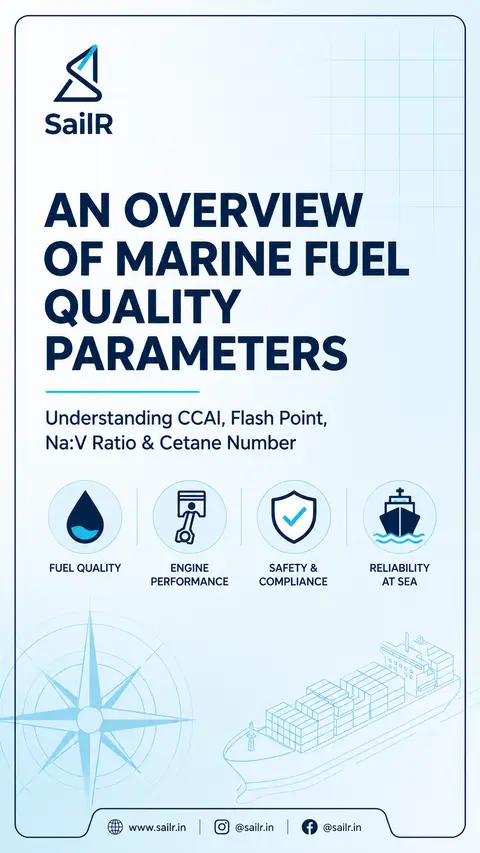
Slide 1 · AN OVERVIEW
AN OVERVIEW
OF MARINE FUEL
QUALITY
PARAMETERS
Understanding CCAI, Flash Point,
Na:V Ratio & Cetane Number
FUEL QUALITY
ENGINE
PERFORMANCE
SAFETY &
COMPLIANCE
RELIABILITY
AT SEA
Slide 2 · CCAI
CCAI
(CALCULATED CARBON
AROMATICITY INDEX)
An indicator of ignition quality for
residual fuels.
Derived from
density & viscosity
WHAT IT
INDICATES
Empirical value calculated
from density and
kinematic viscosity
Estimates the ignition
quality of a residual fuel
HIGHER CCAI
MEANS
Longer ignition delay
More fuel injected before
combustion starts
Harder combustion with
steeper pressure rise
Increased thermal and
mechanical loading
OPERATIONAL
ACTION
Monitor combustion
performance
Follow engine-maker
guidance
Review injection timing
or fuel-quality lever
settings if required
BETTER
IGNITION QUALITY
POORER
IGNITION QUALITY
LOWER CCAI
HIGHER CCAI
ISO 8217 LIMITS
Typical range: 850 – 870
ISO 8217 specifies maximum CCAI values depending on the
residual fuel grade, commonly ranging between 850 and 870.
Fuels approaching the applicable grade limit may require
closer operational attention.
Slide 3 · OPEN VS CLOSED
OPEN VS CLOSED
FLASH POINT
Measures the temperature at which fuel vapours
ignite momentarily in the presence of an external flame.
CLOSED CUP
Fuel is heated in a closed container
Vapours are retained
Generally lower than open-cup
flash point
Regulatory value for marine fuels
SOLAS minimum closed-cup
flash point = 60°C
OPEN CUP
Fuel is heated in an open container
Vapours exposed to atmosphere
Generally higher than closed-cup
flash point
Operational safety reference
Important for hot work, tank
cleaning and entry operations
KEY TAKEAWAY
Closed-cup flash point is the regulatory standard for bunkering
and storage. Open-cup flash point is used for operational
safety and hot work considerations.
Slide 4 · SODIUM & VANADIUM
SODIUM & VANADIUM
RATIO & CETANE NUMBER
Key fuel quality factors that impact engine durability
and combustion performance.
SODIUM & VANADIUM (Na:V RATIO)
CETANE NUMBER
(For Distillate Fuels)
WHAT HAPPENS?
Sodium contamination can react with
vanadium compounds to form
low-melting sodium vanadates.
These molten compounds increase
the risk of high-temperature
corrosion.
Corrosion severity depends on both
sodium and vanadium levels and
their interaction within ash deposits.
AFFECTED COMPONENTS
Exhaust valves
Turbocharger nozzle rings
Other hot-gas-path surfaces
WHAT IT MEASURES
Ignition quality of distillate fuels
(e.g., MDO, MGO).
HIGHER CETANE
Shorter ignition delay
Smoother combustion
Better engine performance
LOWER CETANE
Longer ignition delay
Rough running
Higher thermal loading
REMEMBER
CCAI is used mainly for residual fuels.
Cetane Number is used for distillate fuels.
Drafted by SailR from our daily lessons. AI-drawn illustration. Simplified to explain the idea, not to scale. Last updated 19 Oct 2026.
Spotted a mistake?