The slides, written out
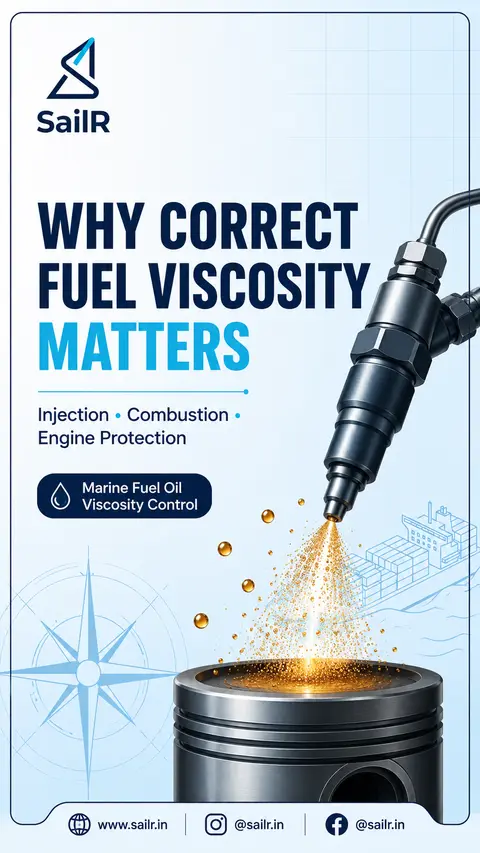
AI-drawn illustration. Simplified to explain the idea, not to scale.
Slide 1 · WHY CORRECT
WHY CORRECT
FUEL VISCOSITY
MATTERS
Injection • Combustion • Engine Protection
Marine Fuel Oil Viscosity Control
Slide 2 · WHY CORRECT
WHY CORRECT
FUEL VISCOSITY
IS ESSENTIAL
Viscosity is the key to efficient combustion
and engine protection.
PROPER VISCOSITY
✔ Fine atomisation
✔ Efficient combustion
✔ Lower emissions
✔ Cleaner engine
TOO HIGH VISCOSITY
• Coarse droplets
• Poor atomisation
• Incomplete combustion
• Carbon deposits on piston, rings & valves
• Higher exhaust temperatures
TOO LOW VISCOSITY
• Poor pump sealing & lubrication
• Nozzle dribble & poor performance
• Reduced atomisation & combustion efficiency
• Increased wear & component damage
FUEL SYSTEM EFFECTS
• Higher pressure drop across filters & heaters
• Increased heater loading
• Risk of fuel starvation at high loads
VISCOSITY SCALE
TOO HIGH
OPTIMUM RANGE (Engine Manufacturer's Specification)
TOO LOW
Poor atomisation Deposits • Overheating High wear
Efficient combustion Lower emissions • Reliable operation Longer engine life
Pump leakage Poor lubrication Increased wear
Slide 3 · HOW MARINE VISCOSITY
HOW MARINE VISCOSITY
IS MEASURED
Two common measurement principles used in
marine fuel viscosity control systems.
1
CAPILLARY DIFFERENTIAL
PRESSURE METHOD
2
MODERN INLINE
VISCOMETER METHOD
A constant flow of fuel passes through a
capillary tube. The pressure drop across
the capillary is proportional to viscosity.
An inline viscometer continuously measures
viscosity using a vibrating-element sensor
or oscillating technology.
FUEL IN
FUEL IN
GEAR PUMP
(Constant
Flow)
INLINE
VISCOSITY
SENSOR
(Vibrating Element
/ Oscillating
Technology)
CAPILLARY
TUBE
(Fixed length
& bore)
CONTROLLER
(PI Control)
DIFFERENTIAL
PRESSURE
TRANSMITTER
(ΔP ∝ Viscosity)
CONTROLLER
(PI Control)
CONTROLLER
(PI Control)
STEAM
CONTROL VALVE
(to Fuel Heater)
STEAM
CONTROL VALVE
(to Fuel Heater)
KEY PRINCIPLE
Pressure drop across the capillary tube
is directly proportional to viscosity
(Hagen–Poiseuille law).
KEY HIGHLIGHTS
Continuous real-time measurement
High accuracy & repeatability
4–20 mA output (Standard)
Digital communication options
(Modbus, etc.)
Low maintenance & no capillary cleaning
BOTH METHODS PROVIDE
A signal proportional to fuel viscosity, which is used by the controller
to maintain the set viscosity by adjusting the heater steam valve.
Slide 4 · VISCOSITY CONTROL ACTION
VISCOSITY CONTROL ACTION
WITH PI CONTROL
A viscosity controller maintains the fuel at the engine manufacturer's recommended viscosity for optimum combustion and engine protection.
1 VISCOSITY MEASUREMENT (Viscometer)
12.5 cSt
2 CONTROLLER (PI) Compares with setpoint
SETPOINT 12.5 cSt
FEEDBACK
3 STEAM CONTROL VALVE Modulates steam flow to heater
STEAM IN
4 FUEL HEATER Heats the fuel to achieve target viscosity
HOT FUEL OUT
5 CORRECT FUEL VISCOSITY Maintained at set value
6 ENGINE Proper atomisation, efficient combustion, protection & performance
WHY PI CONTROL?
FAST RESPONSE Proportional action quickly corrects viscosity deviations.
ZERO STEADY-STATE ERROR Integral (reset) action removes offset and brings viscosity exactly to setpoint.
STABLE & RELIABLE Maintains stable viscosity despite load, fuel change or temperature variations.
MATCHES THERMAL DYNAMICS Integral time is tuned to the heater's thermal response for smooth control.
PROTECTS EQUIPMENT Prevents low/high viscosity conditions that cause wear, deposits and poor combustion.
NOTE Derivative action is generally not used as the process is slow and derivative amplifies measurement noise.
BEST PRACTICE
Maintain fuel viscosity at the engine manufacturer's recommended value to achieve:
Efficient atomisation
Reduced wear & tear
Stable combustion
Better fuel economy
Lower maintenance costs
SAFETY & LIMITS
HIGH TEMPERATURE LIMIT A high temperature override limits the maximum fuel temperature based on fuel grade, heater design and engine manufacturer's recommendations.
ALARM & PROTECTION High/low viscosity alarms ensure timely action and prevent equipment damage or combustion issues.
RIGHT VISCOSITY. RIGHT TEMPERATURE. RIGHT PERFORMANCE.
THE FOUNDATION OF RELIABLE MARINE OPERATIONS.
Drafted by SailR from our daily lessons. AI-drawn illustration. Simplified to explain the idea, not to scale. Last updated 19 Oct 2026.
Spotted a mistake?