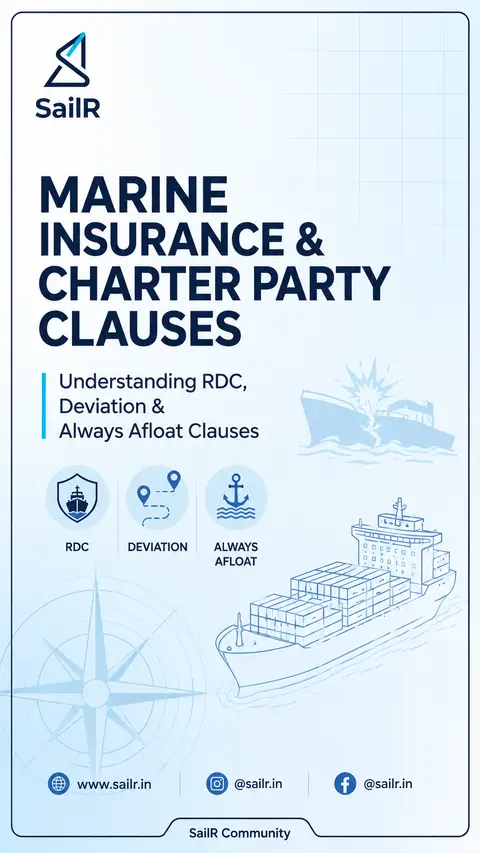
The slides, written out
AI-drawn illustration. Simplified to explain the idea, not to scale.
Slide 1 · MARINE
MARINE
INSURANCE &
CHARTER PARTY
CLAUSES
Understanding RDC,
Deviation &
Always Afloat Clauses
RDC
DEVIATION
ALWAYS
AFLOAT
Slide 2 · 3/4th COLLISION LIABILITY
3/4th COLLISION LIABILITY
(RUNNING DOWN CLAUSE – RDC)
The Institute Time Clauses (Hulls) include the Running Down Clause (RDC), covering three-fourths of the collision liability for damage to another vessel and her cargo/property.
75%
COVERED BY HULL INSURERS
Traditional ITC Hulls indemnify 3/4 of qualifying collision liability.
25%
TYPICALLY RECOVERABLE VIA P&I CLUB
The remaining 1/4 falls outside the traditional RDC indemnity and is commonly covered by the vessel's P&I Club, subject to Club Rules.
COVERS
Collision liability to another vessel
Damage to the other ship
Damage to her cargo and property
Crew's effects on the other vessel
KEY EXCLUSIONS
Removal or disposal of wrecks, obstructions or cargoes
Property on the insured vessel
Cargo or property of the insured
Loss of life, personal injury or illness
Pollution or contamination
RDC focuses on third-party property damage arising from collision incidents.
Slide 3 · DEVIATION CLAUSE
DEVIATION CLAUSE
A deviation is a departure from the agreed route.
Certain deviations are permitted; unreasonable
deviations may carry serious consequences.
ALLOWED DEVIATIONS
Saving life or property
at sea
Avoiding severe
weather
Emergency operational
safety
Medical evacuation
or assistance
AGREED
ROUTE
DEVIATION
LEGAL REFERENCE
Article IV Rule 4,
Hague-Visby Rules:
"Any deviation in saving or attempting
to save life or property at sea, or any
reasonable deviation shall not be
deemed to be an infringement or
breach of the contract of carriage..."
IMPORTANT
An unreasonable deviation may
expose the carrier to loss of
contractual protections or liability
limitations, depending on the
applicable law and jurisdiction.
SAILR TIP
Always inform the charterer in advance if a deviation becomes
necessary. Document the reason and obtain written agreement or
acknowledgement wherever possible.
Slide 4 · ALWAYS AFLOAT CLAUSE
ALWAYS AFLOAT CLAUSE
This clause requires the vessel to be employed only at ports,
berths or anchorages where she can remain safely afloat
at all stages of the tide.
SAFE BERTH
Vessel remains afloat
at all tidal stages
UNSAFE BERTH
Risk of grounding
during low tide
No risk of grounding
Potential damage and delay
CORE PRINCIPLE
Charterers must nominate ports, berths, and anchorages
where the vessel can remain safely afloat.
MASTER'S
PROTECTION
Right to question
unsafe berth orders
Request written
assurances where
required
Document concerns
before entering
restricted berths
PRACTICAL
EXAMPLE
A bulk carrier ordered
to a tidal river berth may
request written confirmation
of berth suitability before
proceeding.
KEY
TAKEAWAY
The clause helps allocate
risk associated with
unsafe berth nominations
and protects vessel
safety, hull integrity and
operational efficiency.
IMPORTANT
Never rely on verbal assurances. Get written confirmation
from the charterer when berth safety is uncertain.
Drafted by SailR from our daily lessons. AI-drawn illustration. Simplified to explain the idea, not to scale. Last updated 19 Oct 2026.
Spotted a mistake?