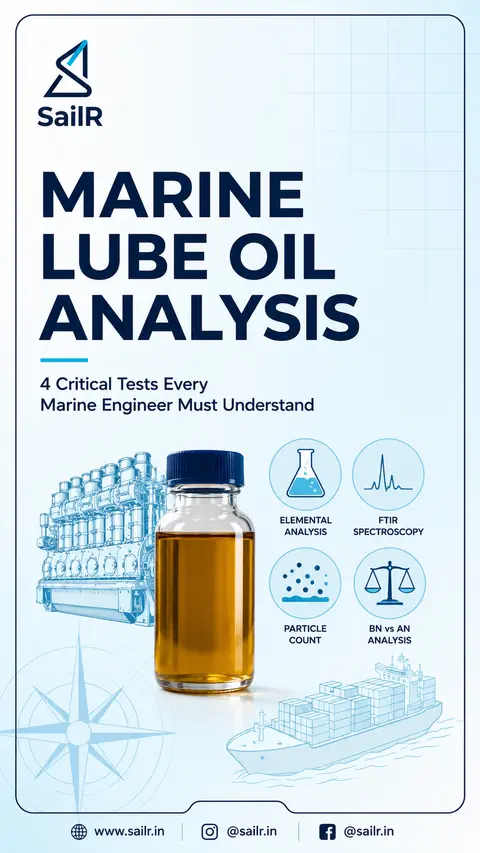
The slides, written out
AI-drawn illustration. Simplified to explain the idea, not to scale.
Slide 1 · MARINE
MARINE
LUBE OIL
ANALYSIS
4 Critical Tests Every
Marine Engineer Must Understand
ELEMENTAL
ANALYSIS
FTIR
SPECTROSCOPY
PARTICLE
COUNT
BN vs AN
ANALYSIS
Slide 2 · A) ELEMENTAL (SPECTROMETRIC) ANALYSIS
A) ELEMENTAL (SPECTROMETRIC) ANALYSIS
(ICP / AES)
Fe
Iron (Fe): From cylinder liners, piston rings, gears, shafts — general ferrous wear.
Cu Sn Pb
Copper (Cu), Tin (Sn), Lead (Pb): May indicate bearing distress or white-metal wear. Confirm through trends and inspection.
Si
Silicon (Si): Ingress of dirt or dust from air intake — air filter or intake leakage.
V Ni
Vanadium (V) & Nickel (Ni): Primary indicators of residual fuel contamination and fuel ash.
Na
Sodium (Na): Interpret alongside water-content, cooling-water indicators, and operating conditions — may indicate seawater ingress, cooling-water contamination, or fuel contamination.
Zn P Ca Mg
Zinc (Zn), Phosphorus (P), Calcium (Ca), Magnesium (Mg): Additive elements from lube oil. A drop indicates additive depletion.
Measures the concentration of elements in oil reported in parts per million (ppm).
ENGINEER'S ACTION:
Investigate the source, trend the results, and inspect equipment as needed.
B) FOURIER TRANSFORM INFRARED (FTIR) SPECTROSCOPY
Infrared light is passed through an oil sample to detect chemical changes and contaminants.
Oxidation: Carbonyl absorption near 1700–1750 cm⁻¹ indicates oil oxidation.
Nitration: Absorption around 1600–1650 cm⁻¹ indicates reaction with combustion by-products.
Water Contamination: Broad absorption near 3400 cm⁻¹ indicates water in the oil.
Fuel Dilution: Fuel pattern in the spectrum indicates diesel contamination.
Sulfation / TBN Depletion: Indicates consumption of alkaline additives (overbased Ca/Mg).
ENGINEER'S ACTION:
Investigate degradation source, confirm viscosity impact, and take corrective action (repair, purify, or oil change).
| |
Slide 3 · C) PARTICLE COUNT
C) PARTICLE COUNT
ISO 4406 CLEANLINESS MONITORING
WHAT IT MEASURES
Counts particles in three size ranges:
> 4 µm (count/ml)
> 6 µm (count/ml)
> 14 µm (count/ml)
PARTICLE COUNTER 20/18/16
Direct measurement of the number of particles in oil by size range (ISO 4406 codes).
EXAMPLE ISO CODE
20 / 18 / 16
>4µm / >6µm / >14µm
particles per millilitre of oil
WHAT RISING COUNTS MEAN
Abnormal Wear
Sharp rise in coarse particles (>14 µm) indicates components are wearing.
Dirt Ingress
Contamination entering through air, seals, or handling.
Filter Inefficiency
High counts may indicate blocked filters or bypass operation.
Purifier Performance Issues
Ineffective separation or wrong temperature reduces oil cleanliness.
ENGINEER'S RESPONSE
Check filter differential pressure (full-flow & bypass filters).
Verify purifier / separator operation and temperature as per maker's recommendation.
Review trend over multiple samples, not just a single result.
Compare with OEM and lubricant-supplier cleanliness targets.
KEY MESSAGE
PARTICLE COUNT tells you HOW MUCH contamination exists. ELEMENTAL ANALYSIS helps identify WHAT is causing it.
| |
Slide 4 · D) BASE NUMBER (BN) vs ACID NUMBER (AN)
D) BASE NUMBER (BN) vs ACID NUMBER (AN)
THE HEALTH CHECK OF MARINE LUBRICANTS
BASE NUMBER (BN)
ACID NUMBER (AN)
MEASURES:
Alkaline reserve
(ability to neutralise
combustion acids)
MEASURES:
Total acidic content
(from combustion
& oil oxidation)
TYPICAL RANGES
Cylinder Oil (fresh): 70 – 100 mg KOH/g
System Oil (fresh): 5 – 15 mg KOH/g
System Oil (used): Drop of 2 – 3 points from fresh is normal
INCREASE INDICATES:
Combustion acids
Oxidation
Contamination
Oil degradation
For cylinder oil, BN should be near zero in the scavenge space – it means the oil is working.
Rising AN is a warning signal. Follow OEM limits and trend consistently.
BN vs AN – THE ALKALINE RESERVE
THE KEY PARAMETER:
BN - AN
(Alkaline Reserve)
A narrowing margin between BN and AN may indicate:
Depletion of alkaline reserve
Increasing oil degradation
Need for closer monitoring
ENGINEER'S RESPONSE
BN TOO LOW?
• Cylinder Oil: Increase feed rate.
• System Oil: Add high-BN make-up oil or change the charge.
AN TOO HIGH?
Oil is corrosive – change the oil. Check for oxidation (FTIR) and other contamination sources.
TREND IS EVERYTHING.
Two or more consecutive samples showing BN falling & AN rising is a RED ALERT.
DO NOT DELAY.
Do not pump acidified oil in the purifier and hope it gets better. Chemistry is spent – change the oil.
FINAL TAKEAWAY
NEVER RELY ON A SINGLE TEST.
COMBINE THESE 4 CRITICAL TESTS FOR A COMPLETE PICTURE OF ENGINE HEALTH:
ELEMENTAL ANALYSIS
+
FTIR SPECTROSCOPY
+
PARTICLE COUNT
+
BN & AN TRENDS
BETTER DATA. BETTER DECISIONS. SAFER VOYAGES.
Drafted by SailR from our daily lessons. AI-drawn illustration. Simplified to explain the idea, not to scale. Last updated 19 Oct 2026.
Spotted a mistake?