The slides, written out
AI-drawn illustration. Simplified to explain the idea, not to scale.
Slide 1 · CHLORINATED RUBBER
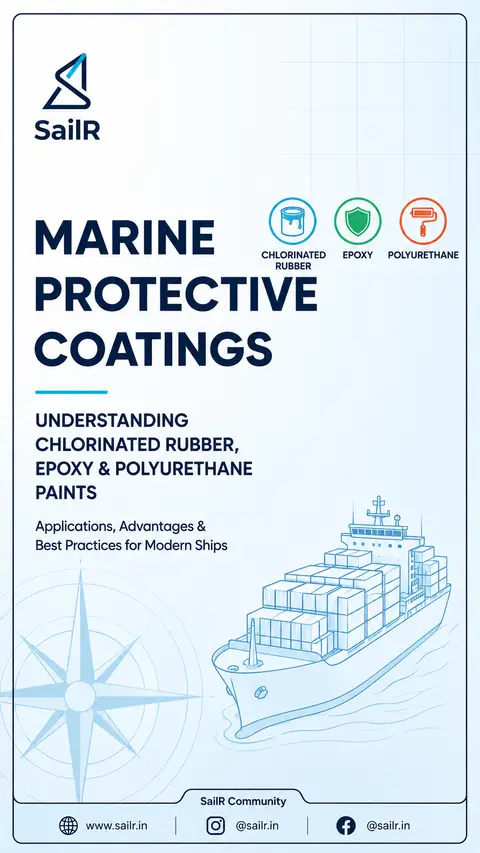
CHLORINATED RUBBER
EPOXY
POLYURETHANE
MARINE PROTECTIVE COATINGS
UNDERSTANDING CHLORINATED RUBBER, EPOXY & POLYURETHANE PAINTS
Applications, Advantages & Best Practices for Modern Ships
Slide 2 · CHLORINATED
CHLORINATED
RUBBER PAINTS
Single-pack • Physically Drying
CHLORINATED
RUBBER
PAINT
COMPOSITION
Binder: Chlorinated rubber resin
Pigments & Additives: Often include corrosion-inhibiting pigments like zinc phosphate
Solvents: High VOC aromatic solvents – xylene, toluene, etc.
Their use has declined because of high VOC emissions and increasingly stringent environmental regulations, although they remain in maintenance service on many existing vessels.
USES
Decks
Superstructure
Boot-topping
Above-water Hull
ADVANTAGES
Quick drying
Easy maintenance
Simple application
Fast overcoating
LIMITATIONS
High VOC emissions
Strong solvent odour
Strict ventilation requirements
Environmental restrictions
Gradually replaced by modern low-VOC systems
Slide 3 · EPOXY
EPOXY
PAINT SYSTEMS
EPOXY BASE
HARDENER
Two-pack • Chemically Curing
COMPOSITION
Base: Epoxy resin
Hardener: Amine or polyamide compounds
Pigments & Additives: Corrosion inhibitors (zinc phosphate, glass flakes, micaceous iron oxide)
Solvents: Used to adjust viscosity – high-solids and solvent-free epoxies are widely used today
WHY SHIPS USE EPOXY
Excellent corrosion protection
High abrasion resistance
Outstanding seawater resistance
Good chemical resistance
Long service life with low maintenance
TYPICAL APPLICATIONS
Ballast tanks
IMO PSPC requires a qualified hard coating system. Light-coloured epoxy-based systems are widely used to comply with PSPC.
Hull exteriors
Used as primer and tie-coat under antifouling systems
Cargo holds
Excellent protection in dry cargo environments
Deck areas
High durability for exposed deck surfaces
Chemical tanks
Phenolic epoxy systems provide excellent chemical resistance
IMO NOTE: IMO PSPC (Performance Standard for Protective Coatings) requires qualified hard coating systems for ballast tanks. Light-coloured epoxy-based coating systems are widely used in the industry to meet these requirements.
Slide 4 · POLYURETHANE
POLYURETHANE
TOPCOATS
Two-pack • UV-Resistant Finish
COMPOSITION
Base: Polyester or acrylic polyol resin
Hardener: Aliphatic isocyanate
Pigments: Often include mica or aluminium flakes for decorative and anti-corrosion performance
APPLICATIONS
Superstructure
Provides long-lasting colour and gloss retention
Accommodation Block
Excellent UV resistance and weather durability
Funnel, Mast & Decks
Maintains appearance and protects against harsh marine environment
Lifeboats & High-Visibility Areas
Ideal for aesthetic and identification purposes
Helideck Markings
Provides durable, UV-stable finish for markings
BENEFITS
Superior gloss retention
Excellent UV resistance
Outstanding colour stability
High durability
Premium cosmetic finish
Easy to clean and maintain
SAFETY FIRST
During spray application, follow the coating manufacturer's SDS and applicable safety regulations. Appropriate respiratory protection—often an air-supplied respirator—is required when spraying isocyanate-containing coatings. Moisture contamination during curing can react with isocyanates and may cause defects such as bubbling, blistering or poor film formation.
TYPICAL MARINE COATING SYSTEM
STEEL
Proper surface preparation
EPOXY PRIMER
Corrosion protection & adhesion
EPOXY INTERIMEDIATE
Builds film thickness & enhances durability
POLYURETHANE FINISH COAT
UV protection, colour & gloss retention
Drafted by SailR from our daily lessons. AI-drawn illustration. Simplified to explain the idea, not to scale. Last updated 19 Oct 2026.
Spotted a mistake?