The slides, written out
AI-drawn illustration. Simplified to explain the idea, not to scale.
Slide 1 · MARINE
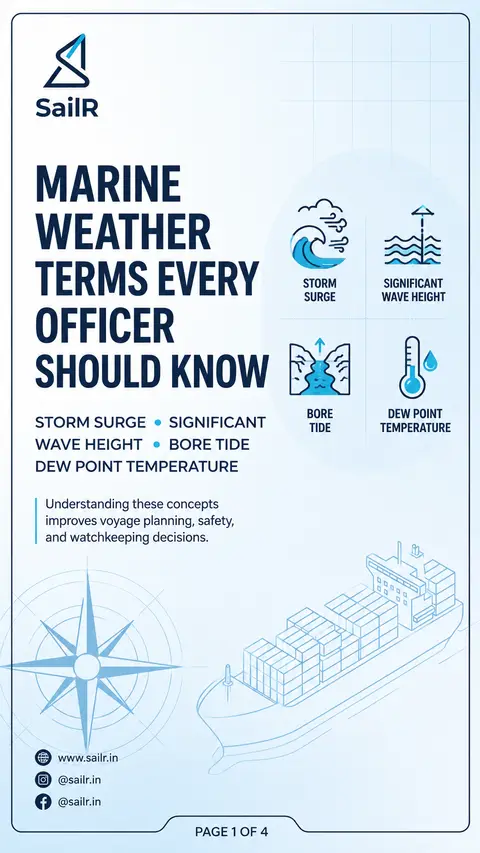
MARINE
WEATHER
TERMS EVERY
OFFICER
SHOULD KNOW
STORM SURGE • SIGNIFICANT
WAVE HEIGHT • BORE TIDE
DEW POINT TEMPERATURE
Understanding these concepts
improves voyage planning, safety,
and watchkeeping decisions.
STORM
SURGE
SIGNIFICANT
WAVE HEIGHT
BORE
TIDE
DEW POINT
TEMPERATURE
Slide 2 · A) STORM SURGE
A) STORM SURGE
DEFINITION
An abnormal rise of sea level generated by a storm, caused mainly by strong winds and low atmospheric pressure.
KEY FACT
Approximate sea-level rise: 1 cm for every 1 hPa pressure drop.
OPERATIONAL IMPACT
• Coastal flooding
• Unsafe anchorages
• Port approach hazards
OFFICER'S FOCUS
Monitor:
• Storm track
• Landfall position
• Predicted surge levels
HOW STORM SURGE FORMS
STRONG WINDS PUSH WATER TOWARDS COAST
LOW PRESSURE (SEA LEVEL RISE)
Wind piles water up against the coast and low pressure allows sea level to rise further.
B) SIGNIFICANT WAVE HEIGHT (Hs)
DEFINITION
Average height of the highest one-third of waves in a sea state.
WHY IT MATTERS
This is the standard wave parameter used in marine forecasts.
OPERATIONAL IMPACT
• Cargo securing
• Ballast planning
• Ship handling decisions
OFFICER'S FOCUS
Always assess vessel response against forecast Hs.
WHAT Hs MEANS
HIGHEST ONE-THIRD OF WAVES
MEAN SEA LEVEL
Individual waves may exceed the significant wave height, with occasional waves substantially larger than Hs.
Slide 3 · C) BORE TIDE
C) BORE TIDE
DEFINITION
A tidal wave travelling upstream against the river current when tidal flow is funneled into a narrowing estuary or river.
COMMON LOCATIONS
• Severn Estuary (UK)
• Hooghly River (India)
• Qiantang River (China)
OPERATIONAL HAZARDS
• Sudden yawing at anchor
• Chain snatch loads
• Strong local currents
OFFICER'S FOCUS
✓ Warn bridge team
✓ Monitor anchor position
✓ Plan river transit timing carefully
HOW A TIDAL BORE FORMS
TIDE COMES IN FROM SEA
BORE FRONT
BORE RUSHES UPSTREAM AGAINST THE RIVER CURRENT
The leading edge may appear as a steep breaking wave or series of waves, with height depending on local tidal range and channel geometry.
Slide 4 · D) DEW POINT TEMPERATURE
D) DEW POINT TEMPERATURE
DEFINITION
The temperature to which air must be cooled, at constant pressure and constant water vapour content, for saturation to occur.
WHY OFFICERS MONITOR IT
Condensation begins when air reaches its dew point.
• Fog forms
• Dew forms
• Relative humidity reaches 100%
FOG RISK INDICATORS
Fog risk increases when:
• Air temperature ≈ Dew point
• Difference reduces to 1–2°C
• Difference is falling
RULE OF THUMB
If the sea surface temperature is below the dew point of the overlying air, advection fog is likely to develop if other meteorological conditions are favourable.
HOW DEW POINT AFFECTS FOG
WARM, MOIST AIR
COOLER SEA SURFACE
AIR COOLS TO DEW POINT
CONDENSATION & FOG FORMATION
Moist air moving over a cooler sea surface cools to its dew point, causing tiny water droplets to form – reducing visibility and creating sea fog.
OFFICER'S PRACTICAL APPLICATION
MONITOR
Dry bulb temperature (air temp.)
Wet bulb temperature
Dew point spread
ASSESS
Track decreasing spread between air temp. and dew point.
ACT EARLY
Be ready for fog signals, reduced speed, and extra lookout measures.
Good seamanship starts with understanding the weather before it becomes a hazard.
Drafted by SailR from our daily lessons. AI-drawn illustration. Simplified to explain the idea, not to scale. Last updated 19 Oct 2026.
Spotted a mistake?