The slides, written out
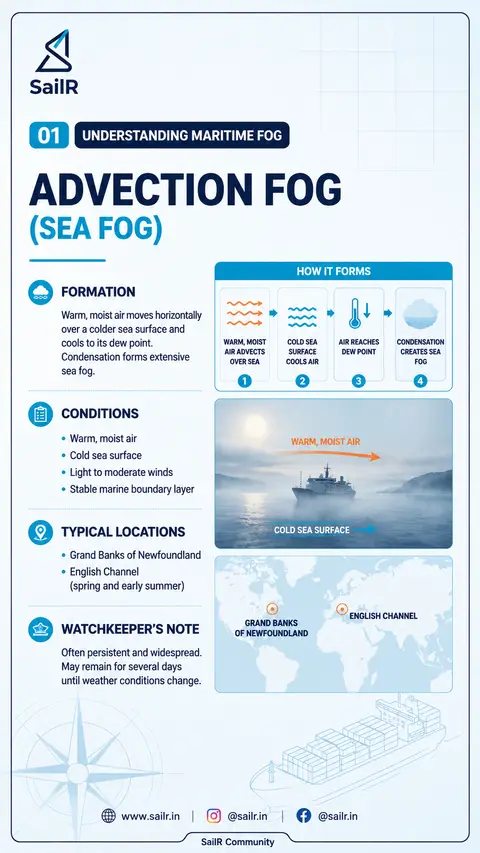
AI-drawn illustration. Simplified to explain the idea, not to scale.
Slide 1 · 01 UNDERSTANDING MARITIME FOG
01 UNDERSTANDING MARITIME FOG
ADVECTION FOG
(SEA FOG)
FORMATION
Warm, moist air moves horizontally over a colder sea surface and cools to its dew point. Condensation forms extensive sea fog.
HOW IT FORMS
WARM, MOIST AIR ADVECTS OVER SEA
COLD SEA SURFACE COOLS AIR
AIR REACHES DEW POINT
CONDENSATION CREATES SEA FOG
1
2
3
4
CONDITIONS
Warm, moist air
Cold sea surface
Light to moderate winds
Stable marine boundary layer
WARM, MOIST AIR
COLD SEA SURFACE
TYPICAL LOCATIONS
Grand Banks of Newfoundland
English Channel
(spring and early summer)
GRAND BANKS OF NEWFOUNDLAND
ENGLISH CHANNEL
WATCHKEEPER'S NOTE
Often persistent and widespread. May remain for several days until weather conditions change.
| |
Slide 2 · 02 UNDERSTANDING MARITIME FOG
02 UNDERSTANDING MARITIME FOG
RADIATION FOG
HOW IT FORMS (OVERNIGHT TO MORNING)
EVENING
LATE NIGHT
PRE-DAWN
MORNING
Land cools by radiation as heat escapes to space.
Surface cools the air above to its dew point.
Fog forms near the ground as air reaches saturation.
Sunlight warms the surface and the fog dissipates.
1
2
3
4
FOG USUALLY THICKER NEAR LAND
MAY DRIFT A SHORT DISTANCE OFFSHORE
FORMATION
Occurs overnight when the land surface loses heat by long-wave radiation, cooling the air above it to its dew point. Fog forms near the ground.
CONDITIONS
Clear skies
Light or calm winds
Damp or marshy ground
Long winter nights
TIMING
Forms overnight, is often thickest around sunrise, and normally dissipates after daytime heating breaks down the inversion.
MARINE RELEVANCE
Can drift a short distance offshore but is primarily a land-based fog.
WATCHKEEPER'S NOTE
Radiation fog is typically local in extent, forms in sheltered areas, and breaks up quickly after sunrise.
DENSE AT SUNRISE, DISSIPATES AFTER SUNRISE
| |
Slide 3 · 03 UNDERSTANDING MARITIME FOG
03 UNDERSTANDING MARITIME FOG
ARCTIC SEA SMOKE
FORMATION
Very cold, dry air moves over relatively warmer water. Rapid evaporation saturates the cold air, producing steam-like fog.
CONDITIONS
• Very cold, dry air
• Relatively warm water
• Light winds
• Strong evaporation
COMMON AREAS
• Arctic Ocean
• Antarctic waters
• Baltic Sea in winter
• Open water within sea ice
WATCHKEEPER'S NOTE
Sea smoke usually appears as rising white steam over the sea surface. It is typically shallow but can reduce visibility.
VERY COLD, DRY AIR
WARMER WATER
STEAM-LIKE FOG (SEA SMOKE)
THE PROCESS
1 Cold, dry air moves over warmer water.
2 Warm water causes intense evaporation into the cold air.
3 Air becomes saturated; vapour condenses.
4 Sea smoke forms as steam-like fog above the water.
QUICK FACTS
Occurs when very cold air flows over significantly warmer water.
Develops most readily in light winds.
Typically shallow, but can locally affect visibility for navigational operations.
| |
Slide 4 · 04 UNDERSTANDING MARITIME FOG
04 UNDERSTANDING MARITIME FOG
SMOG
A MAN-MADE FOG ENHANCED BY AIR POLLUTION
FORMATION
Smog is polluted air formed when atmospheric pollutants mix with moisture and, in some situations, fog.
HOW IT WORKS
Smoke and pollutant particles act as condensation nuclei, helping moisture condense into tiny droplets, which reduces visibility.
WHERE ENCOUNTERED
Industrial ports
Large coastal cities
Busy shipping approaches
WATCHKEEPER'S NOTE
Smog can vary in appearance from gray to brown and may cause strong odours in industrial areas.
TYPES OF SMOG
CLASSICAL (INDUSTRIAL) SMOG
Caused by emissions from coal burning and industrial activities
Rich in smoke, sulfur dioxide and other pollutants
Occurs in cool, humid conditions, often in winter
Associated with reduced visibility and poor air quality
PHOTOCHEMICAL SMOG
Caused by sunlight-driven reactions between nitrogen oxides and volatile organic compounds
Common in sunny, warm conditions
Forms a brownish haze
Can cause eye irritation and respiratory discomfort
OPERATIONAL IMPACT ON NAVIGATION
REDUCED VISIBILITY
Limits lookout effectiveness and increases collision risk.
NAVIGATIONAL HAZARD
Makes buoyage, landmarks, and other aids difficult to identify.
INCREASED DEPENDENCE ON EQUIPMENT
Greater reliance on radar, AIS, ECDIS and sound signals.
PORT APPROACH RISK
Poor visibility in port limits safe manoeuvring and berthing operations.
SAFETY TIPS
Maintain safe speed and enhanced lookout.
Use radar, AIS and other equipment effectively.
Sound appropriate fog signals as per COLREGS.
Monitor weather and air quality reports regularly.
Strengthen bridge team communication and vigilance.
| |
Drafted by SailR from our daily lessons. AI-drawn illustration. Simplified to explain the idea, not to scale. Last updated 19 Oct 2026.
Spotted a mistake?