The slides, written out
AI-drawn illustration. Simplified to explain the idea, not to scale.
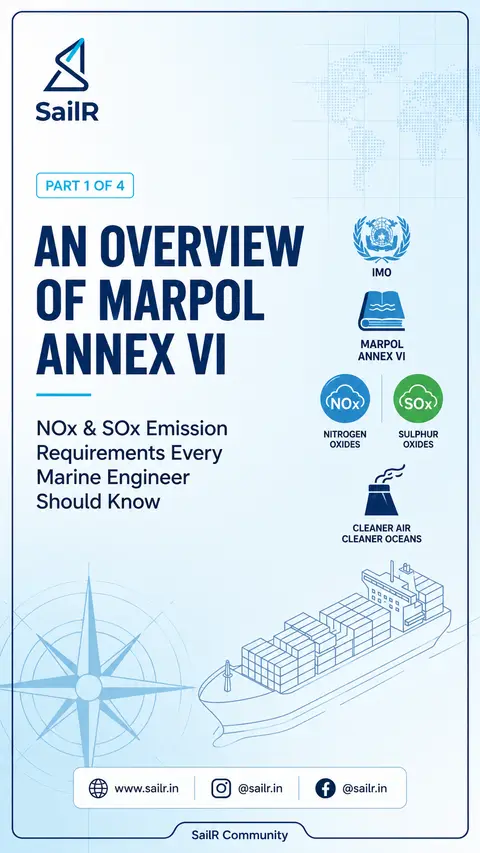
Slide 1 · PART 1 OF 4
PART 1 OF 4
AN OVERVIEW
OF MARPOL
ANNEX VI
NOx & SOx Emission
Requirements Every
Marine Engineer
Should Know
IMO
MARPOL
ANNEX VI
NOx
SOx
NITROGEN
OXIDES
SULPHUR
OXIDES
CLEANER AIR
CLEANER OCEANS
Slide 2 · PART 2 OF 4
PART 2 OF 4
NOx EMISSION LIMITS
(REGULATION 13)
For marine diesel engines over 130 kW,
NOx limits depend on rated engine speed (n in rpm)
TIER (Applicable to) | RATED ENGINE SPEED (n)
n < 130 rpm | 130 ≤ n < 2000 rpm | n ≥ 2000 rpm
TIER I Ships constructed 2000–2010 | 17.0 g/kWh | 45 × n^-0.2 g/kWh | 9.8 g/kWh
TIER II Ships constructed on/after 1 Jan 2011 | 14.4 g/kWh | 44 × n^-0.23 g/kWh | 7.7 g/kWh
TIER III In NECAs | 3.4 g/kWh | 9 × n^-0.2 g/kWh | 2.0 g/kWh
n = Rated engine speed in revolutions per minute (rpm)
OUTSIDE NECA
Tier II is the default standard.
INSIDE NECA
Tier III applies.
ACTIVE NOx TIER III NECAs
North American ECA
U.S. Caribbean Sea ECA
Baltic Sea NECA
North Sea NECA
Applicable ship construction dates:
• North American & U.S. Caribbean: on/after 1 Jan 2016
• Baltic Sea & North Sea: on/after 1 Jan 2021
as per MEPC.286(71)
Slide 3 · PART 3 OF 4
PART 3 OF 4
HOW SHIPS REDUCE NOx
Methods to Control NOx Emissions
1. INTERNAL ENGINE MEASURES (TIER II COMPLIANCE)
1
DELAYED FUEL INJECTION TIMING
Reduces peak cylinder temperature and lowers NOx formation.
2
WATER INJECTION
Direct water injection or water-in-fuel emulsion lowers combustion temperature.
3
EXHAUST GAS RECIRCULATION (EGR)
Recirculates exhaust back to the intake. Inert gases reduce oxygen and flame temperature.
4
MILLER CYCLE / LATE IVC
Late intake valve closing reduces effective compression temperature.
2. EXHAUST AFTER-TREATMENT
5
SELECTIVE CATALYTIC REDUCTION (SCR)
Urea solution (AdBlue/AUS 40) is injected into exhaust. Ammonia reacts with NOx over a catalyst to form harmless nitrogen and water.
Operating Temp.
280–450°C
Reductant
Urea (AdBlue)
ENGINE EXHAUST
UREA INJECTION
SCR CATALYST
CLEAN EXHAUST
N2 + H2O
3. ALTERNATIVE FUELS
6
LNG / DUAL-FUEL OPERATION
Natural gas has lower carbon content and higher auto-ignition temperature, enabling lean-burn combustion and producing significantly less NOx compared to conventional fuels.
LNG
KEY TAKEAWAY
Tier II is achieved through in-cylinder measures. Tier III requires after-treatment (primarily SCR) or clean alternative fuels.
Slide 4 · PART 4 OF 4
PART 4 OF 4
SOx LIMITS & COMPLIANCE METHODS
Regulation 14 – Sulphur Oxides
GLOBAL SULPHUR CAP
0.50%
m/m
On and after 1 January 2020
ECA SULPHUR CAP
0.10%
m/m
In all designated SOx ECAs
CURRENT & APPROVED SOx ECAs
Baltic Sea
North Sea
North American ECA
U.S. Caribbean Sea ECA
Mediterranean Sea ECA
Additional ECAs including the Canadian Arctic, Norwegian Sea and North-East Atlantic have been adopted with phased implementation dates under IMO amendments.
COMPLIANCE METHODS
1
LOW SULPHUR FUELS
Use compliant VLSFO (0.50%) outside ECAs or MGO/MDO (0.10%) within ECAs.
2
OPEN LOOP SCRUBBER
Uses seawater to neutralise SO2. Wash water treated and discharged. Restrictions apply in certain waters/ports.
3
CLOSED LOOP SCRUBBER
Uses fresh water with caustic. Residue (sludge) stored and discharged to shore.
4
HYBRID SCRUBBER
Flexible operation – switch between open and closed modes based on location.
5
LNG & ALTERNATIVE FUELS
Zero sulphur fuels like LNG, methanol, ammonia and hydrogen.
FUEL TANK
ENGINE
SCRUBBER / EGCS
CLEANER EXHAUST
REMEMBER: SOx emissions are directly linked to fuel sulphur content. Choose the right method and operate it correctly to stay compliant.
SOx
Drafted by SailR from our daily lessons. AI-drawn illustration. Simplified to explain the idea, not to scale. Last updated 19 Oct 2026.
Spotted a mistake?