The slides, written out
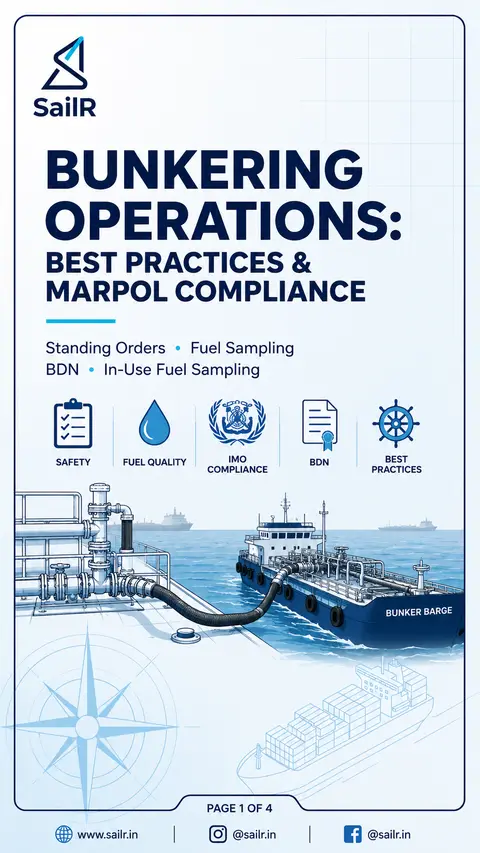
AI-drawn illustration. Simplified to explain the idea, not to scale.
Slide 1 · BUNKERING
BUNKERING
OPERATIONS:
BEST PRACTICES &
MARPOL COMPLIANCE
Standing Orders • Fuel Sampling
BDN • In-Use Fuel Sampling
SAFETY
FUEL QUALITY
IMO
COMPLIANCE
BDN
BEST
PRACTICES
BUNKER BARGE
Slide 2 · STANDING ORDERS
STANDING ORDERS
FOR BUNKERING OPERATIONS
Applicable to all grades of fuel — HFO, MGO/MDO, Biofuel blends
1
PRE-BUNKERING PLANNING
• Confirm tank allocation, available ullage, and intended transfer sequence with the Chief Engineer 24 hours prior.
• Check that all service and overflow tanks have sufficient capacity for the stem plus 10% contingency.
• Review the biofuel compatibility assessment if receiving a biofuel blend — the ship's onboard documentation requires OEM validation where applicable.
2
SAFETY PREPARATIONS
• Post "NO SMOKING — BUNKERING IN PROGRESS" signs and access-restriction barriers at all bunker station approaches.
• Close all non-essential sea valves and scuppers; plug deck drains.
• Position drip trays under each manifold connection.
• Confirm fire-fighting equipment (foam monitor, dry powder extinguishers) is ready at the bunker station.
3
COMMUNICATION & EMERGENCY READINESS
• Establish dedicated VHF channel (or hand-signal line-of-sight) between the manifold watchkeeper and the control room.
• Witness the Emergency Shutdown (ESD) functional test between ship and barge/truck — log the successful test in the bunkering log.
• Verify emergency contact numbers for port authority, local fire brigade, and ambulance are posted.
4
DURING TRANSFER
• Maintain a continuous watch at the manifold — never leave the operation unattended.
• Take ullage readings every 30 minutes and reconcile against barge/truck flowmeter readings.
• Monitor tank vent heads for vapour discharge — if any vent is blocked, stop immediately.
Continuous monitoring is essential throughout the bunkering operation.
5
COMPLETION & DOCUMENTATION
• Secure the MARPOL sample (sealed and signed by both parties) and the commercial sample set.
• Collect the Bunker Delivery Note and verify it against the actual delivery.
• Log final tank soundings in the bunkering log, verify them against the BDN, and retain the fuel quality information (including density at 15°C and sulphur content) with the BDN and bunker records in accordance with MARPOL Annex VI.
• Retain the BDN on board for three years; retain the MARPOL sample for 12 months per MARPOL Annex VI.
BDN RETENTION
3 YEARS
MARPOL SAMPLE RETENTION
12 MONTHS
Slide 3 · REPRESENTATIVE
REPRESENTATIVE
FUEL SAMPLING
WHY IT MATTERS & HOW TO OBTAIN IT
CONTINUOUS
DRIP
SAMPLER
1 WHY REPRESENTATIVE SAMPLING MATTERS
COMMERCIAL
DISPUTES
Proves the supply
was at fault, not
your onboard
handling.
REGULATORY
COMPLIANCE
MARPOL Annex VI
requires reliable
samples to verify
sulphur limits.
ENGINE
RELIABILITY
Accurate analysis
drives the right
treatment and
operational decisions.
HFO IS NOT
HOMOGENOUS
It may be blended
in-line; grab samples
can be misleading
and unrepresentative.
2 HOW TO OBTAIN A REPRESENTATIVE SAMPLE
(Per ISO 13739 & IMO MSC-MEPC.2/Circ.18 Guidelines)
1
BEFORE
BUNKERING
Inspect the continuous
drip sampler on the
receiving line.
Set the drip rate so the
sample bottle fills
gradually throughout
the entire transfer.
2
DURING
BUNKERING
The drip sampler
continuously draws
a small fraction of
the flowing fuel.
Captures the full
composition of the
entire stem.
3
ON
COMPLETION
The primary sample
is collected.
Ensure sealing and
witnessing by both
supplier and receiver
representatives.
4
SAMPLE
DIVISION
The representative
sample is commonly
divided into multiple
bottles according to
company procedures
or contractual
agreement.
5
LABORATORY &
RETENTION
One bottle is sent to
an accredited lab for
analysis.
The MARPOL sample
is retained on board
for 12 months.
TYPICAL SAMPLE ALLOCATION (EXAMPLE PRACTICE)
SHIP
Retained onboard
(Commercial
retention)
SUPPLIER
Retained by
supplier
LABORATORY
For ISO 8217
analysis
MARPOL SAMPLE
Sealed, labelled & signed
by both parties;
retained for 12 months
(Regulatory use only)
IMPORTANT
The MARPOL sample must
ONLY be used for verifying
compliance with sulphur
limits under the direction
of port state or flag state.
Do not use it for
commercial testing.
KEY POINT
Continuous drip sampling is the only method
that provides a true and defensible
representation of the entire bunker delivery.
Slide 4 · BDN & IN-USE FUEL SAMPLING
BDN & IN-USE FUEL SAMPLING
DOCUMENTATION & COMPLIANCE ESSENTIALS
1 BUNKER DELIVERY NOTE (BDN)
Required under MARPOL Annex VI Regulation 18 & Appendix V
Name and IMO number of the receiving vessel
Name, address & registration details of the bunker supplier
Date and location of bunkering
Quantity and type of fuel supplied. Where applicable, biofuel blend ratio should also be stated.
Density at 15°C
Sulphur content (actual value or, if agreed with port authority, statement below 0.001% m/m)
Flash point should comply with SOLAS fuel safety requirements and is commonly included on commercial documentation, though not mandatory under MARPOL Annex VI Appendix V.
Confirmation that the fuel meets relevant standards and regulatory requirements
Declaration that the fuel is free from contaminants prohibited under MARPOL or national law
Signature of authorised representative of supplier and receiving vessel, with name & designation
Unique BDN reference number or batch identifier for traceability
BDN RETENTION: 3 YEARS
The master or responsible officer must retain the BDN on board for three years from the date of delivery and produce it upon request.
2 IN-USE FUEL SAMPLE POINT
Required by port state control for verifying sulphur compliance while underway.
LOCATION
On the fuel oil supply line between the service tank outlet and the engine inlet, typically downstream of the final filter or flowmeter on the high-pressure supply line.
SERVICE TANK
SUPPLY PUMP
FINAL FILTER / FLOWMETER
SAMPLE POINT
ENGINE
REQUIREMENTS
Fitted with a sampling valve easily accessible to inspectors.
Clearly labelled "IN-USE FUEL SAMPLE POINT".
Valve capped and secured when not in use.
Inspection authority may operate the system; fuel pump must be running at normal service pressure for a representative sample.
PURPOSE
To verify that the fuel actually in use by the engine complies with sulphur limits under MARPOL Annex VI. This sample is taken from the fuel supply line, not from storage or settling tanks.
APPLICABLE GUIDANCE
MARPOL Annex VI – Appendix VI (Verification Procedures)
IMO MEPC.1/Circ.864/Rev.1 – 2021 Guidelines on consistent implementation of 0.50% sulphur limit
Local regulations (e.g., EU Sulphur Directive, US EPA – ECA)
3 COMPLIANCE CHECKLIST
Pre-bunkering planning completed
Safety precautions implemented
Emergency shutdown test witnessed & logged
Continuous watch maintained during transfer
Representative sample obtained using drip sampler
MARPOL sample sealed, labelled & signed
BDN verified and retained
Records and samples retained as required
In-use fuel sample point identified & accessible
4 KEY RETENTION RULES
BDN RETENTION 3 YEARS
Retain on board for a minimum of 3 years from the date of delivery.
MARPOL SAMPLE RETENTION 12 MONTHS
The MARPOL delivered sample must be retained on board for at least 12 months for regulatory verification.
ACCURATE SAMPLING + CORRECT DOCUMENTATION = COMPLIANCE, SAFETY & ENGINE RELIABILITY
Drafted by SailR from our daily lessons. AI-drawn illustration. Simplified to explain the idea, not to scale. Last updated 19 Oct 2026.
Spotted a mistake?