The slides, written out
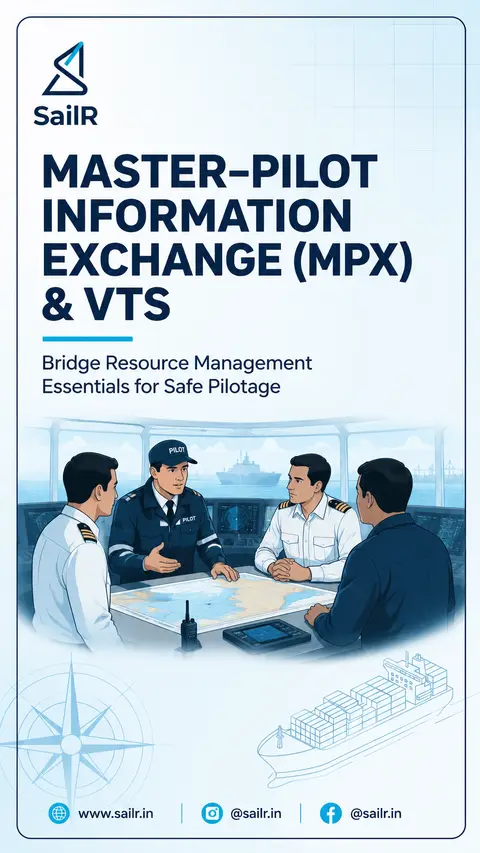
AI-drawn illustration. Simplified to explain the idea, not to scale.
Slide 1 · MASTER-PILOT
MASTER-PILOT
INFORMATION
EXCHANGE (MPX)
& VTS
Bridge Resource Management
Essentials for Safe Pilotage
Slide 2 · MASTER-PILOT
MASTER-PILOT
INFORMATION EXCHANGE
WHAT MUST BE EXCHANGED?
SHIP HANDLING & SPECIFICS
Pilot Card (present & discuss)
Turning Circles
Stopping Distances
Rate of Turn at different speeds
Unusual ship-handling characteristics
Current engine status & setting
PASSAGE PLAN & CONTINGENCIES
Intended passage plan
Critical points & courses
Wheel-over positions
Abort points
Contingency plans: steering failure, thruster failure, berth not ready
Plan is an intention, not a fixed rail
LOCAL CONDITIONS & EXTERNAL FACTORS
Weather
Depth / UKC
Tidal streams
Marine traffic
Berthing arrangements (berth, side, fendering)
Tug details: number, bollard pull, pick-up points
Communication language with tugs (English or common language)
ROLES & LANGUAGE
Who is conning? (Pilot direct / via Master)
Monitoring duties clearly defined
Language on bridge must be English or common to all
If pilot speaks local dialect to tugs / VTS, explain to bridge team as soon as practical
EQUIPMENT STATUS & DEFECTS
Navigational equipment defects (e.g., radar on standby, faulty echo sounder)
Irregularities affecting manoeuvring (e.g., line handler short, main engine limitations)
Any other limitations that may affect safe navigation
MENTOR TIP
Don't just list the points – understand why each item matters. The goal is a shared mental model and safe decision-making.
A shared mental model prevents misunderstandings and improves bridge team effectiveness.
Slide 3 · THE PURPOSE
THE PURPOSE
OF MPX
Effective exchange of information builds a
shared mental model for safe navigation.
SITUATIONAL
AWARENESS
Everyone
understands
the plan.
CROSS-CHECKING
Errors are detected
before becoming
incidents.
COMMUNICATION
Information is
exchanged
openly.
THREE PILLARS
of Effective
Bridge Teamwork
A pilot brings local knowledge.
The bridge team brings vessel knowledge.
Safe navigation requires both.
Slide 4 · VESSEL TRAFFIC SERVICES (VTS)
VESSEL TRAFFIC SERVICES (VTS)
VTS services are traditionally categorized into three service types to improve safety, efficiency and protection of the marine environment.
INS
TOS
NAS
INFORMATION SERVICE
TRAFFIC ORGANISATION SERVICE
NAVIGATIONAL ASSISTANCE SERVICE
Broadcasting traffic, weather and navigational information.
Supports situational awareness and decision-making.
Examples: weather updates, navigational warnings, VTS bulletins.
Manages vessel traffic to prevent congestion and dangerous encounters.
Ships may be directed to a route, speed, sequence or holding area.
Examples: traffic sequencing, route allocation, speed instructions.
Provides advice and instructions to ships upon request.
Used in conditions of navigational doubt, equipment failure or environmental constraints.
Examples: navigational advice, positional information, assistance in restricted waters.
REGULATORY NOTE
SOLAS Chapter V, Regulation 12 establishes the framework for Vessel Traffic Services.
VTS provides information, advice and instructions within the framework of international law, but does not relieve the Master of the responsibility for the safe navigation of the ship.
Drafted by SailR from our daily lessons. AI-drawn illustration. Simplified to explain the idea, not to scale. Last updated 19 Oct 2026.
Spotted a mistake?