The slides, written out
AI-drawn illustration. Simplified to explain the idea, not to scale.
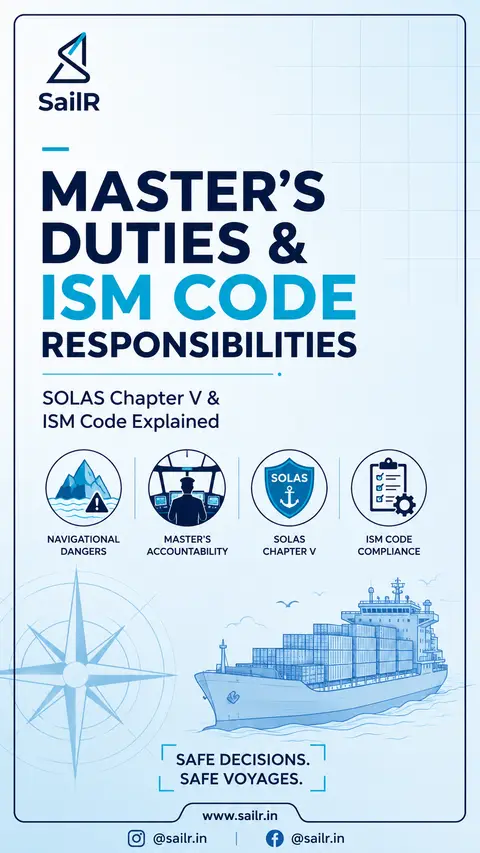
Slide 1 · MASTER'S
MASTER'S
DUTIES &
ISM CODE
RESPONSIBILITIES
SOLAS Chapter V &
ISM Code Explained
NAVIGATIONAL
DANGERS
MASTER'S
ACCOUNTABILITY
SOLAS
CHAPTER V
ISM CODE
COMPLIANCE
SAFE DECISIONS.
SAFE VOYAGES.
Slide 2 · (a) Master's Duties – i)
(a) Master's Duties – i)
SIGHTING ICE OR
DANGER TO NAVIGATION
Under SOLAS V Regulation 31, the Master must immediately
alert other ships and notify the nearest competent shore authority.
1. IMMEDIATE ACTIONS
Determine precise
position of the danger
Identify the nature
of the hazard
Record the time
of observation
Maintain enhanced
lookout
Adjust course/speed
as per the passage plan
2. COMMUNICATION DUTIES
Warn all ships
in the vicinity
Notify the nearest
competent shore
authority
Use available GMDSS
systems (VHF, MF/HF,
DSC, SafetyNET,
NAVTEX etc.)
Update the warning
if the danger is
moving
3. RECORD KEEPING
Log all observations, actions taken and communications
in the Deck Logbook and GMDSS Log.
SOLAS V REGULATION 31
The Master shall transmit information concernicins dangerous ice,
derelicts and other direct dangers to navigation to ships in the
vicinity and to the nearest competent authority.
Slide 3 · (a) Master's Duties – ii)
(a) Master's Duties – ii)
RECEIVING WARNING
OF ICE IN THE VICINITY
When a warning of ice in the vicinity is received,
the Master's duty is twofold: ASSESS & DECIDE, then COMMUNICATE.
1. ASSESS & DECIDE
2. POSSIBLE ACTIONS
Evaluate the warning's currency,
certainty and proximity to your
intended track.
Alter course to
avoid the area
RECEIVE WARNING
Reduce speed
or stop if required
ASSESS POSITION
Post additional
lookouts (as appropriate)
EVALUATE RISK
Review and adjust
passage plan
TAKE ACTION
Inform engine room
of increased risk
LOG DECISION & REASONING
Acknowledge receipt
and inform Company
as required
SOLAS V REGULATION 34-1
SOLAS
V 34-1
The Master's professional judgement cannot be restricted.
No owner, charterer or other person may prevent or restrict
the Master from taking or executing any decision necessary
for the safety of life at sea and protection of the marine environment.
SAFETY FIRST.
JUDGEMENT ALWAYS.
Slide 4 · (b) ISM Code
(b) ISM Code
ISM CODE & COMPANY
RESPONSIBILITIES
The ISM Code makes the Company accountable for establishing,
implementing and continuously improving the Safety Management System.
1. OBJECTIVES OF ISM CODE
Ensure safety at sea and
prevention of human injury
or loss of life.
Avoid damage to the
environment, in particular
the marine environment,
and to property.
Establish safe practices
for ship operation and
a safe working
environment.
Assess all identified risks
and establish appropriate
safeguards.
Continuously improve
safety management skills,
including preparedness
for emergencies.
2. MASTER'S RESPONSIBILITIES
Implement the Company's safety and
environmental protection policy.
Motivate the crew in the observation
of that policy. Lead by example.
Issue clear orders and instructions
(standing orders, night orders,
voyage orders).
Verify that specified requirements
are observed.
Review the SMS and report
deficiencies to shore-based
management.
Ensure the condition of the ship,
machinery and equipment is
maintained to statutory and
class standards.
Uphold your overriding authority –
safety over commercial pressure.
Foster a safety culture and encourage
reporting without blame (just culture).
3. COMPANY'S ROLE (ISM CODE)
Define responsibilities,
authority and
interrelationships
(Section 3.2)
Provide adequate
resources and
shore-based support
(Section 3.3)
Designate a Person
Ashore (DPA) with
direct access to top
management
(Section 4)
Ensure the SMS
states the Master's
overriding authority
clearly
(Section 5.2)
KEY PRINCIPLE
The Master has overriding authority to
make decisions necessary for the safety
of life at sea and protection of
the marine environment.
Protected by SOLAS V Reg. 34-1
Supported by ISM Code
Safety First. Always.
Drafted by SailR from our daily lessons. AI-drawn illustration. Simplified to explain the idea, not to scale. Last updated 18 Oct 2026.
Spotted a mistake?