The slides, written out
AI-drawn illustration. Simplified to explain the idea, not to scale.
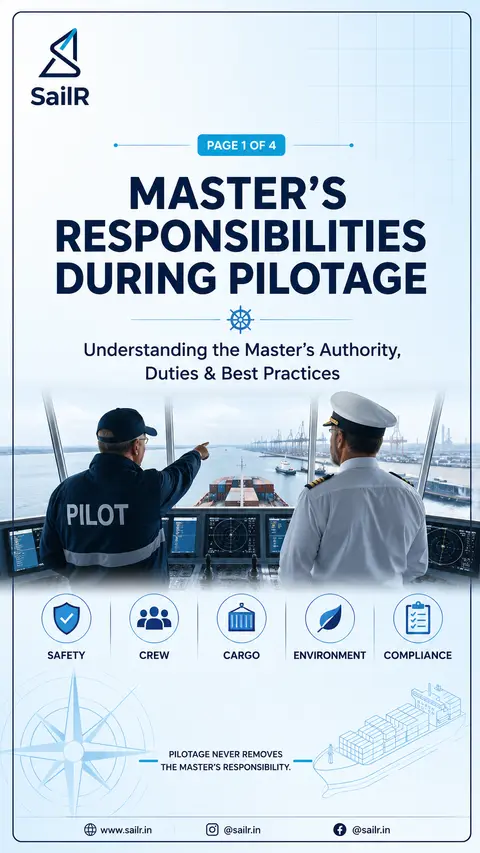
Slide 1 · MASTER'S
MASTER'S
RESPONSIBILITIES
DURING PILOTAGE
Understanding the Master's Authority,
Duties & Best Practices
SAFETY
CREW
CARGO
ENVIRONMENT
COMPLIANCE
PILOTAGE NEVER REMOVES
THE MASTER'S RESPONSIBILITY.
Slide 2 · THE CORE PRINCIPLE
THE CORE PRINCIPLE
THE MASTER REMAINS IN COMMAND
AT ALL TIMES
The pilot conducts the navigation of the vessel,
but the Master remains in overall command
and responsible for the safety of the ship.
MASTER
COMMANDS
THE SHIP
PILOT
CONDUCTS
THE NAVIGATION
THE MASTER'S OVERALL
RESPONSIBILITY COVERS:
SAFETY
Safety of the ship and
all persons on board.
CREW
Well-being, training,
and proper management.
CARGO
Care of cargo and
its safe carriage.
ENVIRONMENT
Protection of the
marine environment.
COMPLIANCE
Compliance with laws,
regulations and company
procedures.
Pilotage never removes
the Master's responsibility.
COMMAND IS NOT DELEGATED.
IT IS ACCOUNTABLE.
PILOT
Slide 3 · DUTIES DURING PILOTAGE
DUTIES DURING PILOTAGE
The Master and bridge team must actively support the pilot
while retaining overall responsibility for the vessel.
BEFORE PILOTAGE
MASTER-PILOT
INFORMATION EXCHANGE
CONDUCT MASTER-PILOT INFORMATION EXCHANGE
Before pilotage commences.
DISCUSS PASSAGE PLAN
Including routes, manoeuvres and contingencies.
EXPLAIN SHIP'S CHARACTERISTICS
Engine power, stopping distance, turning circle,
draft, handling, etc.
REPORT DEFECTS / LIMITATIONS
Any defects, peculiarities or constraints that may
affect the navigation.
SHARE LOCAL INFORMATION
Tides, currents, weather, restrictions and hazards.
DURING PILOTAGE
MONITOR THE PILOT CONTINUOUSLY
Maintain situational awareness and
independent judgement.
MAINTAIN EFFECTIVE BRIDGE
RESOURCE MANAGEMENT
Clear communication and defined roles.
KEEP PROPER LOOKOUT
Visually and by all available means.
ENSURE ORDERS ARE EXECUTED
Confirm helm, engine and other
orders are carried out correctly.
CHALLENGE UNSAFE ACTIONS
IMMEDIATELY
Question and discuss if the vessel
is being put at risk.
EFFECTIVE COMMUNICATION FLOW
MASTER
PILOT
OOW
HELMSMAN
ENGINE
ROOM
CLEAR COMMUNICATION • TIMELY ACTION • SAFE PASSAGE
Remember:
The pilot advises and conducts the navigation.
The Master decides and commands.
SAFETY IS OUR SHARED RESPONSIBILITY.
Slide 4 · INTERVENTION &
INTERVENTION &
BEST PRACTICES
When the safety of the vessel is in doubt,
the Master must act.
IF SAFETY IS AT RISK
NOTICE UNSAFE SITUATION
Remain alert and monitor
the pilot continuously.
QUESTION THE PILOT
Immediately draw the pilot's
attention to your concern.
DISCUSS THE CONCERN
Clearly communicate the risk
and your professional opinion.
RISK CONTINUES?
Is the vessel still being
placed in danger?
NO
Continue pilotage
with due caution.
YES
MASTER TAKES NECESSARY ACTION
Take whatever action is required to
ensure the safety of the ship, persons
on board and the environment.
Any replacement of the pilot should follow
the procedures of the relevant Pilotage
Authority or Port Authority.
RECORD EVENTS
Log all actions in the deck log.
Ensure VDR recording is preserved.
NOTIFY COMPANY /
PORT AUTHORITY
Inform your company and follow
local reporting requirements.
KEY TAKEAWAYS
The pilot assists in
navigation. The Master
retains overall command.
The pilot does not
relieve the Master or
OOW of responsibility.
Effective communication
and professional
judgement prevent
accidents.
Master–Pilot Information
Exchange (MPX) is
essential.
SOLAS V Reg. 34-1
protects the Master's
overriding authority to
make safety decisions.
Safety of the ship,
persons on board and
the marine environment
is always the priority.
GOOD PRACTICE REMINDER
Maintain proper lookout at all times.
Support the pilot with accurate information.
Ensure orders are executed correctly.
Use BRM and follow SMS procedures.
Never hesitate to act for safety.
COMMAND IS NOT DELEGATED.
IT IS ACCOUNTABLE.
Drafted by SailR from our daily lessons. AI-drawn illustration. Simplified to explain the idea, not to scale. Last updated 19 Oct 2026.
Spotted a mistake?