The slides, written out
AI-drawn illustration. Simplified to explain the idea, not to scale.
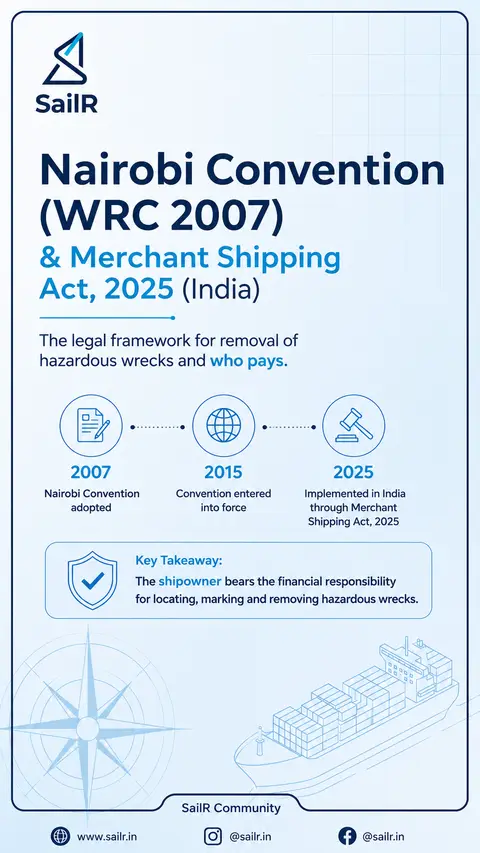
Slide 1 · Nairobi Convention
Nairobi Convention
(WRC 2007)
& Merchant Shipping
Act, 2025 (India)
The legal framework for removal of
hazardous wrecks and who pays.
2007
Nairobi Convention
adopted
2015
Convention entered
into force
2025
Implemented in India
through Merchant
Shipping Act, 2025
Key Takeaway:
The shipowner bears the financial responsibility
for locating, marking and removing hazardous wrecks.
Slide 2 · How India Implements
How India Implements
the Nairobi Convention (WRC 2007)
Implemented through the Merchant Shipping Act, 2025
(Part XII, Chapter I – Wreck).
1. APPLICABILITY
• Applies to wrecks located within the territory of India, including coastal waters.
• Excludes measures under the 1969 Intervention Convention and warships or government vessels in non-commercial service.
2. HAZARD ASSESSMENT
• Central Government determines if a wreck is a hazard.
• Criteria include type, size, depth, currents, proximity to protected/sensitive areas, and IMO/UNCLOS guidelines.
3. REPORTING REQUIREMENTS
• Master or shipowner must report without delay to the DG and MRCC/Sub-Centre of ICG.
• If an Indian vessel wrecks in another State's area, report to that State and also to DG & MRCC.
4. RECEIVER OF WRECK
• Central Government appoints a Receiver of Wreck.
• Duties include possession, disposal/sale, issuing notices, and enforcing obligations of owner, operator or insurer.
THE PROCESS OVERVIEW
Maritime Casualty
Hazard Assessment
Owner Notification
Removal by Owner
Cost Recovery from Owner
Slide 3 · Wreck Removal Process
Wreck Removal Process
Under WRC 2007 & Merchant Shipping Act, 2025
1. MARITIME CASUALTY
A vessel casualty results in a wreck within India's Convention Area (territory of India, including coastal waters).
2. REPORT TO DG & MRCC
Master or shipowner reports without delay to the Director-General and the Maritime Rescue Co-ordination Centre/Sub-Centre (ICG).
3. HAZARD DETERMINATION
Central Government/competent authority determines whether the wreck constitutes a hazard based on statutory criteria.
4. OWNER NOTIFICATION
Registered owner is informed and required to remove the wreck within a reasonable period specified by the authority.
5. OWNER REMOVES THE WRECK
If the owner complies within the deadline, the owner arranges and removes the wreck.
6. GOVERNMENT REMOVES WRECK
If the owner fails to act within the specified period, the Government may remove the wreck by the most practical and expeditious means.
7. COST RECOVERY FROM OWNER
The Government recovers all reasonable costs of removal (including preventive measures) from the registered owner, operator or insurer.
IMPORTANT NOTE
No fixed statutory number of days is prescribed. The authority specifies a REASONABLE DEADLINE for wreck removal.
Slide 4 · Hague-Visby Rules
Hague-Visby Rules
vs Hamburg Rules
Key Differences & What It Means for the Ship-Master
ASPECT
HAGUE-VISBY RULES (1924 / 1968)
HAMBURG RULES (1978)
CARRIER'S OBLIGATION
Exercise due diligence to make the ship seaworthy before and at the beginning of the voyage.
Carrier liable for loss, damage or delay unless it proves it took all reasonable measures to avoid the event and its consequences.
BURDEN OF PROOF
Claimant must prove loss or damage occurred while goods were in carrier's custody. Carrier then raises exceptions.
Presumption of carrier liability. Burden shifts to carrier to prove that it, its servants or agents took all reasonable measures and that the loss was not due to their fault.
NAUTICAL FAULT
Act or default of the Master or crew in the navigation or management of the ship is an exception.
No nautical fault defence. Carrier liable for errors of Master, officers and crew in navigation or management of the ship.
PERIOD OF RESPONSIBILITY
From tackle-to-tackle (loading to discharge).
From taking over the goods at the port of loading until delivery at the port of discharge (extended responsibility).
LIABILITY FOR DELAY
No liability for mere delay in delivery.
Carrier liable for delay in delivery.
LIMITATION OF LIABILITY
Lower limits (per package or unit or per kg) unless higher value declared and inserted.
Higher limits of liability based on Special Drawing Rights (SDR).
TIME FOR SUIT
1 year from delivery (or when goods should have been delivered).
2 years from delivery (or when goods should have been delivered).
MASTER'S OPERATIONAL TAKEAWAYS
RECORD EVERYTHING
Maintain accurate logbooks, deck logs and engine records.
DOCUMENT CONDITION
Record cargo condition, packing, securing and hold condition at all stages.
CARGO CARE MATTERS
Maintain ventilation records, temperature logs, cleanliness checks and hold inspections.
ERRORS NOW COSTLY
Under Hamburg Rules, navigation or management errors are not a defence.
STRONG DOCUMENTATION = STRONG DEFENCE
Good records are your best protection under the modern regime.
BOTTOM LINE
Hamburg Rules place greater responsibility on the carrier.
Meticulous record-keeping by the Master is key to minimising risk and successfully defending claims.
Drafted by SailR from our daily lessons. AI-drawn illustration. Simplified to explain the idea, not to scale. Last updated 19 Oct 2026.
Spotted a mistake?