The slides, written out
AI-drawn illustration. Simplified to explain the idea, not to scale.
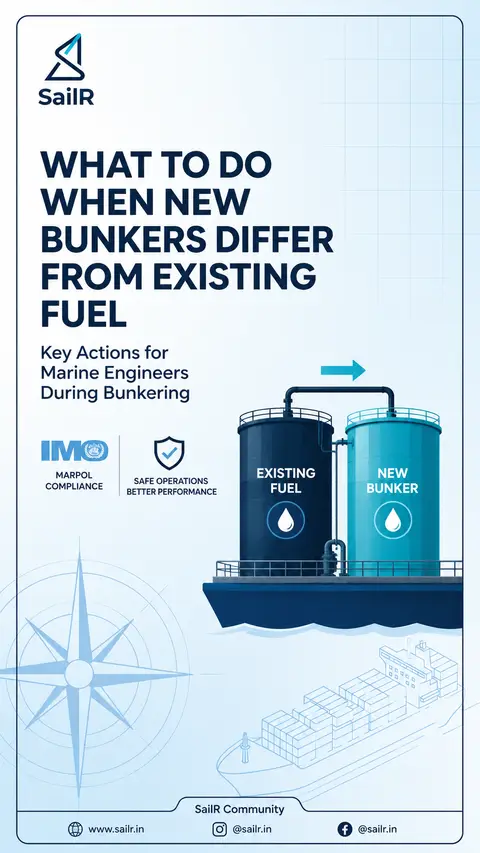
Slide 1 · WHAT TO DO
WHAT TO DO
WHEN NEW
BUNKERS DIFFER
FROM EXISTING
FUEL
Key Actions for
Marine Engineers
During Bunkering
IMO
MARPOL
COMPLIANCE
SAFE OPERATIONS
BETTER PERFORMANCE
EXISTING
FUEL
NEW
BUNKER
Slide 2 · DENSITY &
DENSITY &
VISCOSITY CHECKS
A DENSITY DIFFERENCES
Segregate fuels where possible.
Review purifier gravity disc selection using separator maker's chart.
Verify bunker quantity using ASTM D1250 / API MPMS Ch. 11 temperature correction factors.
Conduct fuel compatibility assessment before mixing.
RISK OF INCOMPATIBILITY
Mixing incompatible fuels may cause:
Asphaltene precipitation
Sludge formation
Filter blockage
B VISCOSITY DIFFERENCES
Verify delivered viscosity against BDN.
Adjust fuel heating using supplier viscosity–temperature data.
Maintain engine inlet viscosity within maker's recommendations.
Monitor exhaust temperatures and combustion condition.
RISK – HIGH VISCOSITY
Poor atomisation
Incomplete combustion
Increased deposits and wear
RISK – LOW VISCOSITY
Reduced fuel system lubrication
Increased leakage and wear
Slide 3 · CAT FINES &
CAT FINES &
WATER MANAGEMENT
A
CAT FINES
(AL + SI)
Verify ISO 8217
specification.
Arrange laboratory
analysis if elevated
levels suspected.
Optimise purifier
operation.
Reduce separator
throughput when
required.
Follow engine maker's
treatment recommendations.
B
WATER CONTENT
Test fuel using approved
onboard equipment.
Use settling tanks
effectively.
Drain water
regularly.
Optimise purifier
temperature and
throughput.
Monitor service tanks
every watch.
RISK OF
CAT FINES
Cat fines may cause:
Fuel pump
wear
Injector
damage
Liner and ring
abrasion
RISK OF
EXCESS WATER
Excessive water may cause:
Poor combustion
Corrosion
Separator
performance issues
Slide 4 · SULPHUR COMPLIANCE
SULPHUR COMPLIANCE
& RESPONSE PLAN
A SULPHUR CONTENT
BDN
Verify sulphur content declared on BDN.
Confirm route and ECA/SECA compliance requirements.
Use approved EGCS (scrubber) where applicable and ensure proper operation.
FONAR
Follow Fuel Oil Non-Availability Report (FONAR) procedures if compliant fuel cannot be obtained.
Follow engine-maker cylinder oil recommendations and monitor drain oil analysis.
IMPORTANT
Non-compliance with sulphur limits may result in fines, detention, and reputational damage.
B QUICK RESPONSE FLOW
NEW BUNKER RECEIVED
CHECK BDN
COMPARE:
• Density
• Viscosity
• Sulphur
• Cat Fines (Al + Si)
• Water Content
SEGREGATE IF REQUIRED
TEST & VERIFY
OPTIMISE PURIFIER
USE SAFELY
KEY PRINCIPLE
Never mix, transfer, or consume unfamiliar bunkers until compatibility, treatment requirements, and regulatory compliance have been verified.
Drafted by SailR from our daily lessons. AI-drawn illustration. Simplified to explain the idea, not to scale. Last updated 19 Oct 2026.
Spotted a mistake?