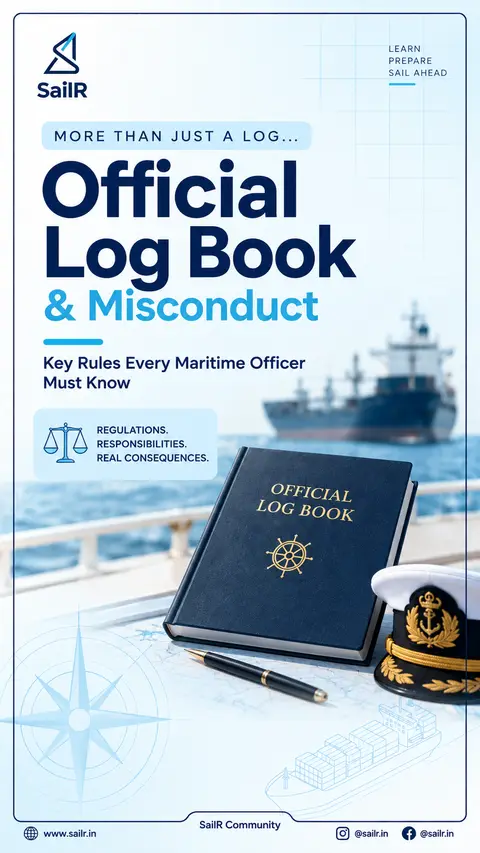
The slides, written out
AI-drawn illustration. Simplified to explain the idea, not to scale.
Slide 1 · LEARN
LEARN
PREPARE
SAIL AHEAD
MORE THAN JUST A LOG...
Official
Log Book
& Misconduct
Key Rules Every Maritime Officer
Must Know
REGULATIONS.
RESPONSIBILITIES.
REAL CONSEQUENCES.
OFFICIAL
LOG BOOK
Slide 2 · 01/04
Official Log Book
The Statutory
Record On Board
The Official Log Book (OLB) is a statutory record,
separate from the ordinary deck logbook.
Under the Merchant Shipping Act 1995, Section 77
and the Merchant Shipping (Official Log Books)
Regulations 1981 (SI 1981/569), as amended,
an OLB is required for applicable UK ships.
Exemptions include:
Ships belonging
to a General
Lighthouse Authority
Ships of less than
25 gross tons
Pleasure yachts
Typical entries include:
Changes of Master
Safety appointments
and committee matters
Accidents and casualties
Disciplinary matters
Crew discharge and desertion
Complaints and wage disputes
Births, deaths and illnesses
Meetings of safety committees
Promotions and demotions
Annexing of documents
Other matters specified
by the Regulations
SailR Key Point
Know what must be recorded — and who is required
to make or sign each particular entry.
Slide 3 · 02/04
Official Log Book
How & When
To Record
Entries must be made according to the requirements of the Official Log Books Regulations and the approved OLB format.
After the event
Accidents, casualties, meetings, disciplinary matters and other narrative events.
Before proceeding to sea
Specified statutory entries such as load line and depth of loading requirements.
For each entry
The person responsible for making and signing the entry depends on the specific entry prescribed in the Regulations.
Important
• Make entries as each event occurs.
• Do not treat the OLB as a document to be reconstructed at the end of the voyage.
• The OLB is an important statutory record and may be relevant as evidence in an investigation or legal proceeding.
Avoid this statement
"If it isn't in the OLB, it didn't happen."
Use instead
"Missing or inaccurate entries can seriously prejudice the ship's or Master's position."
Slide 4 · 03/04
Merchant Shipping Act 1995
Section 58
Conduct Endangering Ships, Structures or Individuals
Section 58 addresses conduct involving an act or omission that meets the statutory conditions for endangering ships, structures or individuals.
Key elements under Section 58
SHIP / MACHINERY
Loss, destruction or serious damage to the ship or its machinery.
PEOPLE
Death of or serious injury to any person.
DUTY
Failure, breach or neglect of a duty falling to be discharged in the person's capacity as Master or seaman, where the requirements of Section 58 are met.
DRINK / DRUGS
The section contains specific provisions concerning being under the influence of drink or a drug in connection with the statutory offence.
Examples of conduct that may fall under Section 58
Negligent navigation causing a grounding or collision
Failure to maintain required duties (e.g. lookout, watchkeeping)
Unsafe cargo operations endangering the vessel
Serious neglect of safety equipment
Sending a vessel to sea improperly loaded or unseaworthy
These are examples only. Conduct is not automatically a Section 58 offence merely because it resembles one of these examples. The statutory conditions must be satisfied.
SailR Exam Point
Section 58 is a criminal offence on the statute book, distinct from company disciplinary action.
Slide 5 · Discipline & Gross Misconduct
Discipline & Gross Misconduct
Know the
Difference
A Section 58 offence and company
disciplinary action are not the same thing.
Section 58
MSA 1995
Statutory criminal offence
Conduct endangering ships,
structures or individuals
Prosecuted under the law
Can lead to fines or imprisonment
Company Discipline
Dealt with under the Merchant
Navy Code of Conduct and
applicable SEA/company procedures
Aimed at maintaining order, safety
and good conduct on board
Can lead to disciplinary action,
including dismissal from the ship
Examples of gross misconduct
Violence or assault
Dishonesty or theft
Serious disobedience of a lawful order
Serious safety breaches
Drug or alcohol related misconduct
Conduct endangering the ship
or persons
Sleeping or failure to remain on duty
where safety is prejudiced
Persistent or wilful failure to perform duty
Other serious breaches as defined in the
Merchant Navy Code of Conduct
Important
Repeated misconduct following
an appropriate warning may
justify stronger disciplinary
action, potentially including
dismissal, depending on the
applicable procedure and
circumstances.
Remember
Dismissal from the ship
is not automatically
termination of employment.
Termination of employment
depends on the applicable
SEA, company procedure
and employment law.
SailR Exam Point
Section 58 = statutory offence
Gross misconduct = disciplinary/employment framework
Drafted by SailR from our daily lessons. AI-drawn illustration. Simplified to explain the idea, not to scale. Last updated 19 Oct 2026.
Spotted a mistake?