Ozone-depleting substances on ships under MARPOL Annex VI
- MEO Class 2
- MEO Class 4
- MEO Class 1
- times asked
- 32
- times asked
- questions
- 6
- questions
- last asked
- 2026
- last asked
Halons, CFCs and HCFCs on ships fall under MARPOL Annex VI Regulation 12. Here is what counts as an ozone-depleting substance, what can still be fitted, how to handle the gas and what goes in the record book.
The slides, written out
AI-drawn illustration. Simplified to explain the idea, not to scale.
Slide 1 · Recover it
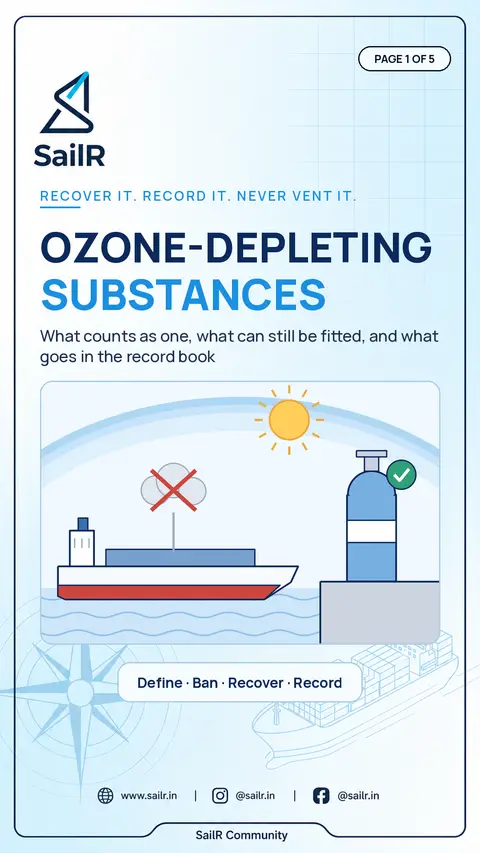
Recover it. Record it. Never vent it. Ozone-depleting substances: what counts as one, what can still be fitted, and what goes in the record book. The four steps are define, ban, recover and record.
Slide 2 · What counts as one
What counts as one. A bar chart shows ozone-depleting potential under the Montreal Protocol: Halon 1301 is 10.0, Halon 2402 is 6.0, Halon 1211 is 3.0, CFC-12 is 1.0 and HCFC-22 is 0.055, while HFC-134a is not an ozone-depleting substance because it is listed in Annex F. Ozone-depleting substances are the controlled substances listed in Annexes A, B, C or E of the Montreal Protocol. Those that may be on board include Halon 1211, 1301 and 2402, and CFC-11, CFC-12, CFC-113, CFC-114 and CFC-115. HCFC-22 is listed in Annex C, so it is an ozone-depleting substance, with a far lower potential than CFC-12. HFC-134a is listed in Annex F for global warming, with a potential of 1,430, so it is not an ozone-depleting substance under MARPOL Annex VI. Ref: MARPOL Annex VI Regulation 2.1.25. Montreal Protocol Annexes A, C and F.
Slide 3 · What can still be fitted
What can still be fitted. A timeline shows that from 19 May 2005 there are no new installations of ozone-depleting substances except HCFCs, and from 1 January 2020 there are no new HCFC installations; each date applies to a ship built on or after the date, or to equipment delivered on or after it. Older systems may stay in service if they are listed in section 2.1 of the IAPP Certificate Supplement. Fire-extinguishing systems using Halon 1211, 1301 or 2402 are prohibited. Sealed units with no charging connections and no removable parts containing ozone-depleting substances are outside Regulation 12. The build date of the ship, or the delivery date of the equipment, decides whether an installation is allowed. Ref: MARPOL Annex VI Regulation 12.1, 12.3, Appendix I. SOLAS II-2/10.4.1.3.
Slide 4 · Recover it, never vent it
Recover it, never vent it. A flow diagram shows gas going from the refrigeration plant to a recovery cylinder and then to a reception facility ashore, with venting to air crossed out because it is a deliberate emission. Deliberate emissions are prohibited, and that includes releases while maintaining, servicing, repairing or disposing of a system. Recovery is allowed, because minimal releases while recapturing or recycling the gas are not deliberate emissions. When the gas or the equipment is removed from the ship, it goes to an appropriate reception facility. The exception is an emission needed to secure the safety of the ship or save life at sea. Ref: MARPOL Annex VI Regulation 3.1, 12.2, 12.4.
Slide 5 · The list and the record book
The list and the record book. An open book shows the equipment list, with columns for system, location and substance, and the Ozone-depleting Substances Record Book, with a kilogram entry for recharge, repair or maintenance, discharge to air (deliberate and non-deliberate), discharge ashore and supply to the ship. The equipment list is kept on every ship that needs an IAPP Certificate under Regulation 6.1. The record book is needed if the ship has rechargeable systems containing ozone-depleting substances, and it may be part of a logbook or an approved electronic record book. Entries are made in kilograms, without delay, every time one of these events happens. Common mistake: logging cylinders or jobs. Every entry is a mass in kilograms, made at the time. Ref: MARPOL Annex VI Regulation 6.1, 12.5, 12.6, 12.7.
What it is
MARPOL Annex VI defines ozone-depleting substances as the controlled substances listed in Annexes A, B, C or E of the Montreal Protocol, as those annexes stand when the rule is applied. The definition points to the treaty lists, so a gas is either on them or it is not. (MARPOL Annex VI Regulation 2.1.25)
The Annex itself names the ones you are most likely to meet on board: Halon 1211, Halon 1301 and Halon 2402, and the refrigerants CFC-11, CFC-12, CFC-113, CFC-114 and CFC-115. The list is a guide and is not complete. (MARPOL Annex VI Regulation 2.1.25)
HCFC-22 sits in Annex C of the Montreal Protocol, so it counts as an ozone-depleting substance under Annex VI. HFC-134a does not. It is listed in Annex F, which controls gases for their global warming potential, and Annex F is not one of the annexes named in the MARPOL definition. (Montreal Protocol Annex C, Group I; Annex F, Group I; MARPOL Annex VI Regulation 2.1.25)
Why it matters
The figures show why the halons were the first target. The Montreal Protocol gives Halon 1301 an ozone-depleting potential of 10.0, Halon 2402 6.0 and Halon 1211 3.0. CFC-11 and CFC-12 are both listed at 1.0. (Montreal Protocol Annex A, Groups I and II)
HCFC-22 is far lower at 0.055, which is why it served for years as the replacement refrigerant. It still carries a 100-year global warming potential of 1,810, and it is still on the controlled list. HFC-134a has no entry for ozone depletion and a global warming potential of 1,430 under Annex F. (Montreal Protocol Annex C, Group I; Annex F, Group I)
For the ship, the rules in Regulation 12 are part of chapter 3 of Annex VI. Ships of 400 gross tonnage and above are surveyed against chapter 3 at the initial survey, at renewal surveys no more than five years apart, and at intermediate and annual surveys. Regulation 12 sits inside that survey scope. (MARPOL Annex VI Regulation 5.1)
How it works on board
Start with what you are allowed to do with the gas. Any deliberate emission of an ozone-depleting substance is prohibited, and the rule spells out that this covers releases while maintaining, servicing, repairing or disposing of a system. Opening a refrigerant circuit and letting the charge go to the atmosphere is a deliberate emission. (MARPOL Annex VI Regulation 12.2)
The only allowance for handling losses is narrow. Minimal releases associated with recapturing or recycling the substance are not treated as deliberate emissions. In practice that means the gas goes into a recovery cylinder, and only what escapes in that process falls outside the ban. Leaks, deliberate or not, may be regulated separately by each Party. (MARPOL Annex VI Regulation 12.2)
When the substance or the equipment containing it comes off the ship, it goes to an appropriate reception facility. Parties undertake to provide facilities for this in repair ports and in ship-breaking facilities. (MARPOL Annex VI Regulation 12.4; Regulation 17.1.1 and 17.1.3)
The ban is subject to Regulation 3.1. That regulation excludes any emission needed to secure the safety of the ship or to save life at sea. It also excludes emissions from damage to the ship or its equipment where all reasonable precautions were taken afterwards, unless the owner or master acted with intent to cause damage or recklessly knowing damage would probably result. (MARPOL Annex VI Regulation 3.1)
Every ship subject to Regulation 6.1 keeps a list of equipment containing ozone-depleting substances. Regulation 6.1 covers ships of 400 gross tonnage and above on voyages to ports or offshore terminals of other Parties, and platforms and drilling rigs on such voyages. (MARPOL Annex VI Regulation 12.5; Regulation 6.1)
If the ship also has rechargeable systems containing these substances, it keeps an ozone-depleting substances record book. The book may be part of an existing logbook or an electronic record book approved by the Administration. An electronic recording system adopted under resolution MEPC.176(58) counts as an electronic record book if the Administration approved it on or before the first IAPP renewal survey on or after 1 October 2020, and not later than 1 October 2025. (MARPOL Annex VI Regulation 12.6)
Each entry is a mass in kilograms, made without delay on each occasion. The occasions are recharge, full or partial; repair or maintenance; discharge to the atmosphere, recorded as deliberate or non-deliberate; discharge to a land-based reception facility; and supply of the substance to the ship. (MARPOL Annex VI Regulation 12.7)
The rules
Two dates govern new installations, and each works on either the ship's construction date or the equipment's delivery date. (MARPOL Annex VI Regulation 12.3)
Installations containing ozone-depleting substances other than HCFCs are prohibited on ships constructed on or after 19 May 2005. On older ships they are prohibited where the equipment has a contractual delivery date on or after 19 May 2005, or, with no contractual date, is actually delivered on or after that date. (MARPOL Annex VI Regulation 12.3.1)
Installations containing HCFCs are prohibited on ships constructed on or after 1 January 2020, and on older ships where the equipment is contractually or actually delivered on or after 1 January 2020. (MARPOL Annex VI Regulation 12.3.2)
Systems installed before those dates may continue in service. The IAPP Certificate Supplement lists them: section 2.1.1 for non-HCFC systems installed before 19 May 2005, and section 2.1.2 for HCFC systems installed before 1 January 2020. (MARPOL Annex VI Appendix I, Supplement section 2.1)
Regulation 12 does not apply to permanently sealed equipment with no refrigerant charging connections and no potentially removable components containing ozone-depleting substances. (MARPOL Annex VI Regulation 12.1)
Fire-extinguishing systems using Halon 1211, 1301 and 2402 and perfluorocarbons are prohibited under SOLAS. (SOLAS II-2/10.4.1.3)
Common mistakes
One error is treating the record book as a summary written up later. Regulation 12.7 requires each entry without delay on each occasion, stated as a mass in kilograms. A cylinder count or a note that a job was done does not meet the rule. (MARPOL Annex VI Regulation 12.7)
Another is assuming every gas in the provision plant or air conditioning is covered. HFC-134a sits in Montreal Protocol Annex F and falls outside the MARPOL definition, while HCFC-22 sits in Annex C and falls inside it. Check the annex before you decide which rules apply. (MARPOL Annex VI Regulation 2.1.25; Montreal Protocol Annexes C and F)
Another error is misreading the HCFC date. The 1 January 2020 rule stops new HCFC installations on new ships and new deliveries of equipment. It does not order existing HCFC systems off older ships, which may stay in service when they appear in section 2.1.2 of the Supplement. (MARPOL Annex VI Regulation 12.3.2; Appendix I, Supplement section 2.1.2)
The last is venting a small charge during a repair because it seems harmless. The rule names servicing and repair as occasions of deliberate emission. Recover the gas into a cylinder and enter the mass in the record book. (MARPOL Annex VI Regulation 12.2, 12.7)
In exams
Asked 32 times across 6 different questions, most recently in 2026. Asked most in MEO Class 2 (26), MEO Class 4 (4), MEO Class 1 (2).
Sources
- MARPOL Annex VI revised by resolution MEPC.328 76 , Regulation 2.1.25, Regulation 3.1, Regulation 5.1, Regulation 6.1, Regulation 12.1 to 12.7, Regulation 17.1, Appendix I IAPP Certificate Supplement, section 2.1
- MARPOL Annex VI Regulation 12 text cross-check
- Montreal Protocol Annex A, Groups I and II
- Montreal Protocol Annex C, Group I
- Montreal Protocol Annex F, Group I
- SOLAS Chapter II-2 Regulation 10, paragraph 4.1.3
Drafted by SailR from the regulations cited. AI-drawn illustration. Simplified to explain the idea, not to scale. Last updated 31 Oct 2026.
Spotted a mistake?