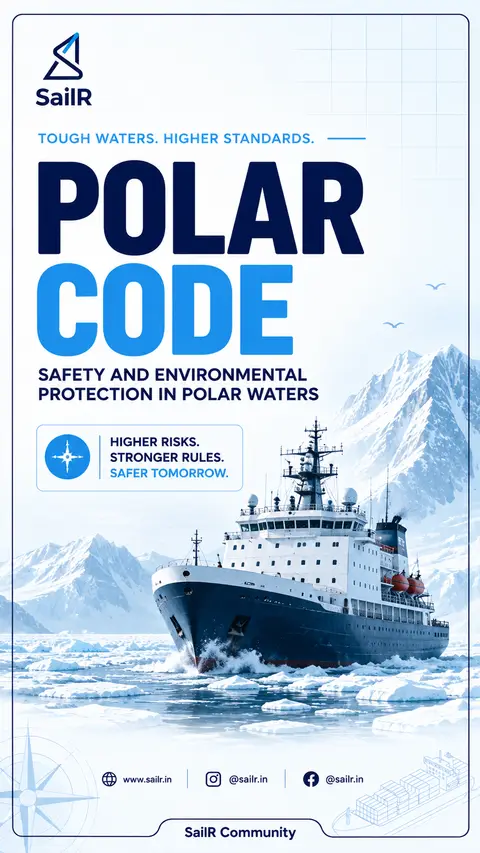
The slides, written out
AI-drawn illustration. Simplified to explain the idea, not to scale.
Slide 1 · TOUGH WATERS
TOUGH WATERS. HIGHER STANDARDS.
POLAR
CODE
SAFETY AND ENVIRONMENTAL
PROTECTION IN POLAR WATERS
HIGHER RISKS.
STRONGER RULES.
SAFER TOMORROW.
Slide 2 · POLAR CODE
POLAR CODE
Safety + Environmental Protection
in Polar Waters
ENTERED INTO FORCE
1 JANUARY 2017
THE POLAR CODE IS MANDATORY UNDER
SOLAS
Safety requirements through
SOLAS Chapter XIV
MARPOL
Pollution prevention requirements
through MARPOL Annexes
I, II, IV & V
TWO PARTS. ONE CODE.
PART I
SAFETY
Part I-A: Mandatory
Part I-B: Recommendatory
PART II
POLLUTION PREVENTION
Part II-A: Mandatory
Part II-B: Recommendatory
EXAM POINT
The Code covers ship design, construction, equipment,
operations, training, voyage planning, SAR and
environmental protection.
Slide 3 · THE PWOM
THE PWOM
Polar Water Operational Manual
Every applicable ship operating under the
Polar Code must carry a Polar Water
Operational Manual (PWOM).
WHAT DOES IT PROVIDE?
CAPABILITIES
What the ship
can safely do in
polar conditions.
LIMITATIONS
Ice, environmental
and operational
limitations.
OPERATING
PROCEDURES
Procedures for
operations in ice
and low
temperatures.
EMERGENCY
RESPONSE
Procedures
appropriate to
the ship's polar
operating
conditions.
POLAR SHIP CATEGORIES
A
CATEGORY A
At least medium first-year ice,
which may include old ice inclusions.
B
CATEGORY B
At least thin first-year ice,
which may include old ice inclusions.
C
CATEGORY C
Open water or ice conditions
less severe than Categories A and B.
Slide 4 · PLAN
PLAN. ASSESS. PREPARE.
BEFORE ENTERING
PACK ICE
Do not treat pack ice
as a normal passage plan.
1
CHECK THE PWOM
Confirm the planned operation is within
the ship's Polar Ship Certificate and
PWOM capabilities and limitations.
2
STUDY ICE INFORMATION
Consider current information on:
Ice extent and type
Icebergs
Expected conditions
Historical ice and
temperature information
3
CHECK HYDROGRAPHIC LIMITATIONS
Assess limitations in:
Charts
Hydrographic information
Aids to navigation
Use appropriate
depth monitoring
where required by
the operating
circumstances.
4
PLAN CONTINGENCIES
Identify:
Safe areas
No-go areas
Places of refuge
Alternative options
SAR limitations
Account for limited
support, remoteness
and long response
times.
5
ASSESS WHEN NOT TO ENTER
Consider conditions involving:
Darkness
Fog
Swell
Pressure Ice
Maintain a
safe distance
from icebergs.
The voyage plan must account for the potential hazards
of the intended polar voyage.
Slide 5 · BE PREPARED
BE PREPARED. STAY AHEAD.
THE POLAR
READINESS CHECK
BEFORE YOU ENTER THE ICE
Think beyond navigation.
1
MACHINERY
Check propulsion, steering, auxiliary machinery and seawater intake arrangements for anticipated ice and cold conditions.
2
STABILITY
Assess the loading condition and the effect of topside icing on stability.
3
COMMUNICATION
Verify communication capability considering high-latitude limitations and the intended operating area.
4
LIFE-SAVING & EMERGENCY EQUIPMENT
Ensure equipment remains functional under anticipated low-temperature and icing conditions.
5
CREW
Ensure applicable Masters, Chief Mates and navigational watch officers have the required polar training.
6
POLLUTION PREVENTION
Ensure applicable MARPOL Polar Code requirements are met and discharge restrictions are properly considered.
FINAL TAKEAWAY
POLAR OPERATIONS =
CAPABILITY + ICE INFORMATION + VOYAGE PLANNING
+ CREW + CONTINGENCY
Know your limits before entering the ice.
The IMO identifies cold temperatures, ice, remoteness, limited navigational information, communication challenges and limited SAR capability as important polar operating risks.
Drafted by SailR from our daily lessons. AI-drawn illustration. Simplified to explain the idea, not to scale. Last updated 19 Oct 2026.
Spotted a mistake?