The slides, written out
AI-drawn illustration. Simplified to explain the idea, not to scale.
Slide 1 · 02/04
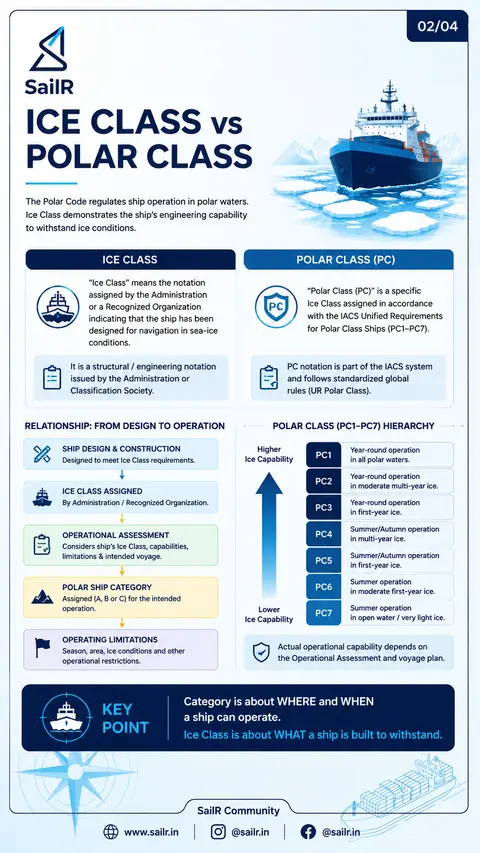
ICE CLASS vs
POLAR CLASS
The Polar Code regulates ship operation in polar waters.
Ice Class demonstrates the ship's engineering capability
to withstand ice conditions.
ICE CLASS
"Ice Class" means the notation
assigned by the Administration
or a Recognized Organization
indicating that the ship has been
designed for navigation in sea-ice
conditions.
It is a structural / engineering notation
issued by the Administration or
Classification Society.
POLAR CLASS (PC)
"Polar Class (PC)" is a specific
Ice Class assigned in accordance
with the IACS Unified Requirements
for Polar Class Ships (PC1–PC7).
PC notation is part of the IACS system
and follows standardized global
rules (UR Polar Class).
RELATIONSHIP: FROM DESIGN TO OPERATION
SHIP DESIGN & CONSTRUCTION
Designed to meet Ice Class requirements.
ICE CLASS ASSIGNED
By Administration / Recognized Organization.
OPERATIONAL ASSESSMENT
Considers ship's Ice Class, capabilities,
limitations & intended voyage.
POLAR SHIP CATEGORY
Assigned (A, B or C) for the intended
operation.
OPERATING LIMITATIONS
Season, area, ice conditions and other
operational restrictions.
POLAR CLASS (PC1–PC7) HIERARCHY
Higher
Ice Capability
PC1
Year-round operation
in all polar waters.
PC2
Year-round operation
in moderate multi-year ice.
PC3
Year-round operation
in first-year ice.
PC4
Summer/Autumn operation
in multi-year ice.
PC5
Summer/Autumn operation
in first-year ice.
PC6
Summer operation
in moderate first-year ice.
PC7
Summer operation
in open water / very light ice.
Lower
Ice Capability
Actual operational capability depends on
the Operational Assessment and voyage plan.
KEY
POINT
Category is about WHERE and WHEN
a ship can operate.
Ice Class is about WHAT a ship is built to withstand.
Slide 2 · 03/04
POLAR SERVICE
TEMPERATURE (PST)
EXPLAINED
PST is the minimum temperature at which a ship's
systems, equipment and materials must remain
fully functional in polar service.
WHAT IS PST?
Polar Service Temperature (PST) is the design minimum temperature
used to ensure that the ship's systems, equipment, machinery and
materials can perform their intended functions safely in the intended
polar environment.
POLAR SHIP
CERTIFICATE
PST is specified on the
Polar Ship Certificate.
HOW IS PST SET?
The PST must be at least 10°C below the lowest Mean Daily Low
Temperature (MDLT) for the intended area and season of operation.
PST = MDLT – 10°C
WHAT IS MDLT?
MDLT (Mean Daily Low Temperature) is the
mean of the daily low temperatures for
each day of the year, averaged over a
minimum 10-year period for the intended
area and season of operation.
EXAMPLE CALCULATION
Intended area & season:
Bering Sea – March
Lowest MDLT in area:
−25°C
PST Calculation:
PST = MDLT – 10°C
PST = −25°C – 10°C
PST = −35°C
CRITICAL REQUIREMENT
Systems and equipment
required by the Polar Code
shall be fully functional at
the approved PST.
Survival systems and
equipment must remain
fully operational at the PST
during the Maximum
Expected Rescue Time
(never less than 5 days).
KEY TAKEAWAY
PST ensures that a ship is designed, equipped and prepared to operate safely
in the harshest polar conditions it may encounter.
Slide 3 · 04/04
WHY PST MATTERS:
SYSTEMS AFFECTED BY
POLAR SERVICE TEMPERATURE
The Polar Service Temperature (PST) ensures that
critical systems, equipment and materials remain
fully functional in extreme cold for the intended operation.
SYSTEMS & EQUIPMENT DESIGNED TO OPERATE AT THE APPROVED PST
1 SHIP STRUCTURE
• Hull structure and materials
shall retain adequate strength
and toughness at the
approved PST.
• Ensures resistance to brittle
fracture and low temperature
effects.
2 MACHINERY INSTALLATIONS
• Essential machinery and
associated systems shall
start and operate reliably at
the approved PST.
• Includes engines, pumps,
valves, fuel systems, starting
systems, batteries and other
auxiliary equipment.
3 FIRE PROTECTION
• Fire protection systems shall
remain functional at the
approved PST.
• Fire pumps and associated
systems shall be capable
of performing their intended
functions.
• Fixed fire-extinguishing
systems shall remain
functional at the approved PST.
4 LIFE-SAVING APPLIANCES
& ARRANGEMENTS
• Survival systems and equipment
shall remain fully functional at
the approved PST.
• Must be operational for the
Maximum Expected Time of
Rescue (never less than 5 days).
• Includes lifeboats, rescue boats,
liferafts, immersion suits and
associated equipment.
PST ENSURES
RELIABLE PERFORMANCE
WHEN IT MATTERS MOST
5 SAFETY OF NAVIGATION
• Navigation systems required for
the intended operation shall
remain functional at the
approved PST.
• Ensures safe navigation in
polar conditions.
6 COMMUNICATION
• Communication systems required
for safe operation shall remain
functional at the approved PST.
• Includes communication equipment
and associated systems required
for the intended operation.
KEY TAKEAWAY
Every Polar Ship Certificate specifies an approved
Polar Service Temperature (PST) which forms the basis
for ensuring the ship is designed, equipped and prepared
to operate safely in the intended polar environment.
Slide 4 · 02/04
ICE CLASS vs
POLAR CLASS
The Polar Code regulates ship operation in polar waters.
Ice Class demonstrates the ship's structural capability
to withstand ice conditions.
ICE CLASS
"Ice Class" is a notation assigned
by the Administration or a
Recognized Organization indicating
that the ship has been designed
and constructed for navigation in
ice conditions.
It is a structural / engineering notation
issued by the Administration or
Classification Society.
POLAR CLASS (PC)
Polar Class (PC1–PC7) is an IACS
Ice Class notation assigned in
accordance with the IACS Unified
Requirements (UR I) for
Polar Class Ships.
Polar Class indicates the ship's
structural capability for operation
in polar ice conditions.
RELATIONSHIP: FROM DESIGN TO OPERATION
SHIP DESIGN & CONSTRUCTION
Designed in accordance with the Polar Code
and applicable requirements.
ICE CLASS / POLAR CLASS ASSIGNED
By Administration / Recognized Organization.
OPERATIONAL ASSESSMENT
Considers the ship's capabilities,
limitations, ice conditions, area, season
and voyage plan.
POLAR SHIP CATEGORY (A, B OR C)
Assigned based on the outcome of the
Operational Assessment.
OPERATING LIMITATIONS
Season, area, ice conditions and other
operational restrictions.
Ship Category (A/B/C) is assigned under the IMO Polar Code
based on the ship's operational capability following an
Operational Assessment. It is not the same as the ship's
Ice Class or Polar Class notation.
POLAR CLASS (PC1–PC7)
Higher
Structural
Capability
Lower
Structural
Capability
PC1
Designed for the highest level
of polar ice capability.
PC2
Designed for very severe
multi-year ice conditions.
PC3
Designed for year-round
operation in second-year ice,
which may include multi-year
ice inclusions.
PC4
Designed for year-round
operation in thick first-year ice,
which may include old ice
inclusions.
PC5
Designed for year-round
operation in medium first-year
ice, which may include old ice
inclusions.
PC6
Designed for summer/autumn
operation in medium first-year
ice, which may include old ice
inclusions.
PC7
Designed for summer/autumn
operation in thin first-year ice,
which may include old ice
inclusions.
Polar Class (PC1–PC7) indicates structural capability
only. Actual operational capability depends on the
Polar Operational Assessment, voyage planning,
prevailing ice conditions and Flag Administration
requirements.
KEY POINT
Ship Category = Operational capability
(Where and when the ship may operate)
Ice Class / Polar Class =
Structural capability
(What the ship is designed to withstand)
Drafted by SailR from our daily lessons. AI-drawn illustration. Simplified to explain the idea, not to scale. Last updated 19 Oct 2026.
Spotted a mistake?