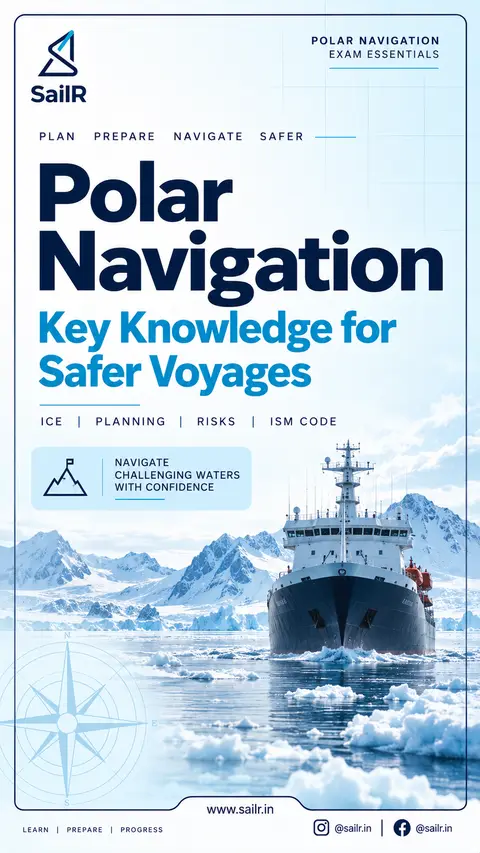
The slides, written out
AI-drawn illustration. Simplified to explain the idea, not to scale.
Slide 1 · POLAR NAVIGATION
POLAR NAVIGATION
EXAM ESSENTIALS
PLAN PREPARE NAVIGATE SAFER
Polar
Navigation
Key Knowledge for
Safer Voyages
ICE | PLANNING | RISKS | ISM CODE
NAVIGATE
CHALLENGING WATERS
WITH CONFIDENCE
LEARN | PREPARE | PROGRESS
Slide 2 · POLAR NAVIGATION
POLAR NAVIGATION
EXAM ESSENTIALS
LOOK BEYOND WHAT YOU SEE
Early Indications
of Approaching Ice
RECOGNISE THE SIGNS. NAVIGATE SAFER.
1
Sea Temperature
A falling sea temperature
can indicate colder water,
but does not by itself
confirm nearby ice.
2
Ice Blink
White or bright bands on
the horizon or underside
of low cloud can indicate
ice beyond the visible
horizon.
3
Water Sky
Dark bands beneath
low clouds may indicate
open water in the
direction observed.
4
Change in Sea State
Abrupt moderation of
sea and swell may occur
when approaching an
ice field from leeward.
5
Growlers &
Ice Fragments
Small ice fragments may
indicate that larger
quantities of ice are
nearby.
6
Radar – Use
With Caution
Radar is useful for ice
detection, but small bergy
bits and growlers may be
difficult to detect reliably.
Never rely on radar alone.
EXAM POINT
No single indication should be
treated as conclusive.
Knowledge
Today
Safer Voyages
Tomorrow
LEARN | PREPARE | PROGRESS
Slide 3 · POLAR NAVIGATION
POLAR NAVIGATION
EXAM ESSENTIALS
HIGH LATITUDE NAVIGATION
Navigation Changes
in Polar Waters
ADAPT. PLAN. NAVIGATE SAFELY.
1
Heading & Position
Do not use a fixed 85° gyro rule.
For ships covered by the applicable Polar Code navigation requirements, ships proceeding to latitudes over 80° require at least one GNSS compass or equivalent.
2
Charts & Positioning
Polar hydrographic information may have limitations. Plan and monitor the voyage with available nautical publications and chart information.
3
Radar
Radar supports ice detection, but should form part of an overall ice-detection strategy. Small bergy bits and growlers may be difficult to detect reliably. Never rely on radar alone.
4
Communications
Ensure communication arrangements are suitable for high-latitude operations and expected environmental conditions.
5
Lookout
Maintain enhanced visual awareness for ice, visibility changes and other polar hazards.
EXAM TAKEAWAY
POLAR CODE CATEGORY
≠ IACS POLAR CLASS
Polar Code Categories (A, B, C) are based on intended ice capability and are not the same as IACS Polar Class.
Same Oceans Stronger Mariners
LEARN | PREPARE | PROGRESS
Slide 4 · POLAR NAVIGATION
POLAR NAVIGATION
EXAM ESSENTIALS
Master's Polar
Passage Assessment
KEY FACTORS BEFORE ENTERING POLAR WATERS
01
SHIP CAPABILITY
Polar Ship Category (A, B or C)
Ice-strengthening capability
Global and local ice loads
Intact stability including ice accretion
Materials suitable for low air temperattures
02
CREW COMPETENCE
Required Polar Waters training (STCW)
Basic and/or Advanced training as applicable
Experience appropriate to the intended operation
Briefing on cold-weather survival and working practices
Fatigue management in continuous darkness
03
ENVIRONMENT & OPERATING WINDOW
Time of year and known ice conditions
Ice and iceberg information
Weather forecast (fog is common)
Low air and sea temperatures
Availability of icebreaker support where required
Search and rescue (SAR) availability and remoteness
04
ROUTE & CONTINGENCY
Route-specific risks (e.g. coastal features, limited chart accuracy)
Safe areas and no-go areas
Icebreaker operations where applicable
Emergency communication plan (considering high-latitude limitations)
Abandonment scenarios – onto ice or land
Adequate spares and critical equipment for extended operations
MASTER'S PRINCIPLE
The Polar Water Operational Manual (PWOM) supports operational decision-making by defining the ship's capabilities and limitations.
Plan Prepare Navigate Safer
LEARN | PREPARE | PROGRESS
Slide 5 · POLAR NAVIGATION
POLAR NAVIGATION
EXAM ESSENTIALS
ISM Code
Company & Master
SAFETY MANAGEMENT FOR A SAFER TOMORROW
01
COMPANY – WHO IS RESPONSIBLE?
(ISM §1.1.2)
The Company means the shipowner or any other organisation such as a manager or bareboat charterer that has assumed responsibility for operating the ship and agreed to take over all duties and responsibilities imposed by the ISM Code.
The Company cannot abdicate responsibility.
02
COMPANY OBJECTIVES (ISM §1.2)
• Ensure safety at sea
• Prevention of human injury or loss of life
• Avoid damage to the environment, particularly the marine environment, and to property
COMPANY MUST (ISM §1.2.2)
• Provide for safe practices and a safe working environment
• Establish safeguards against all identified risks
• Continuously improve the safety management skills of personnel
• Prepare for emergencies (safety and environmental protection)
03
SMS MUST ENSURE (ISM §1.2.3)
• Compliance with mandatory rules and regulations
• Take account of applicable codes, guidelines and standards from IMO, Administrations, classification societies and industry organisations
04
MASTER'S RESPONSIBILITIES (ISM §5.1)
• Implement the Company's safety and environmental-protection policy
• Motivate the crew in observing that policy
• Issue clear and simple orders and instructions
• Verify that specified requirements are observed
• Review the SMS and report deficiencies to shore
MASTER'S OVERRIDING AUTHORITY (ISM §5.2)
The SMS must clearly establish the Master's overriding authority and responsibility to make decisions concerning safety and pollution prevention, and to request the Company's assistance when necessary.
EXAM TAKEAWAY
ISM = COMPANY SYSTEM + MASTER'S AUTHORITY
LEARN | PREPARE | PROGRESS
Safety Today Cleaner Seas Tomorrow
Drafted by SailR from our daily lessons. AI-drawn illustration. Simplified to explain the idea, not to scale. Last updated 19 Oct 2026.
Spotted a mistake?