The slides, written out
AI-drawn illustration. Simplified to explain the idea, not to scale.
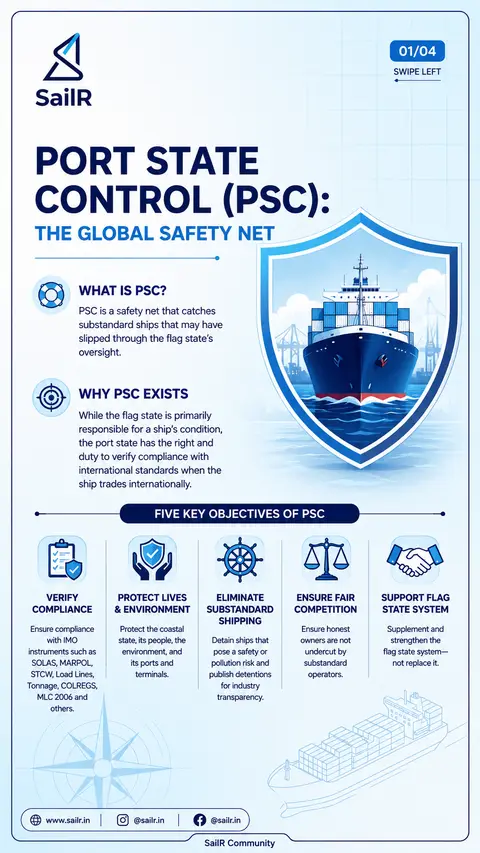
Slide 1 · 01/04
PORT STATE
CONTROL (PSC):
THE GLOBAL SAFETY NET
WHAT IS PSC?
PSC is a safety net that catches substandard ships that may have slipped through the flag state's oversight.
WHY PSC EXISTS
While the flag state is primarily responsible for a ship's condition, the port state has the right and duty to verify compliance with international standards when the ship trades internationally.
FIVE KEY OBJECTIVES OF PSC
VERIFY COMPLIANCE
Ensure compliance with IMO instruments such as SOLAS, MARPOL, STCW, Load Lines, Tonnage, COLREGS, MLC 2006 and others.
PROTECT LIVES & ENVIRONMENT
Protect the coastal state, its people, the environment, and its ports and terminals.
ELIMINATE SUBSTANDARD SHIPPING
Detain ships that pose a safety or pollution risk and publish detentions for industry transparency.
ENSURE FAIR COMPETITION
Ensure honest owners are not undercut by substandard operators.
SUPPORT FLAG STATE SYSTEM
Supplement and strengthen the flag state system—not replace it.
Slide 2 · 02/04
HOW THE PSC
MOU SYSTEM WORKS
Working together to eliminate
substandard shipping worldwide.
1. HARMONISED
INSPECTIONS
All MOU members follow the
same procedures, the same
inspection standards and the
same criteria for deficiencies
and detentions.
MAJOR PSC MOUS
2. SHIP RISK PROFILE (SRP)
Every ship is assigned a risk rating.
HIGH RISK
SHIP (HRS)
Based on:
Ship type
Age
Flag performance
Recognised
Organisation
performance
Company performance
Deficiencies &
detentions
STANDARD RISK SHIP
(SRS)
LOW RISK SHIP
(LRS)
Inspection frequency (Paris MoU)
HRS
Every 5–6
months
SRS
Every 10–12
months
LRS
Every 24–36
months
Paris MoU
Europe &
North Atlantic
Tokyo MoU
Asia–Pacific
Indian Ocean
MoU
Indian Ocean
Acuerdo de
Viña del Mar
South America
Black Sea
MoU
Black Sea
3. DATA SHARING
All inspections, deficiencies
and detentions are recorded
in a central database.
Databases e.g.
THETIS • APCIS
Every port state in the MOU
can see a ship's history.
4. TARGETING
Inspectors use the SRP and
inspection history to decide
the type and depth of
inspection.
FOCUSED INSPECTIONS
SUBSTANDARD SHIPS
GET TARGETED
5. TRANSPARENCY
& PUBLIC SHAMING
Detentions are published online.
The industry sees them.
DETENTIONS
Repeat offenders lose
charters, reputation
and commercial success.
ONE REGION INSPECTS.
THE WHOLE WORLD BENEFITS.
Stronger together. Safer seas.
Slide 3 · 03/04
SHIP SECURITY PLAN (SSP):
BUILDING SECURITY ON BOARD
Under SOLAS Chapter XI-2 and the ISPS Code,
every ship must have an approved Ship Security Plan.
ISPS CODE — SECURITY LEVELS
LEVEL 1
NORMAL
No specific threat.
Maintain baseline
security measures.
LEVEL 2
HEIGHTENED
Heightened risk of
a security incident.
Implement additional
security measures.
LEVEL 3
EXCEPTIONAL
Imminent threat.
Implement the most
stringent security
measures.
KEY ROLES
COMPANY SECURITY OFFICER (CSO)
Appointed by the Company.
Responsible for the development,
implementation and maintenance
of the Ship Security Plan.
SHIP SECURITY OFFICER (SSO)
Every ship shall have a designated
Ship Security Officer appointed
by the Company. In practice, the
position is commonly assigned to
the Master or Chief Officer,
depending on company policy.
THE MASTER'S AUTHORITY
OVERRIDES ALL
SECURITY DECISIONS
ON BOARD.
FROM ASSESSMENT TO APPROVAL
1 APPOINT
CSO & SSO
Company appoints
CSO. Ship is
assigned an SSO.
2 CONDUCT SSA
Carry out Ship
Security Assessment
to identify threats,
vulnerabilities and
current measures.
3 IDENTIFY &
EVALUATE RISKS
Evaluate risks and
determine the
appropriate security
measures.
4 DEVELOP SSP
Document procedures
for access control,
communications,
emergency actions,
drills and records
at all security levels.
5 SUBMIT FOR
APPROVAL
Submit the SSP to
the Flag State or
Recognized Security
Organization (RSO)
for approval.
6 ISSC ISSUED
On approval,
the International
Ship Security
Certificate (ISSC)
is issued.
INTERNATIONAL SHIP SECURITY CERTIFICATE (ISSC)
Valid for 5 years from the date of issue.
Intermediate verification is required between
the 2nd and 3rd anniversary dates.
Slide 4 · 04/04
SHIP SECURITY PLAN (SSP):
KEY CONTENTS & BEST PRACTICES
A practical SSP protects the ship, the crew,
the cargo, and the environment.
WHAT YOUR SSP SHOULD INCLUDE
ACCESS CONTROL
Control and monitor access to the ship.
Verify identity, screen visitors,
log entries, and escorts at all
security levels.
INCIDENT RESPONSE
Define procedures for security
breaches, threats, pirate attacks,
suspicious activities and
emergencies.
RESTRICTED AREAS
Identify, mark and secure areas
critical to ship operations.
Limit access based on
security level.
TRAINING & DRILLS
All crew must be familiar with
security duties. Conduct drills
at least once every 3 months.
See requirement below.
CARGO & STORES SECURITY
Ensure the integrity of cargo,
stores and provisions.
Implement search, screening
and vendor verification.
RECORDS & DOCUMENTATION
Maintain logs of drills, inspections,
equipment maintenance,
visitor access, MARSEC level
changes and incidents.
SURVEILLANCE & MONITORING
Use CCTV, lighting, alarms and
patrols. Increase monitoring
and patrol frequency at
higher levels.
SSP REVIEW & UPDATES
Keep the SSP up to date and
amend whenever changes to the
SSA, ship operations, trading pattern,
equipment or security organization
require revisions.
SECURITY COMMUNICATIONS
Maintain reliable communications
with CSO, PFSO, coastal states
and emergency contacts.
Keep contact lists updated.
APPROVAL & CERTIFICATION
The SSP is approved by the Flag State
or an RSO. The basis for issuance of
the International Ship Security
Certificate (ISSC).
BEST PRACTICES
Keep the SSP practical and easy to follow.
Train the crew – the strongest link in security.
Store the SSP securely. Share only on a need-to-know basis.
Coordinate with the Port Facility Security Officer (PFSO).
Test your plans with realistic drills.
Document everything – inspectors check the records.
SECURITY DRILLS REQUIREMENT
Drills shall be conducted at least
once every three months.
Where more than 25% of the ship's
personnel have changed at one time
with personnel who have not participated in
a security drill on that ship within the
previous three months, a drill shall be
conducted within one week of the
personnel change.
ISSC VALID FOR 5 YEARS
Intermediate verification is required
between the 2nd and 3rd anniversary dates.
A SECURE SHIP
IS A SAFE SHIP.
BE PREPARED.
STAY PROTECTED.
Drafted by SailR from our daily lessons. AI-drawn illustration. Simplified to explain the idea, not to scale. Last updated 19 Oct 2026.
Spotted a mistake?