The slides, written out
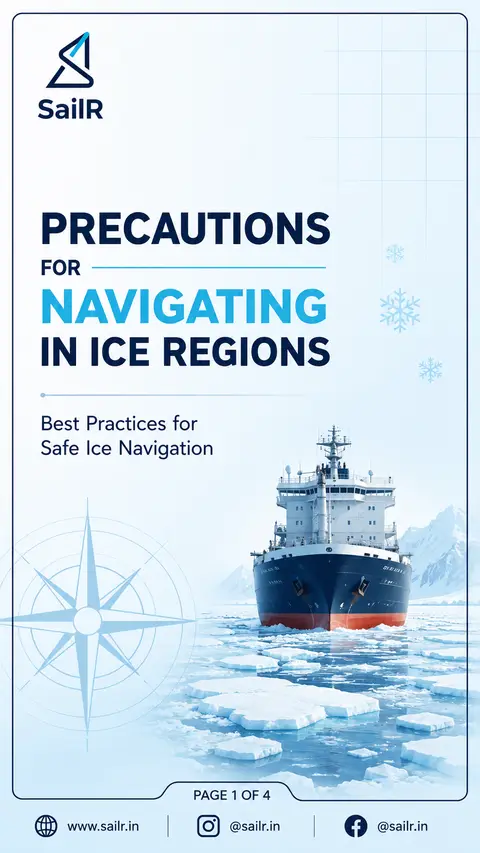
AI-drawn illustration. Simplified to explain the idea, not to scale.
Slide 1 · PRECAUTIONS
PRECAUTIONS
FOR
NAVIGATING
IN ICE REGIONS
Best Practices for
Safe Ice Navigation
Slide 2 · BEFORE
BEFORE
ENTERING ICE
Prepare the vessel and crew
to ensure safe navigation in ice conditions.
1. HULL & SEA SUCTIONS
Check all hull openings, sea chests, sea suctions,
ice boxes and cooling-water arrangements.
Ensure all overboard discharges and valves
are secure.
2. CARGO SECURING
Verify cargo securing arrangements.
Navigation in ice may increase vibration,
impact loading and ship motions.
3. ENGINE ROOM PREPARATION
Brief the engine room well in advance.
Adjust cooling-water system (high-suction
configuration where required).
Pre-warm or switch to heated fuel oil tanks
to prevent waxing.
4. DRAUGHT & TRIM
Maintain the Company's recommended
draught and trim for anticipated ice conditions.
This ensures adequate propeller immersion,
steering effectiveness and safe operation.
Good preparation reduces risk,
protects the vessel and ensures crew safety.
Slide 3 · DURING
DURING
ICE NAVIGATION
Operate with caution and
maintain constant situational awareness.
1. ICE LOOK-OUT
• Post an experienced ice look-out.
• Radar may not detect thin ice and brash ice.
• Where required by the Polar Code, Flag Administration
or the Company's risk assessment, a suitably qualified
Master, deck officer or personnel trained for Polar
operations shall be available.
2. SAFE SPEED
• Reduce speed progressively.
• Enter ice at bare steerage way and increase only
after assessing the ice conditions.
• High speed in ice can cause severe damage.
3. MONITOR HULL VIBRATIONS
• Monitor vibration and unusual sounds.
• Report any change immediately.
• Vibration indicates interaction with ice, hull,
propeller or rudder.
4. ICE INFORMATION & CHARTS
• Use ice charts, satellite imagery and reports.
• Continuously update the ice situation.
• Follow guidance from icebreaker services
and local authorities.
5. RUDDER USE
• Avoid excessive rudder angles at low speeds.
• Ice loads may overload the steering gear or damage the
rudder, rudder stock or associated fittings.
• Use short, small rudder orders and allow time to respond.
6. ICEBREAKER ESCORT
• Maintain continuous contact with the icebreaker.
• Follow instructions precisely.
• Maintain recommended distance (typically 3–5 ship lengths).
Caution, observation and good seamanship
are your strongest tools in ice.
Slide 4 · ISM CODE ESSENTIALS
ISM CODE ESSENTIALS
CRITICAL OPERATIONS & EQUIPMENT
The ISM Code requires every Company to identify critical shipboard operations and critical equipment through risk assessment and include procedures in the SMS.
CRITICAL SHIPBOARD OPERATIONS
Operations where an error could lead to serious injury, loss of life, major pollution or loss of the ship.
1. NAVIGATION IN RESTRICTED VISIBILITY
Includes radar, reporting and collision avoidance procedures.
2. BERTHING & UNBERTHING
Especially in confined waters or strong currents.
3. CARGO OPERATIONS INVOLVING HAZARDOUS GOODS
Including loading, stowage, segregation and emergency response for dangerous goods (IMDG Code cargo).
4. BUNKERING
Particularly HFO or LNG. A spill during bunkering can be catastrophic.
5. ENCLOSED SPACE ENTRY
Tank entry for cleaning, inspection or repair. Requires a permit-to-work system, gas testing and rescue plan.
CRITICAL EQUIPMENT
Equipment and technical systems whose sudden operational failure may result in hazardous situations.
1. MAIN ENGINE FUEL OIL SYSTEM
Including fuel pumps, filters and emergency shutdown valves. Failure can cause loss of propulsion.
2. STEERING GEAR
Loss of steering capability in confined waters can lead to a major incident.
3. FIRE DETECTION & ALARM SYSTEM
Failure may prevent early detection of fire and delay emergency response.
4. EMERGENCY GENERATOR & EMERGENCY SWITCHBOARD
Blackout response depends on reliable power for critical systems and safety equipment.
5. CARGO ESD SYSTEM*
Emergency Shutdown system on tankers and gas carriers. Failure can lead to over-pressurisation during cargo transfer.
* Where fitted / applicable to vessel type.
MAINTAINING CRITICAL EQUIPMENT – KEY REQUIREMENTS
Planned Maintenance
Follow manufacturer, class and statutory requirements for inspections and overhauls.
Calibration & Alarms
Test and calibrate sensors and alarms at intervals defined in the SMS.
Testing & Inspection
Regular testing (e.g., monthly for emergency generator, weekly for steering gear as per SOLAS requirements).
Recording & Reporting
Record all maintenance actions and report non-conformities to the Designated Person. Rectify without delay.
Spare Parts Management
Identify critical spares and keep them on board or available on short notice.
Trained Personnel
Ensure personnel are trained, have access to manuals and the right tools.
Effective identification and maintenance of critical operations and equipment strengthens safety, protects the environment and ensures compliance.
Drafted by SailR from our daily lessons. AI-drawn illustration. Simplified to explain the idea, not to scale. Last updated 19 Oct 2026.
Spotted a mistake?