The slides, written out
AI-drawn illustration. Simplified to explain the idea, not to scale.
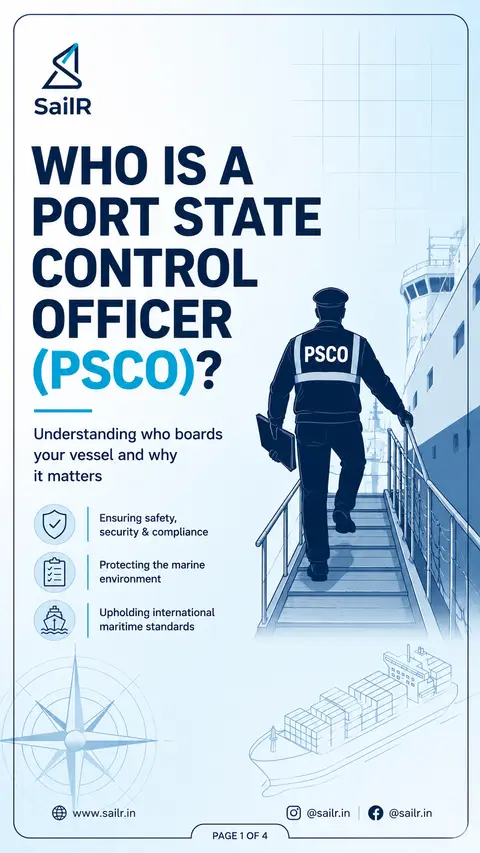
Slide 1 · WHO IS A
WHO IS A
PORT STATE
CONTROL
OFFICER
(PSCO)?
Understanding who boards
your vessel and why
it matters
Ensuring safety,
security & compliance
Protecting the marine
environment
Upholding international
maritime standards
Slide 2 · NOT EVERY
NOT EVERY
SURVEYOR
CAN BE A
PSCO
Under India's M.S. Notice 02 of 2024,
a PSCO must meet strict qualifications
and experience requirements.
A PSCO MUST:
Be appointed under
Section 9 of the
Merchant Shipping Act, 1958.
Hold qualifications as
• Master Mariner
• Chief Engineer
• Naval Architect
(with equivalent experience)
Complete:
• Required maritime training
• One year as a qualified
Flag State Surveyor
• Additional requirements
specified by DG Shipping
The person
boarding your
vessel has
likely spent
years at sea
themselves.
THE PATH TO BECOMING A PSCO
SEA SERVICE
Hands-on experience
at sea
SURVEYOR
Appointed under
Section 9, MS Act
FLAG STATE
SURVEYOR
Minimum 1 year
required
PSCO
Authorized to conduct
PSC inspections
Slide 3 · HOW SHIPS
HOW SHIPS
ARE SELECTED
FOR INSPECTION
The Indian Ocean MoU New Inspection
Regime (NIR) uses a risk-based
targeting system.
FACTORS CONSIDERED:
Previous deficiencies
and detentions
Flag State
performance
Recognised Organisation
performance
Company
performance
Ship type
Vessel age
RISK PROFILE
Ships with higher risk profiles
are given higher priority
for inspection.
TARGETING IS ALL ABOUT
CATCHING SUBSTANDARD SHIPS.
Good performance keeps you off
the list — but never be complacent.
INSPECTION PRIORITY
PRIORITY I
HIGHEST RISK
These ships must always
be given preference
for inspection.
PRIORITY II
MEDIUM RISK
These ships may be
inspected depending on
targeting criteria and
available resources.
REMEMBER:
Strong compliance records, clean detention history,
and a reputable flag & class reduce your chances of being targeted.
Slide 4 · WHAT ARE
WHAT ARE
"CLEAR GROUNDS"?
A PSCO may expand an inspection when clear grounds exist, leading to a more detailed inspection.
Absence of or non-compliance with statutory certificates
Evidence of structural deficiencies or deferred maintenance (rust streaks, cracked plating, corroded piping)
Deficiencies in firefighting equipment
Deficiencies in life-saving appliances
Dirty or deficient records (oil record book, garbage record book, logbooks)
Malfunctioning navigation or communication equipment
Crew unable to demonstrate knowledge of safety procedures during drills
Previous detention or high deficiency count in the inspection database
PSCOs use professional judgement.
If something feels off, they are trained to investigate further.
PREPARATION IS EASIER THAN EXPLAINING DEFICIENCIES.
Stay compliant. Stay inspection-ready.
FOLLOW
FOR PRACTICAL PSC INSIGHTS
Drafted by SailR from our daily lessons. AI-drawn illustration. Simplified to explain the idea, not to scale. Last updated 19 Oct 2026.
Spotted a mistake?