The slides, written out
AI-drawn illustration. Simplified to explain the idea, not to scale.
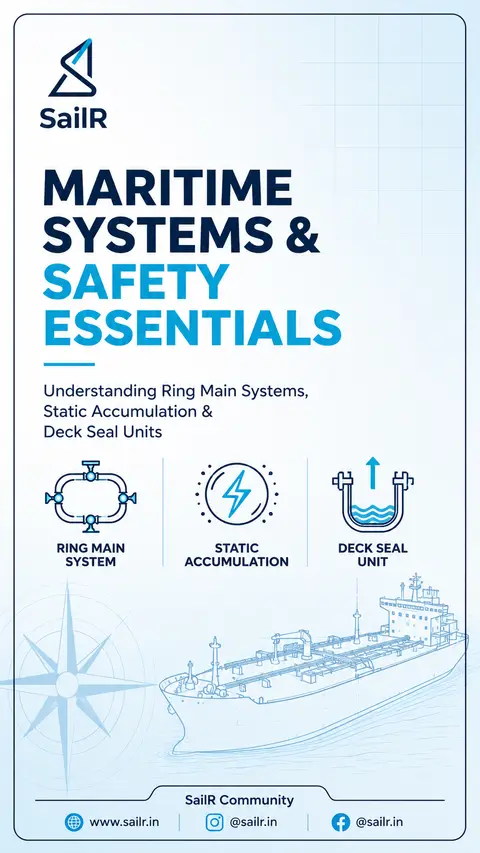
Slide 1 · MARITIME
MARITIME
SYSTEMS &
SAFETY
ESSENTIALS
Understanding Ring Main Systems,
Static Accumulation &
Deck Seal Units
RING MAIN
SYSTEM
STATIC
ACCUMULATION
DECK SEAL
UNIT
Slide 2 · MARITIME FUNDAMENTALS SERIES
MARITIME FUNDAMENTALS SERIES
RING MAIN SYSTEM
A ring main system is a continuous cargo pipeline arrangement running through the cargo area with branch lines connected to individual cargo tanks.
HOW IT WORKS
Cargo can be loaded into or discharged from any tank via the common ring main.
TANK 1
TANK 2
TANK 3
TANK 4
TANK 5
RING MAIN LINE
ISOLATION / BRANCH VALVE
KEY FUNCTIONS
Load cargo into selected tanks
Discharge cargo from selected tanks
Isolate damaged sections
Maintain operational flexibility
WHY IT MATTERS
Isolation valves allow continued cargo operations even when part of the pipeline is under maintenance or damaged.
Slide 3 · MARITIME FUNDAMENTALS SERIES
MARITIME FUNDAMENTALS SERIES
STATIC
ACCUMULATION
Static charge is generated when cargo flows through pipes, pumps, filters and hoses. If the liquid has low electrical conductivity, the charge accumulates in the cargo tank.
KEY FACT
Static accumulator cargoes typically have conductivity below
50 pS/m
BUILD-UP OF STATIC CHARGE
THE HAZARD
Accumulated charge can create a high voltage on the liquid surface. If a conductive object at a different potential is introduced too soon, an ignition-capable spark may occur.
HOW CHARGE IS GENERATED
FLOW
PIPES
PUMPS
FILTERS
HOSES
Turbulence and friction cause electron transfer, creating electrostatic charge.
POTENTIAL INCENDIARY SPARK
PREVENTION & CONTROL MEASURES
Control charge generation (smooth operations, maintain recommended flow rates)
Bond and earth all conductive equipment
Maintain required inert atmosphere where applicable
Observe prescribed relaxation times before gauging, sampling or dipping
Follow approved sampling and cargo handling procedures
RELAXATION TIME MATTERS
Always allow sufficient time for static charge to dissipate before entering the tank or introducing any equipment.
Slide 4 · MARITIME FUNDAMENTALS SERIES
MARITIME FUNDAMENTALS SERIES
DECK SEAL (WET TYPE) TYPICAL SECTION
INERT GAS TO TANKS
DECK SEAL BODY
HYDROCARBON VAPOUR (BLOCKED)
WATER SEAL
The water seal forms the principal barrier against reverse flow of flammable vapour.
DECK SEAL UNIT
A deck seal is a non-return device fitted in a tanker's inert gas system. It prevents hydrocarbon vapours from flowing back toward the inert gas system while allowing inert gas to flow from the inert gas plant to the cargo tanks.
FUNCTIONS
Allows inert gas to flow from inert gas plant to the cargo tanks.
Prevents hydrocarbon vapours from flowing back to the inert gas system and gas-safe areas.
Protects the inert gas plant and gas-safe spaces from contamination and explosion risk.
INERT GAS SYSTEM FLOW
INERT GAS PLANT
DECK SEAL UNIT
CARGO TANKS
HYDROCARBON VAPOUR FLOW (BLOCKED)
WHY IT MATTERS
Failure of the deck seal or associated non-return devices can allow flammable vapours to migrate into the inert gas system and gas-safe areas, creating a serious explosion risk.
MAINTENANCE & INSPECTION
Keep water seal topped up to the correct level.
Ensure water is clean and free from oil.
Inspect regularly for leakage, corrosion and fouling.
Verify that non-return function is effective.
Follow manufacturer and flag requirements.
REMEMBER
A small component like the deck seal plays a big role in keeping the inert gas system safe and effective.
Drafted by SailR from our daily lessons. AI-drawn illustration. Simplified to explain the idea, not to scale. Last updated 19 Oct 2026.
Spotted a mistake?