The slides, written out
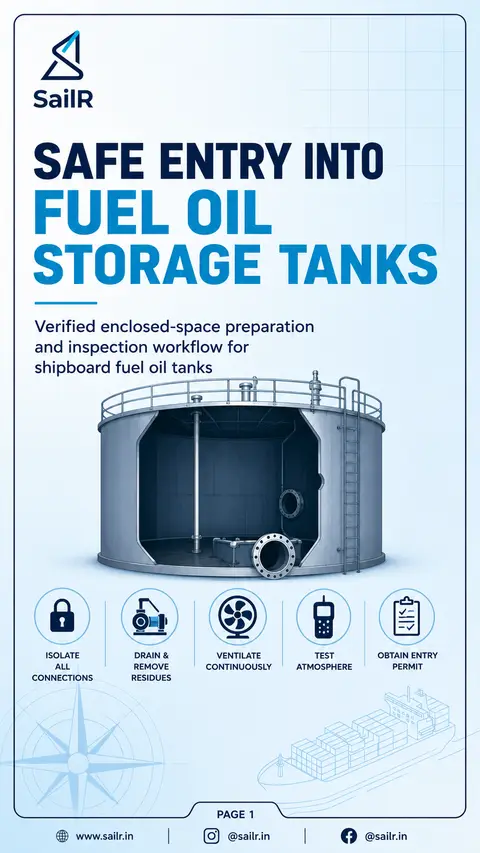
AI-drawn illustration. Simplified to explain the idea, not to scale.
Slide 1 · SafE ENTRY INTO
SafE ENTRY INTO
FUEL OIL
STORAGE TANKS
Verified enclosed-space preparation
and inspection workflow for
shipboard fuel oil tanks
ISOLATE
ALL
CONNECTIONS
DRAIN &
REMOVE
RESIDUES
VENTILATE
CONTINUOUSLY
TEST
ATMOSPHERE
OBTAIN ENTRY
PERMIT
Slide 2 · STEP 1
STEP 1:
ISOLATE, DRAIN & VENTILATE
Prepare the fuel oil storage tank before entry
1. ISOLATE ALL CONNECTIONS
Suction valve – lock closed & tag
Filling line – blank flange or lock shut
Overflow line – secure against backfeed
Heating coil valves – lock shut & tag out
Pneumercator / gauge lines – isolate or cap
FILLING LINE
OVERFLOW LINE
HEATING COIL
SUCTION LINE
GAUGE LINE
DRAIN VALVE
2. REMOVE RESIDUES
Pump out remaining oil to shore or storage
Strip tank to remove heel
Drain water and sludge from bottom drain
Collect in containers and dispose as per MARPOL requirements
3. VENTILATE THOROUGHLY
Open top manhole (if fitted) and side manhole
Use mechanical ventilation (air blower)
Ensure duct reaches the bottom of the tank
Continue ventilation until atmosphere tests confirm safe entry conditions
PREPARATION FLOW
OIL REMOVAL
ISOLATION
VENTILATION
Pump out & strip tank
Lock, blank & tag all connections
Ventilate until safe atmosphere confirmed
Slide 3 · STEP 2
STEP 2:
VERIFY SAFE ENTRY CONDITIONS
Test the atmosphere and issue the enclosed space entry permit
ATMOSPHERE TESTING
OXYGEN
Approximately 20.9% by volume
OK
FLAMMABLE GAS
Less than 1% of LFL / LEL
OK
TOXIC GASES
Check for:
• H2S (Hydrogen Sulphide)
• CO (Carbon Monoxide)
• Other cargo-specific hazards
OK
ATMOSPHERIC CONDITIONS
Conditions must be stable for safe entry
OK
IMPORTANT
Re-test atmosphere:
• Before entry
• After any interruption
• If conditions change
USE A CALIBRATED MULTI-GAS DETECTOR
Ensure instrument is calibrated and functioning properly.
ENTRY PERMIT MUST INCLUDE
Tank identification
Date and time
Atmospheric test results with time
Isolation status
Ventilation status
Names of persons entering
Name of standby person
Permit validity period (shall not exceed 8 hours unless specified by approved procedures)
Emergency and rescue arrangements
Authorizing officer signature
ENCLOSED SPACE ENTRY PERMIT
APPROVED
Tank ID :
Date / Time :
Last Test :
Valid Until :
Authorized By :
Authorizing Officer
Slide 4 · STEP 3
STEP 3:
ENTER, INSPECT & RESTORE
Follow safe entry practices, complete the inspection
and restore the tank to service
BEFORE ENTRY
Standby person stationed
outside the tank
Rescue equipment and
breathing apparatus ready
Lifelines and harness
prepared
Communication (radio /
voice signals) established
Portable lighting and tools
checked
DANGER
PERMIT
REQUIRED
CONFINED SPACE
DO NOT ENTER
DURING ENTRY
Wear appropriate PPE
Carry and monitor personal
multi-gas detector
Maintain continuous ventilation
Work under constant
observation and communication
Evacuate immediately if
alarm activates or conditions
deteriorate
AFTER INSPECTION
Close the entry permit
Remove isolation locks, tags
and blanks
Close and secure all manholes
with gasket
Restore all lines and valves
to normal configuration
Refill tank to service level
and check for leaks
Record the operation in
engine log and oil record book
NO ENTRY WITHOUT ISOLATION,
VENTILATION, TESTING,
PERMIT AND RESCUE READINESS.
RESCUE EQUIPMENT
AT ENTRANCE
Breathing
Apparatus
Lifeline &
Harness
First Aid &
Oxygen
Resuscitator
Rescue
Winch /
Tripod
Explosion-proof
Lighting
Communication
Device
Drafted by SailR from our daily lessons. AI-drawn illustration. Simplified to explain the idea, not to scale. Last updated 19 Oct 2026.
Spotted a mistake?